Disaster and urban farming ④ — Do not rush to ‘green’ damaged land
Christchurch and the time needed for temporary use and recovery
2026-08-08 · 15 min read
Series · Disaster and Urban Farming4 / 7
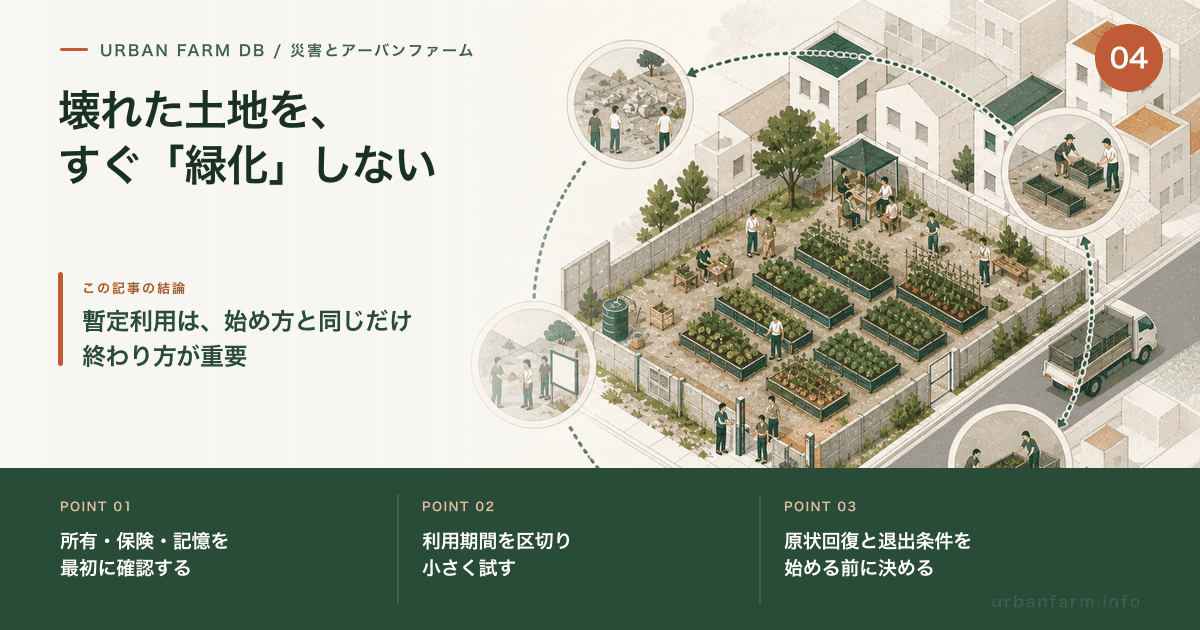
Vacant land after disaster can become a symbol of hope or an object of speculation. This article resists consuming an overseas case as a model and asks whose land it is, for how long, and who maintains it.
This article in 3 minutes
- Temporary use after disaster needs both room for recovery and clear exit conditions.
- Gardens and farms can be places where people receiving support are not passive.
- Do not transplant another city's example while stripping out its institutions and land ownership.
Opening
The time of vacant land
Land that loses buildings in a disaster does not automatically become vacant land to be ‘used’. Ownership, insurance, contamination, rebuilding and memory overlap. A farm proposal must ask whether it obstructs rebuilding or shifts maintenance onto someone else. Temporary use becomes public-minded only when its ending is designed as well as its beginning.
The Christchurch case is not a feel-good story about greenery after an earthquake. It is about who managed land where ownership, rebuilding and youth work overlapped, and for how long.
The map
Christchurch and New Orleans
Alongside Christchurch, the database's study of Edible Schoolyard New Orleans after Hurricane Katrina describes a school garden as a site for food security, environmental learning and children's emotional recovery. Post-disaster farming cannot be measured by harvest alone.
Christchurch City presents community gardens and edible landscapes through Edible Christchurch, while Cultivate used earthquake-affected sites as an entry to youth work, training and community activity. A garden is not decoration; it multiplies people with roles.
Sources & further reading
Examination
To avoid copying
To do something similar in Japan, establish who can lend land, which budget supports maintenance and what must be restored when activity ends, alongside disaster scale and land institutions. A name such as ‘recovery garden’ does not function by itself. What to borrow from a case is not its form but its habit of naming relationships and time.
Temporary use needs an end date. Decide at the start whether to clear when rebuilding begins, move elsewhere, and who takes trees and tools.
Examination
A next step
If there is a candidate site, write a small plan for only three months: what to make, opening days, caretakers, rainy-day decisions and what will be removed at the end. A short trial makes the land's conditions and participants' burden visible.
To adapt this to Japan, check land rights, contamination, insurance and grant terms before earthquake scale. Making constraints visible comes before making a similar landscape.
How to read the evidence
Read recovery cases through land, duration and exit conditions
The objection that greening delays recovery cannot be ignored. A temporary garden occupying a rebuilding site becomes delay, not support. Exit conditions and an alternative site make the proposal public-minded.
Practice
Use a three-month trial to test the ending as well as the start
A post-disaster farm links not only food production but participatory work and memory. Measure trainees, returning participants and tools successfully moved, not harvest alone.
Recap
Post-disaster green space grows with time limits and exit conditions
Day 4 moved from institutional activation to the time land needs to recover. The next instalment examines Japan's disaster-cooperation farmland through both time and ordinary use.
Comparative evidence generalising overseas effects to Japan is limited. Christchurch's land institutions and civic organisations cannot simply be transplanted.
This article treats temporary use not as a technique for greening quickly, but as recovery work capable of promising both a beginning and an end.
Key takeaways
- How temporary use ends matters as much as how it begins.
- Learn cases as designs of relationships and time, not as forms to copy.
This column is free to read
As new columns publish, older ones move into the members' archive. Join the free newsletter to get every new column and the week's urban-farming news by email.
Reader feedback
Was this article useful?
No sign-in required. One vote per article on this device; you can change your choice.
Related columns
Urban Farming and Community: The Social Capital that Soil Grows
How strangers become neighbours — read through social science and the world's gardens
21 min readUrban farming in France — how the City of Paris turned land it does not farm into farmland
From a 1952 law to the 2016 Parisculteurs. Reading the urban farming that public institutions built, through the lens of policy
29 min readUrban Farming in South Africa — Reading the 'Garden for Survival' through Its Institutions
Urban-agriculture policy, food-resilience strategy, and municipal programmes — a country report that reads South Africa's cities and farms through the mesh of its institutions
15 min readDisaster and urban farming ③ — Build agreements before calling a farm an evacuation site
Keys, responsibility, water and communication: lessons from implementation
15 min read