Exploration columns
In-depth, long-form essays that take an urban-farming theme all the way from its scientific principles to the social systems built around it across the world. The latest columns are free for everyone; the archive is for Urban Farm Crew members and up, who fund this database.
It is not one law that draws the line around a seed — breeder's rights, patents, contracts and custom→
The four overlap on the same plant, and each of them bites in a different place
Saving seed was, for a very long time, simply part of farming. Yet almost no law writes it down as a right. Where seed saving survives inside the rules today, it survives as an exception — less protected than not yet cut away. So may you sow next year the seed in your hand? No single law decides. A breeder's right protects the variety itself; a patent holds a gene, a trait or a technique; a contract binds whoever receives the seed; and saving seed is a custom. The four overlap on the same plant, and each bites in a different place. The international footing for breeder's rights, the UPOV Convention, was adopted in Paris on 2 December 1961; as of 27 February 2025 it has 80 members. On the first of seven days, what this series hands over is not a conclusion but a ruler for telling the four lines apart.
2026-09-16 · 15 min read
Chilean urban planning has no land use called agriculture — that is the gap the bill is trying to fill→
A 500-square-metre ceiling, a register and the temporary use of abandoned land: the bill tabled on 24 March 2025 has yet to be voted on in the Chamber
Chilean urban planning has no land-use category for agriculture. Decree 75 of the housing and urban development ministry, dated 25 June 2001, amended the General Ordinance on Urbanism and Construction and standardised land uses into six classes — residential, facilities, productive activities, infrastructure, public space and green space. That is article 2.1.24, and agriculture fits into none of the six. This does not mean Chile has no law about gardens. Law 6,815 of 5 February 1941 directed 30 per cent of the national housing fund's money to gardens for workers and their families, and that law has never been repealed. What disappeared, in 1953, was the fund the text names. On 24 March 2025 six deputies tabled a new bill on urban gardens: boletín 17.433-06, which defines an urban garden as up to 500 square metres and sets up a register. The 1941 law required a garden of no less than 5,000.
2026-09-15 · 19 min read
Five city administrations came and went, and the gardens stayed — AGRUPAR in Quito, Ecuador→
It sits not in a city department but in a private-law non-profit corporation that holds training, seedlings and the marketplace in one hand
AGRUPAR, Quito's urban agriculture programme, began in 2002 and enters its twenty-fourth year in 2026. A paper published in 2022 records that five municipal administrations of differing political outlook came and went from 2000 onward while the programme held on to its core values and principles. Part of the reason is the shelf it sits on. AGRUPAR is not housed in a city department but in CONQUITO, the economic promotion agency constituted by resolution C 0193 of the Metropolitan Council on 28 March 2003. Article 1 of its statute defines it as a private-law non-profit corporation with assets of its own and no fixed term. From there the programme hands out training, seedlings and technical support, and runs the bioferias where the produce is sold. The rules caught up much later: food security entered the city's land use and development plan on 13 September 2021, and the ordinance on urban gardens passed on 29 April 2025.
2026-09-14 · 19 min read
The national law came for the pot, not the plot — Peru, Lima's gardens and communal kitchens→
In a city with under 15 millimetres of rain a year, what keeps the gardens going is a municipal ordinance and women's neighbourhood organisations
On 27 April 2022 Law 31,458 appeared in Peru's official gazette. It recognises the ollas comunes — the neighbourhood groups that cook in a shared pot and hand out meals locally — as grassroots social organisations, and sets out how they are to be registered and funded. The same country has no national law on urban agriculture. The only text that deals with the plots is framework ordinance 1629, issued by Metropolitan Lima on 24 September 2012, and that is a municipal instrument. National law arrived for the pot, not for the plot. Peru's national meteorological service, SENAMHI, describes Lima as a city with under 15 millimetres of rain a year; apart from the winter drizzle known as garúa, almost none falls. Even so there are gardens in Villa El Salvador and Villa María del Triunfo in the south of the city, and what they grow goes to household tables and to communal kitchens. Today follows how those two things, the pot and the plot, are joined.
2026-09-13 · 17 min read
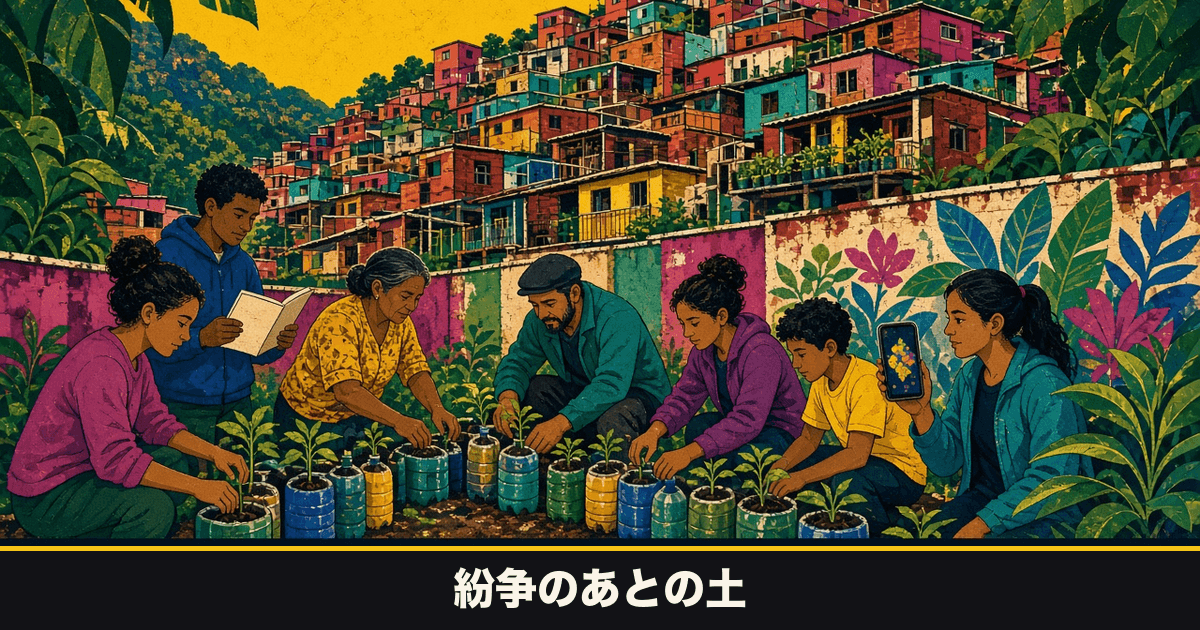
The rap collectives made the gardens first — Colombia, Medellín and Bogotá→
In Medellín the gardens began from the memory of the disappeared, and in Bogotá residents mapped them before the city did
At midnight on 16 October 2002 some thousand police and soldiers entered Comuna 13 in Medellín. That mobilisation, known as Operación Orión, is described as the largest military action carried out in an urban area of Colombia during the armed conflict. People disappeared around it. The UBPD, the body charged with searching for the missing, estimates that 502 of the 5,912 people who vanished in Medellín may lie buried in La Escombrera, a rubble dump on the west side of the city. A third round of digging there began at the end of July 2024, and between 18 December 2024 and 25 September 2025 seven bodies were recovered. In the same district residents had begun something else. AgroArte, a collective that treats rapping and planting as one piece of work, lines the walls of the cemetery with planters made from plastic bottles and writes on each of them the name of someone killed or still missing. Colombia's urban gardens started in that soil. The municipal programmes came afterwards.
2026-09-12 · 18 min read
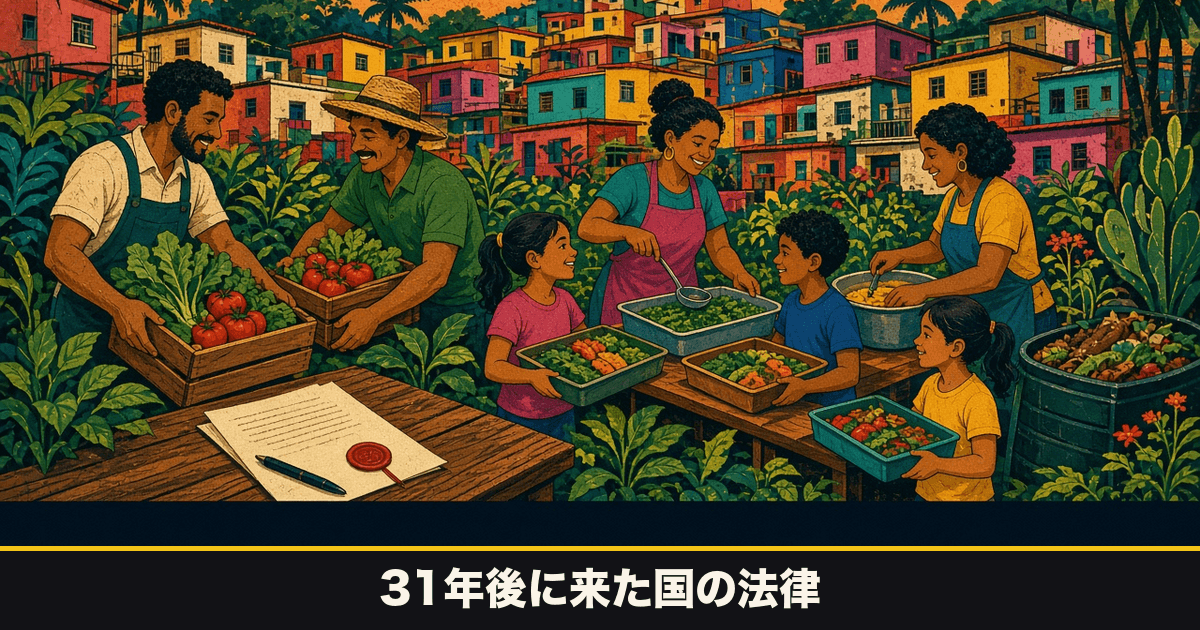
Thirty-one years in city hall, nine in congress — how urban farming became law in Brazil→
What the national statute took over was a circuit with a buyer at the end, already built by municipalities and the school meal programme
School meals in Brazil are bound by federal law. Article 14 of Law 11,947 of 2009 requires at least 30 per cent of the school meal money transferred by the National Fund for the Development of Education (FNDE) to be spent buying directly from family farming. Law 15,226 of 30 September 2025 raised that floor to 45 per cent, in force since 1 January 2026. When Law 14,935, which established the National Policy for Urban and Periurban Agriculture (PNAU), was sanctioned on 26 July 2024 and printed in the gazette on 29 July, item IV of its article 2 named precisely this purchasing circuit: schools, nurseries, hospitals, care homes, public food-security facilities and prisons. Send what the city grows into those kitchens, the text says. The circuit existed before the national law did. Belo Horizonte created a municipal supply secretariat through by-law 6,352 in 1993 and has had a support policy aimed at urban agriculture alone since municipal law 10,255 of 2011. Today we look at those thirty-one years from both sides: the text and the ground.
2026-09-11 · 18 min read
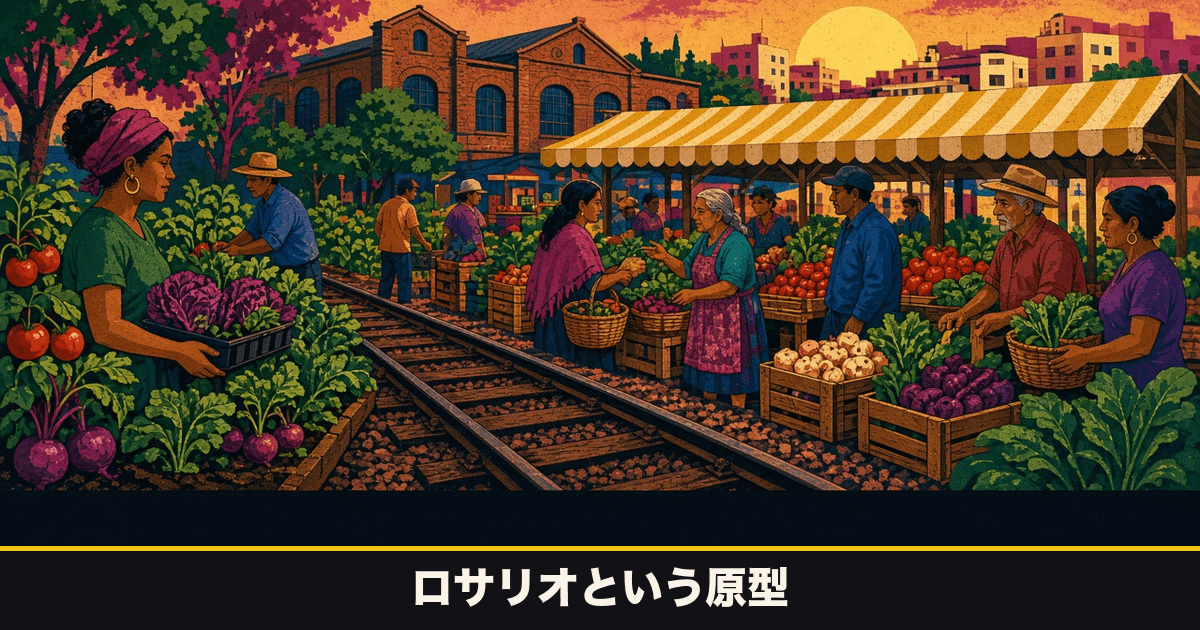
The gardens existed from 1987 — what the 2001 collapse made Rosario build was the machinery for handing over land→
A 300-square-metre plot, no rent, and a market three or four times a week: Argentine urban farming in units of land and money
The first community garden in Rosario was made in 1987, in the district of Saladillo Sur in the south of the city. Those who made it were Antonio Lattuca, a 36-year-old agronomist newly out of the National University of Rosario, and Custodio Lemos, a man from Corrientes province who knew how to farm, along with others around them. By 1990 a municipal ordinance had created a community gardens programme, and the national ProHuerta began in the same year. So when the economy collapsed in December 2001, Rosario already had fourteen years of practice and method behind it. The urban agriculture programme, the PAU, which the city launched in February 2002, did not invent the gardens; it moved gardens that already existed onto an institutional footing. Today we open that footing up. Who hands the land to whom, at what price and on what conditions. Where the income comes from. And what happened on the ground in March 2024, when the national government stopped buying the seed.
2026-09-10 · 19 min read
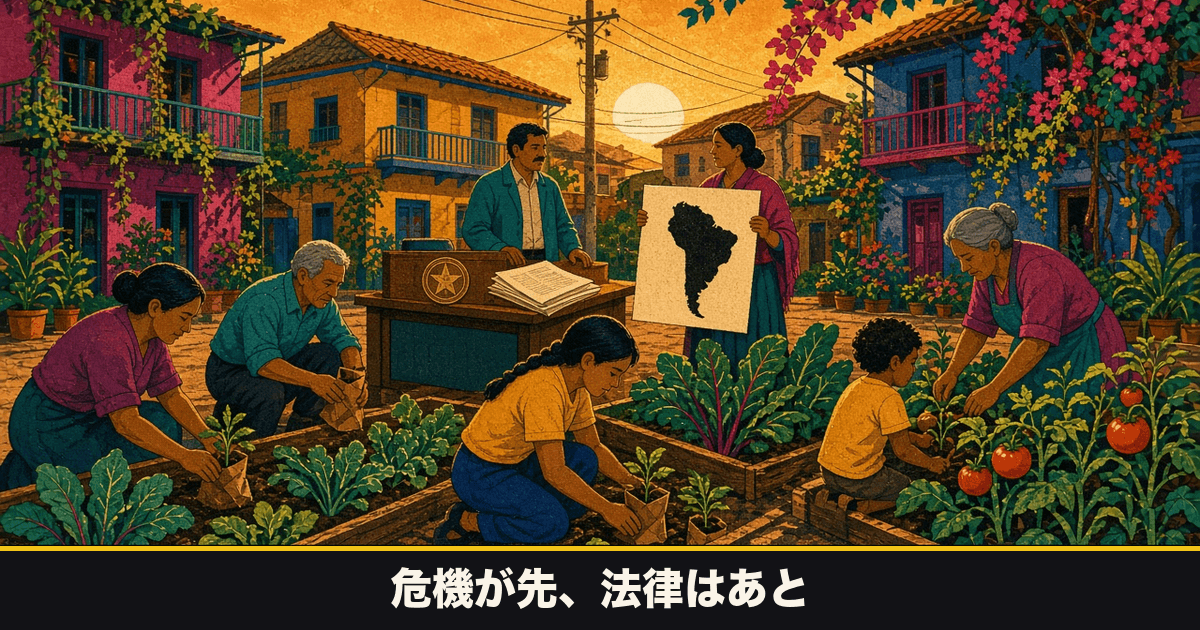
The gardens came in 1990, the national law in 2024 — a map of six South American countries→
In South America the response to crisis came first, municipalities carried it for two decades, and national law arrived last
Law 14,935, which made urban farming a national policy in Brazil, appeared in the official gazette on 29 July 2024. The bill behind it was tabled in 2015 by the deputy Padre João, so it took nine years to become law. On the same continent, in Argentina, a resolution of the board of the National Institute of Agricultural Technology (INTA) launched ProHuerta on 3 August 1990 — an emergency measure to get seed and seedlings to people the 1989 economic crisis had cut off from food. Belo Horizonte in Brazil made food security municipal policy with by-law 6,352 of 15 July 1993, and Quito in Ecuador started AGRUPAR in 2002. Municipal ordinances run ten to thirty years ahead of national law. That order is the reverse of Europe's. This series works through six South American countries over seven days, and today sets out the sequence by its dates.
2026-09-09 · 17 min read

Germany among its neighbours — what is actually different from Britain, France and Poland?→
Allotments are no German monopoly. What differs is not the number of plots but the rent cap, the closed list of termination grounds and the legal standing of the association
Calling Germany a country of gardens implies, quietly, that nowhere else is. That is not true. The international body for allotment gardens was founded in Luxembourg in 1926 and today, as the Fédération Internationale des Jardins Familiaux, brings together national federations from twelve European countries and states that it represents more than two million affiliated garden families. On plot counts, Poland's national organisation PZD managed 901,869 plots as of 31 December 2023 — more than the 867,092 published by Germany's own allotment federation, the BKD. So 'Germany has a lot of them' cannot explain what the previous six days examined. This closing instalment shifts the axis of comparison from quantity to institutional strength. Line Germany up next to Britain, France, Poland, the Netherlands, Denmark and Austria, and what is left that is genuinely German? The answer narrows to three things: a rent cap and a closed list of termination grounds bound together in a single federal statute, a structure in which the law makes the association indispensable, and a two-layer system in which the law protects the Kleingarten while a foundation carries the community garden.
2026-09-08 · 19 min read
A Munich foundation that links 1,000 gardens — anstiftung and the network of self-making→
Who keeps the gardens that no law protects?
The first five days of this series looked at how law keeps gardens in the city. But the Federal Allotment Gardens Act of 1983 protects allotments and nothing else. The community gardens on vacant lots, in the gaps between housing blocks, on the grounds of disused cemeteries, all sit outside it. So who holds those up? There is a foundation in Munich. anstiftung began as a research body set up in 1982 by Jens Mittelsten Scheid, born into the family that ran Vorwerk, the Wuppertal firm known for vacuum cleaners and kitchen machines; since 2017 it has operated as a charitable foundation, linking a nationwide network of 1,000 community gardens, more than 400 intercultural gardens as of 2025, and over 1,800 repair initiatives. Its grant applications take no set form, must not exceed three pages and must contain no photographs. It buys no land and pays neither rent nor salaries. The gardens keep multiplying anyway. This instalment examines that second mechanism — the one that works outside the law — through its origins, its money, its programmes and its ideas.
2026-09-07 · 18 min read
1.5 million in the East, a 1983 law in the West — the two gardens that division made→
In the East an organisation kept the gardens; in the West a statute did. What unification left standing was the statute, plus a set of exemptions written for the East
Germany's small gardens survived on both sides of the Wall — but the mechanism that kept them differed. In East Germany a single vast organisation, the Association of Allotment Gardeners, Settlers and Small Livestock Breeders (VKSK), founded in Leipzig in November 1959, counted some 1.49 million members by 1988 and by 1989 held together more than 830,000 plots across roughly 60,000 hectares. In West Germany the Federal Allotment Garden Act was passed on 28 February 1983, turning a set of numbers into statute: plots of 400 square metres, sheds of 24, rent capped at four times the going rate in commercial fruit and vegetable growing. In 1990 the two met inside one country. This article takes the East–West contrast that our earlier country report, Urban farming in Germany: 150 years from Schreber's garden, sketched in a paragraph apiece, and drives it down to section numbers and membership figures. Not atmosphere: which clause says what, and by exactly what procedure the eastern gardens entered western law.
2026-09-06 · 18 min read
A Reich league of one million — how the Nazis organised the allotment→
Nuremberg, 29 July 1933: an allotment federation was replaced by a Reich league in a single day
An earlier column, Hitler and Migge: subsistence gardens in the age of 'Blood and Soil', covered the ideological inversion — how a tool of emancipation was swallowed by the vocabulary of agrarian nationalism. None of that is repeated here. What this article looks at is the org chart and the numbers. On 29 July 1933, at the ninth Reich Allotment Gardeners' Congress in Nuremberg, the Reich Federation of German Allotment Garden Associations, founded in 1921, was replaced by the Reichsbund der Kleingärtner und Kleinsiedler Deutschlands — the Reich League of German Allotment Gardeners and Small Settlers. Boards stopped being elected; a 'leader' appointed by the NSDAP appointed his own board instead. By 1938 the league is recorded as having roughly one million members on about 45,000 hectares, producing some 350 million kg of fruit and 300 million kg of vegetables. In that same year of 1938, Jewish members were excluded from the league completely. The figure of one million and the total exclusion stand in the same year. This article follows the organisation in four steps: law, personnel, production drive, and the reality after defeat.
2026-09-05 · 18 min read

Walking Migge's gardens — what became of the plots at Britz, Römerstadt and Törten a hundred years on→
The thinking was covered in an earlier column; today the subject is area, dates and present condition
On 26 July 2026, at its 48th session in Busan, South Korea, the UNESCO World Heritage Committee inscribed Berlin's Waldsiedlung Zehlendorf as the seventh component of the World Heritage site 'Housing Estates in the Berlin Modern Style'. The open space of that estate, built between 1926 and 1932, was designed by the landscape architect Leberecht Migge together with Martha Willings-Göhre. A century after its foundation stone was laid, another estate whose gardens Migge drew has become World Heritage. This article covers neither Migge's life nor his thought; that was the subject of an earlier column, Hitler and Migge: subsistence gardens in the age of 'Blood and Soil'. What it looks at is land. The Horseshoe Estate in Berlin-Britz, Römerstadt in Frankfurt, and Ziebigk and Törten in Dessau. Of the subsistence plots drawn alongside the houses in the 1920s, how many square metres survive a hundred years later, who owns them, which instrument protects them, and where did they turn into extensions and garages? Areas, dates and present condition, and nothing else.
2026-09-04 · 18 min read

31 July 1919 — the allotment ordinance that hunger wrote→
On the same day as the Weimar Constitution, Germany acquired a law that protects gardens
On 31 July 1919 the German National Assembly, sitting in Weimar, adopted the Weimar Constitution. The same day, the same assembly passed a second law: the Kleingarten- und Kleinpachtlandordnung, the Small Garden and Small Leasehold Land Ordinance, KGO for short. Printed at page 1371 of the Reich Law Gazette, it capped the rent that could be charged for a small urban plot, forbade the landlord to terminate the lease, and made the creation of permanent allotments a task of the municipality. It is called an 'ordinance', but its text opens with the words 'the constituent German National Assembly has resolved the following law'. Its passage through parliament took just six weeks. What wrote it was not an idea but hunger: through the 'turnip winter' of 1916–17, the calorie intake of city dwellers under blockade fell to roughly 1,000 a day. This article is about that 1919 ordinance itself — what its text says, what mechanisms it assembled, who operated them, and why it survived until the Federal Allotment Gardens Act of 1983.
2026-09-03 · 18 min read

From poor gardens to community gardens — a 200-year map of Germany's plots→
What kept Germany's plots is not a national love of gardening but a law, an association structure and a cap on rent
German cities hold 867,092 small plots of cultivated land. Together they cover 44,000 hectares, and the average plot measures 370 square metres. Berlin has about 66,000 of them, Leipzig about 39,000. This is not scenery; it is an institution. A plot may not exceed 400 square metres, its shed may not exceed 24 square metres, and the rent may not exceed four times the local going rate for commercial fruit and vegetable growing — every one of those numbers is written into a single statute, the Federal Allotment Gardens Act. Why did Germany alone spend two centuries building a machine like this? This series answers that over seven days, looking not at people or landscapes but at four devices: law, association, land and money, and foundations. Today is the map. From the poor gardens of 1797 to the intercultural gardens of 2025, we cross two hundred years by the dates.
2026-09-02 · 18 min read
The sin and the point of trying to measure the unmeasurable — the case against impact evaluation, and what to do anyway→
Is it a mistake to try putting a number on what a number cannot hold
This series began with an observation: goodwill alone no longer draws in funding. Over seven days it examined how the SROI ratio actually works, how young the phrase 'impact investing' really is, the light and shadow of the Social Impact Bond, the concrete money trail of Japan's dormant deposits, and the real cost evaluation itself imposes. Today, the final instalment, confronts the question this series has circled around from the start: do a chance encounter in a garden, or the trust and dignity that grow there, even belong on an indicator in the first place? It faces head-on both the values that resist quantification and fall through the cracks, and the critique of 'impact washing' — results exaggerated or oversimplified — before setting out why measurement is still worth doing, and closing the full seven days.
2026-09-01 · 22 min read

When evaluation itself exhausts the organisation — the cost of measuring impact→
Measuring is not free — so who, exactly, is paying for the time and money it takes
Over the past four days this series has looked at the tools of measurement — SROI, logic models, RCTs, JANPIA's four-stage evaluation cycle. Today looks squarely at what using those tools actually costs. Evaluation is not free: it takes time, it takes expertise, and outsourcing it costs money. A 2016 survey of 1,125 US nonprofits by Innovation Network found only 12 per cent spent 5 per cent or more of their budget on evaluation, down from 27 per cent in 2012 — less than half. Organisations with any dedicated evaluation staff were fewer still, just 8 per cent, falling to 2 per cent among small organisations alone. The demand to evaluate has grown stronger every year even as the on-the-ground capacity to meet it has shrunk. Today traces what that twist actually produces, through figures from the US, the UK and Japan.
2026-08-31 · 20 min read
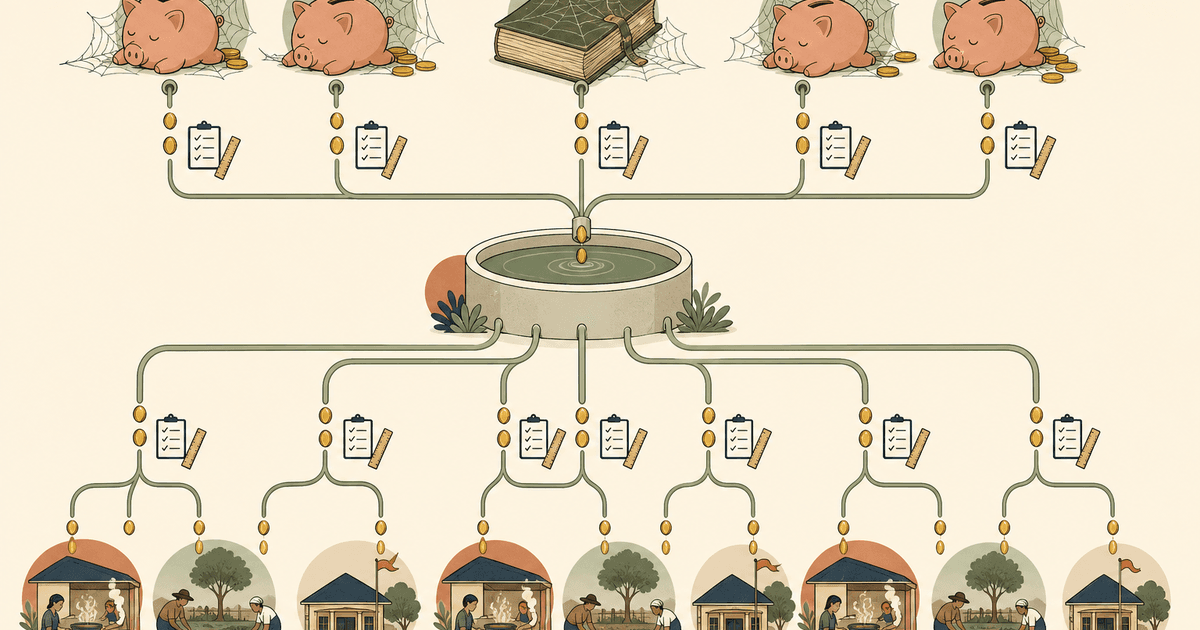
How dormant deposits are reshaping community gardens — Japan's impact-evaluation landscape today→
Money from bank accounts untouched for ten years now reaches children's cafeterias and local grants — with evaluation attached as the price of admission
So far this series has looked at UK Social Impact Bonds and US programme-related investment. Today narrows to Japan, which already has its own funding channel built on the same premise — that measuring results is a condition of the money. The Dormant Deposit Utilization scheme draws on deposits left untouched in bank accounts for ten years or more, and channels them through a three-tier structure headed by the designated entity JANPIA to community organisations and NPOs. Since its fiscal-2019 launch, cumulative grants had reached roughly ¥40.1 billion by the end of April 2026, including funding for a children's-cafeteria network and food-bank operations in Nagano Prefecture. But getting that money means carrying out social-impact evaluation — there is no way around it. Today looks at how far this system actually reaches, what form the evaluation requirement takes, and how regional-revitalisation grant KPIs constrain project design on the ground.
2026-08-30 · 21 min read
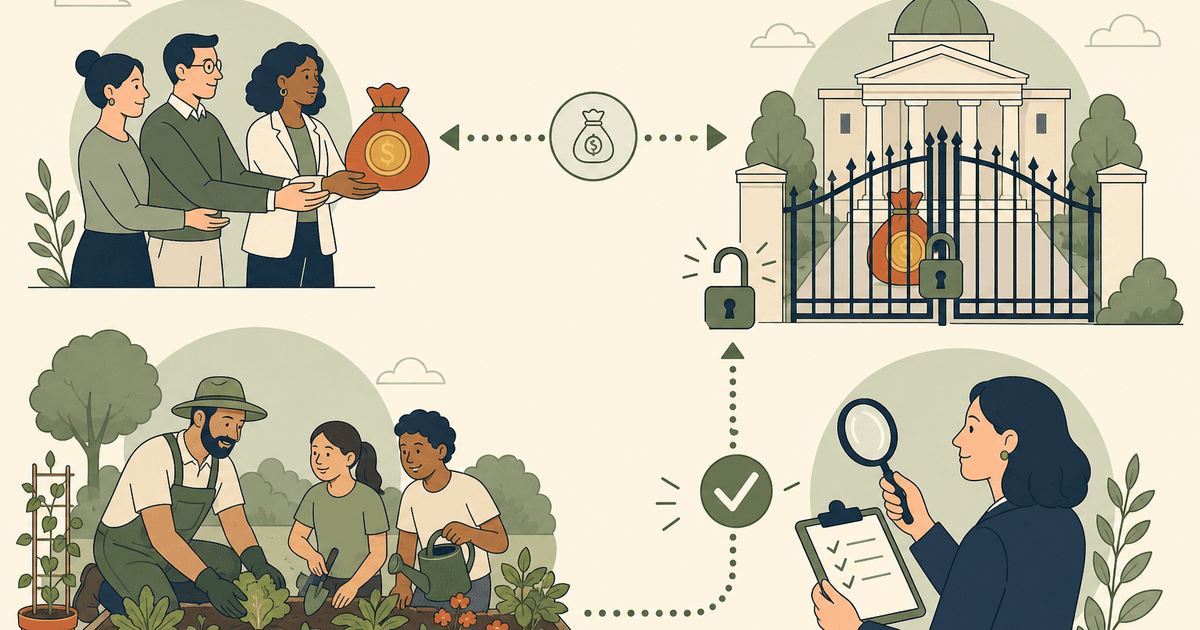
No results, no payment — the gamble of the Social Impact Bond→
Investors put up the money first, and the government pays only if results appear — one case that worked, and one that didn't
Day three established that the phrase 'impact investing' was coined only in 2007. Today looks at what that idea actually became as a contract. A Social Impact Bond — also called 'Pay for Success' — has investors put up the operating money for a welfare programme first, with government repaying their capital and interest only if an independent evaluator confirms a predetermined outcome was met. If the outcome fails to appear, investors lose money. The world's first such contract began in 2010 at a prison in Peterborough, England, and hit its target seven years later. A comparable contract in New York, using the same model, was shut down in 2015. Today draws on both the case that worked and the one that didn't to see what this contract form actually does on the ground.
2026-08-29 · 21 min read

When was 'impact' invented? — a genealogy of the idea of social investment→
The vocabulary this whole field uses is far newer than it feels
Day two looked at the tools used to measure — SROI, logic models. Today the lens shifts to history: why these tools came to seem necessary in the first place. The short answer is that the phrase 'impact investing' itself is a startlingly recent invention, coined in 2007 at a Rockefeller Foundation meeting in Bellagio, Italy. It did not, though, appear out of nowhere. In Britain, the ideas of 'social enterprise' and 'social audit' had been growing since the 1970s. In Japan, the 1998 NPO Act gave citizen activity a legal footing, and the 2016 Dormant Deposit Act built evaluation into the funding system. Today traces both lineages — the Anglo-American act of naming an investment category, and Japan's slower build-out of legal and institutional machinery — and where they meet.
2026-08-28 · 20 min read

What SROI measures, and what it misses — the methodology of impact evaluation→
Where does a number like '$7 of social value for every $1 invested' actually come from
'Every dollar invested generated seven dollars of social value' — many readers will have seen a report phrased that way. The figure comes from SROI, Social Return on Investment, now a standard fixture of grant applications and annual reports. Few people, though, can explain exactly how the ratio is calculated: what goes into the numerator and denominator, where human judgment enters, and where measurement ends and estimation begins. This article covers how SROI is actually calculated and where it breaks down, the theory-of-change and logic-model frameworks used to fill the gaps it leaves, and why the method considered the gold standard for proving 'did this actually work' — the randomised controlled trial — cannot simply be transplanted into welfare and community settings. It closes by looking at what a Goodhart's-law-style distortion, where only what can be measured gets measured, actually does on the ground.
2026-08-27 · 20 min read
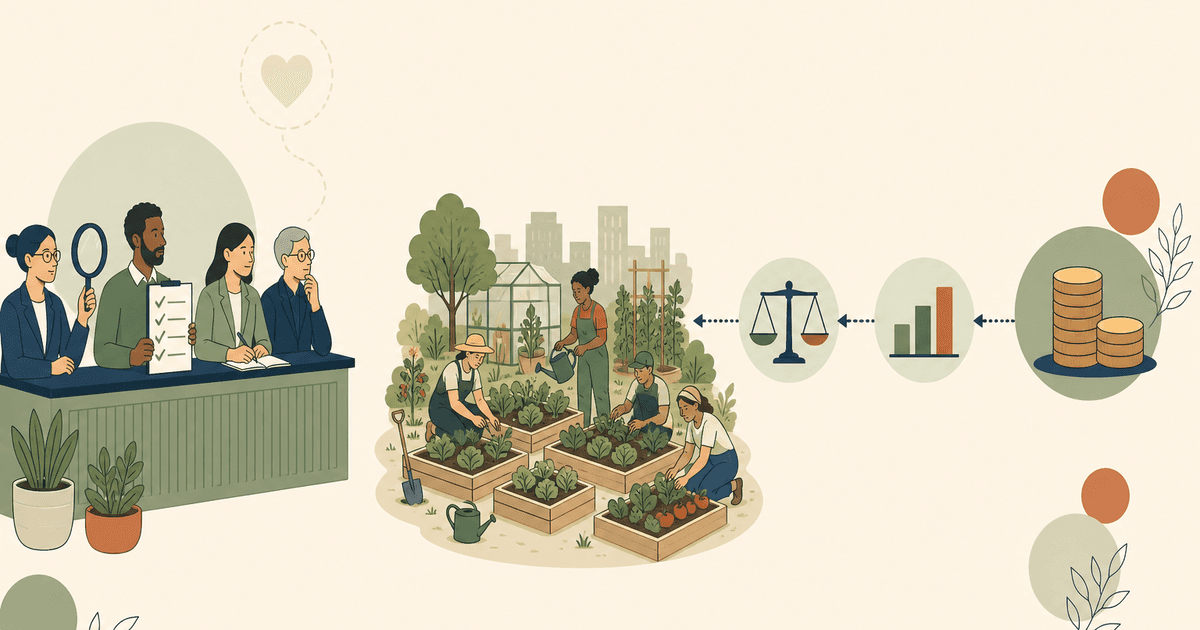
The era when 'feels good' no longer funds anything — a map for this series on social impact→
'Good for society' has stopped being a reason to fund anything, on its own
'It's good for the community,' 'it helps welfare' — the era when that sentence alone unlocked a grant is ending. In a 2020 survey of investors by the Global Impact Investing Network, one of the world's largest bodies tracking impact capital, 66 per cent of respondents named concern about 'impact washing' — impact claimed but not delivered — as the single biggest obstacle to the healthy growth of the impact-investing market, far ahead of 'inability to demonstrate impact results' (35 per cent) or 'inability to compare impact results with peers' (34 per cent). Funders no longer take goodwill at its word; what they ask for is evidence of what worked, by how much, and for whom. Amid that shift, how is urban and community farming evaluated, measured and financed? This series tracks that over seven days. Two earlier columns, Urban Farming and Community: The Social Capital that Soil Grows and Care farming and horticultural therapy, covered the benefits a farm itself produces — social capital, physical and mental healing. This series takes up what comes after: how those benefits get proven, priced and paid for.
2026-08-26 · 19 min read
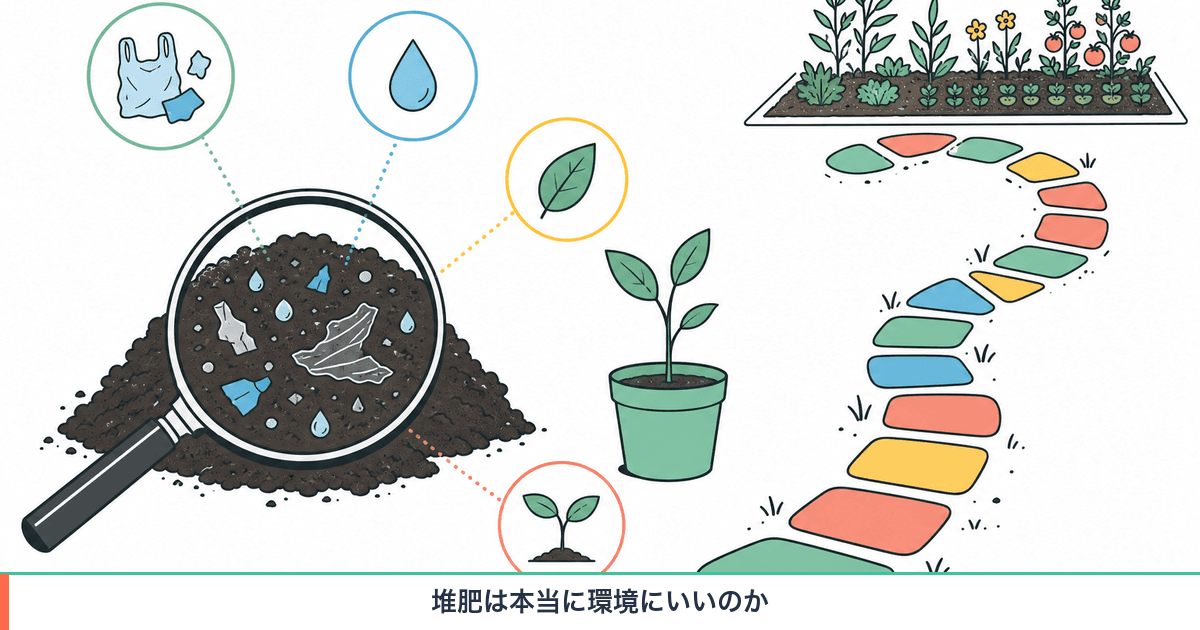
Is compost actually good for the environment — the case against composting, and what to do anyway→
Compostable plastics that do not break down, PFAS and metals in finished compost, and the climate arithmetic once transport is counted
Yesterday's sixth instalment, on whether food scraps become compost or methane, read that fork from the side of two competing business models. If money decides the destination, the next question is what the destination is worth. This closing instalment takes the opposite chair. Composting has long been spoken of as a synonym for doing the right thing. Over the past few years, however, evidence has accumulated that punctures that assumption directly. Much of the plastic certified as compostable does not fully disintegrate in a home heap. PFAS, heavy metals and microplastics turn up in commercial compost. And once the collection round and the energy of the processing site are counted, it is fair to ask how much city-scale composting actually delivers as climate policy. This article sets out those four objections with the best numbers available, then shows where the objections themselves run out. It closes by drawing the seven days together and leaving handles that an individual and a municipality can each take hold of on Monday.
2026-08-25 · 19 min read
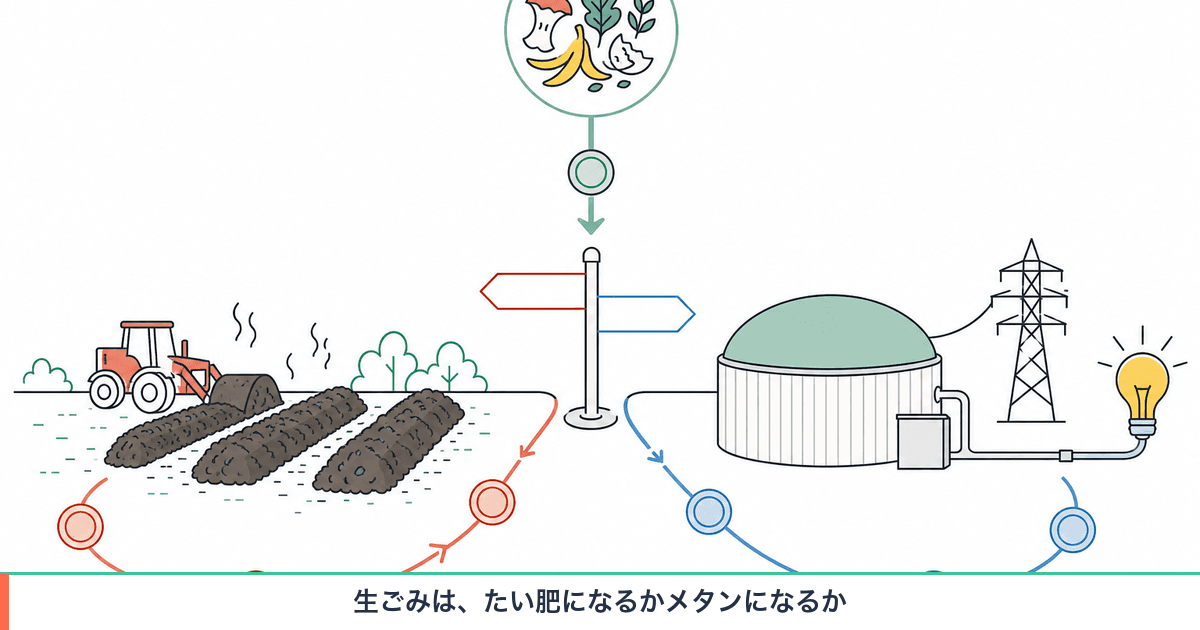
Compost or methane — the two business models competing for your food scraps→
Two industries put different prices on the same bucket of food scraps. One sells the result as electricity; the other can only sell soil. That asymmetry decides which plant gets built
Our previous instalment asked why Japan's household food waste is still barely separated, reading the record of twenty years of the Food Recycling Act. One answer was that no one had an economic reason strong enough to move it. This article takes that economic reason apart, layer by layer. The revenue of a composting facility does not, in the main, come from selling compost. It comes from the gate fee charged to whoever delivers the material — and the ceiling on that fee is set by what it would cost to landfill the same load instead. On EREF figures reported by BioCycle, the average US landfill tip fee in 2023 was 56.80 dollars a ton nationally and 84.44 dollars in the Northeast. Whether a composting business closes at all is decided first against that number. Then the cost side. Plastic mixed into food scraps is not a cosmetic problem but a legal disqualification: California's regulations cap physical contaminants larger than four millimetres at 0.5 percent of dry weight, of which no more than a fifth may be film plastic, and product over the line cannot be sold. Third, extended producer responsibility has begun to put a price on the words 'certified compostable' themselves. And finally the heart of it — send the same scraps to a compost windrow, or to a digester that turns them into methane and electricity? Under Japan's feed-in tariff, power from methane fermentation has been bought at 35 yen per kilowatt-hour since fiscal 2023, for twenty years, the highest rate in the biomass category. Compost has no equivalent institutional buyer. One of the two routes carries a twenty-year price tag and the other does not. This article's position is that what decides where food scraps go is neither the technology nor the environmental performance, but the presence or absence of that tag.
2026-08-24 · 19 min read
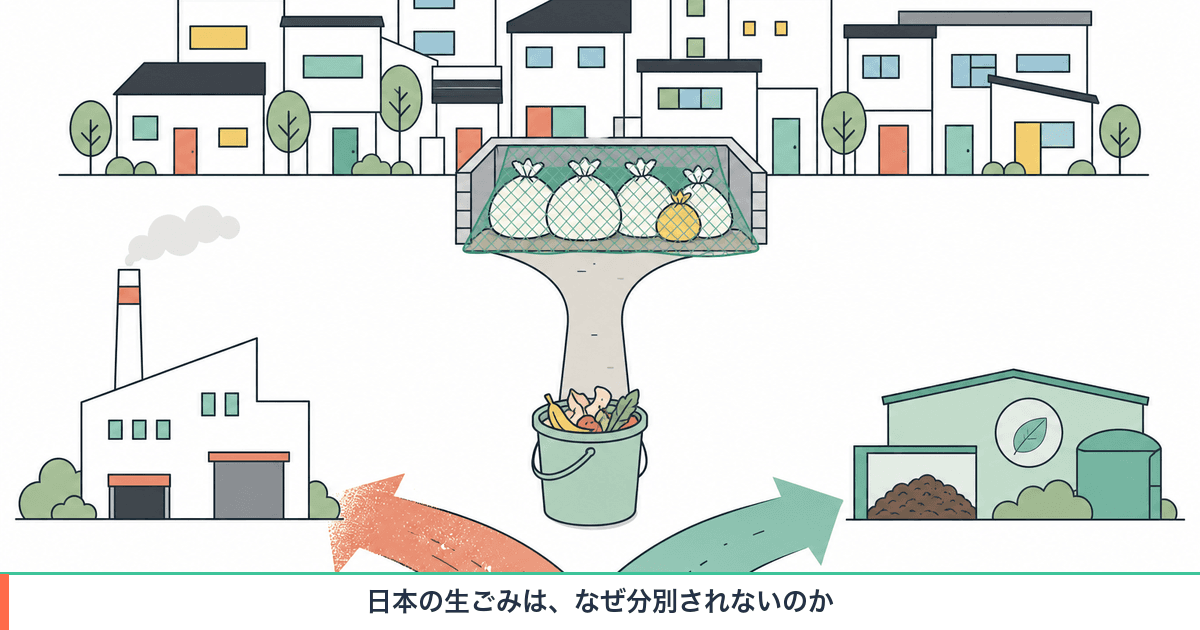
Why Japan still doesn't sort its food waste — twenty years of the Food Recycling Act→
Business food-waste recycling reaches 91%, yet four fifths of household scraps still go to the incinerator. What sits between the honour-roll figure and the kitchen the law never covered
Yesterday's fourth instalment looked at countries where composting mandates were written and the material still failed to move: contamination, household effort, the design of collection. Rules alone do not shift matter. So what about Japan? Japan has had something close to a mandate for a quarter of a century — the Food Recycling Act, passed in 2000 and in force from 2001. And the numbers are remarkably good. On the agriculture ministry's estimates, the food industry as a whole reached a recycling-and-recovery rate of 91% in fiscal 2024; food manufacturing alone reached 98%. Set against the world's stumbles, Japan looks like it is winning. Yet in the same year, environment ministry statistics show that four fifths of Japan's municipal waste goes straight to an incinerator, and that municipal composting plants received less than half of one per cent of all waste processed. Same country, same food scraps. This article follows how those two figures coexist — through the reach of the statute, the contents of the recycling, and the municipal facility ledger. The short version: Japanese food recycling is not succeeding so much as measuring only inside the boundary where success was defined.
2026-08-23 · 19 min read
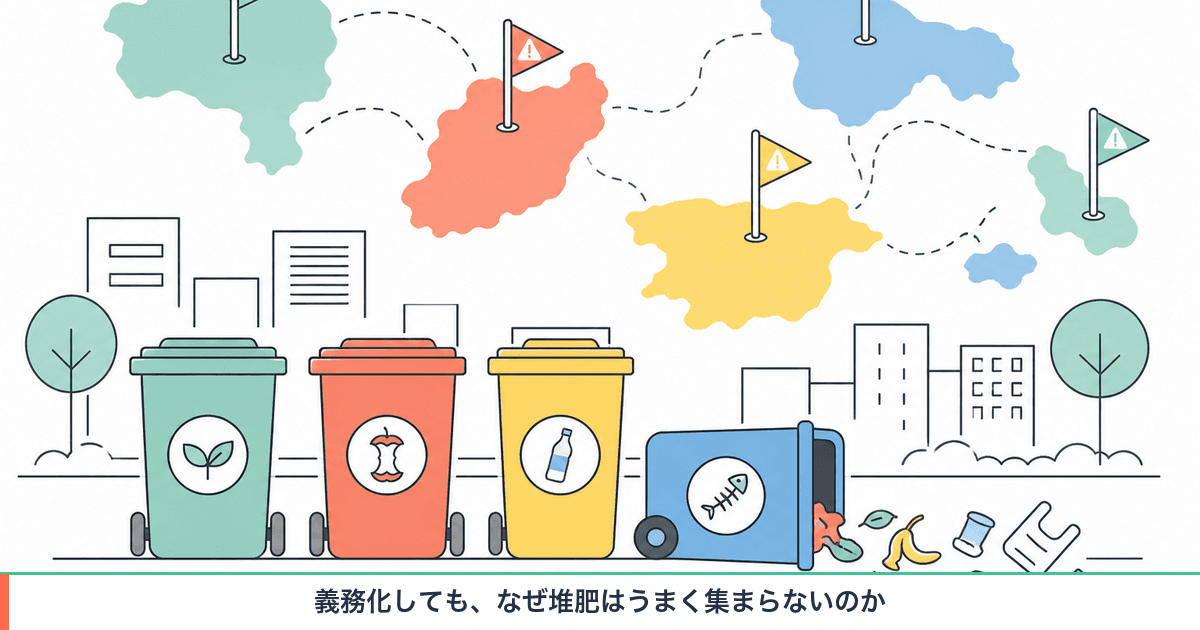
Mandating it isn't enough — where the world's composting rollouts have stumbled→
France, New York, California and China — four mandates lined up against the same three bottlenecks
Yesterday's third instalment followed how the twentieth century — chemical fertiliser at one end, the sanitary landfill at the other — moved compost onto the garbage side of the ledger. The 2020s are full of attempts to push it back by law. On 1 January 2024 France made source separation of food waste compulsory with no exemption for size. New York City finished rolling curbside organics collection out across all five boroughs in October 2024 and began fining households the following spring. California legislated in 2016 to cut the organic matter going to its landfills 75 per cent below 2014 levels by 2025. China, starting with Shanghai in 2019, imposed strict sorting on urban residents. None of these is running to schedule. This article lines the four up as cases of stumbling rather than of success, and asks, on a common scale, exactly where each one jammed. The answer, stated in advance: none of the four is a story about public willingness. The place a mandate reaches and the place a system jams turned out not to be the same place.
2026-08-22 · 19 min read
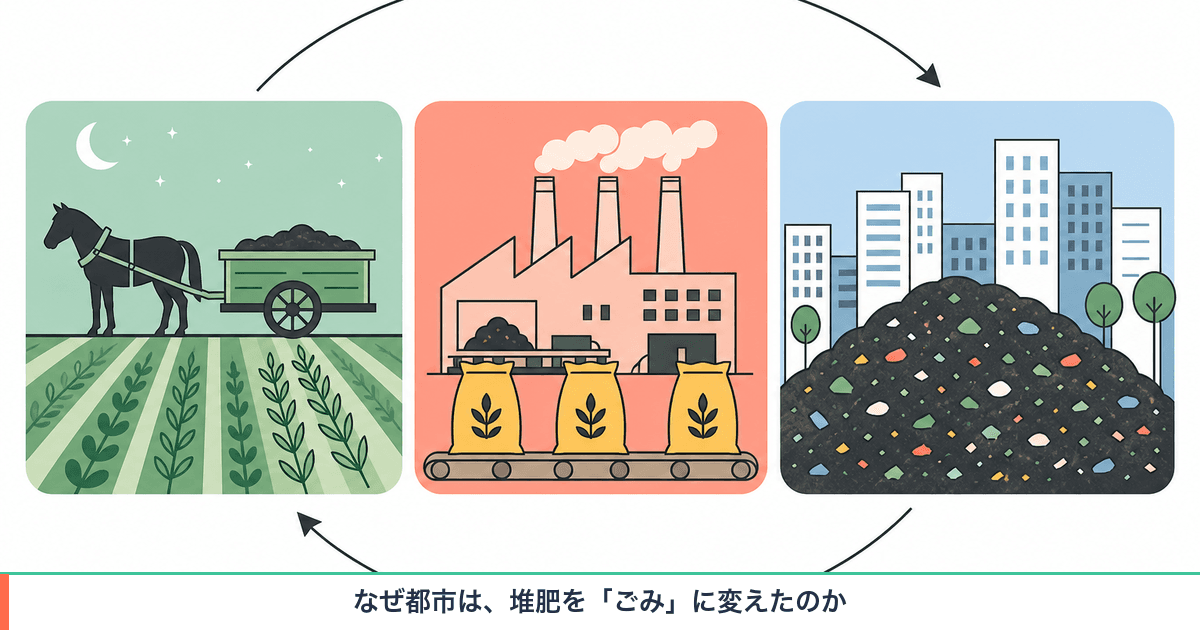
How cities turned compost into garbage — chemical fertiliser and the century of the landfill→
The day nitrogen came out of the air, urban organic matter lost its buyer — and burial became a technology
Yesterday's second instalment, on the greenhouse-gas arithmetic of food waste, counted what food scraps emit once they are buried without oxygen. That calculation takes one thing as given: that the scraps go to a landfill at all. This article questions the premise. Urban organic matter has been heading for burial for only about a century. Before that, night soil, kitchen waste and wood ash were commodities that farmers paid to collect. Something removed that price. On 9 September 1913 the world's first ammonia synthesis plant started up at Oppau in Germany, pulling nitrogen out of the air at thirty tonnes a day, and the fertility of a field was decoupled from what a city produced. Organic matter without a buyer became surplus, and in 1937, in Fresno, California, an engineer worked out how to bury it hygienically. Compost did not become garbage because compost changed. It became garbage because its price disappeared and a method of burial was found. What follows traces that disappearance, follows the minority who refused it — Howard and Rodale — and asks what today's mandates are actually trying to buy back.
2026-08-21 · 19 min read
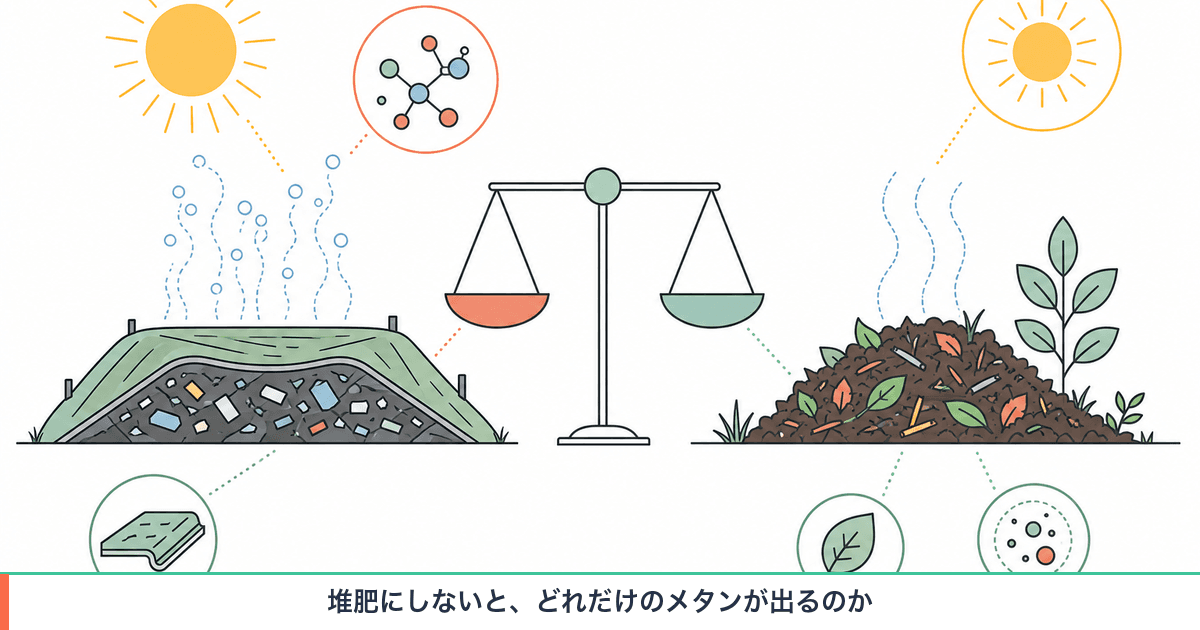
How much methane if you don't compost it? The greenhouse-gas arithmetic of food waste→
0.86 tonnes per tonne, the 61% that never gets captured, and what 'certified compostable' does not certify
Yesterday's opening instalment, The day food scraps become infrastructure, mapped the three currents — climate targets, food-waste reduction and landfill capacity running out — that pushed compost towards being treated as public infrastructure. Today we open the first of those ledgers. 'Landfilled food waste releases methane' now appears in the preamble of ordinances and in corporate decks alike. But how much? Counted by whom, and how? And does composting really bring it to zero? The US Environmental Protection Agency's first published estimate, in 2023, puts roughly 0.86 tonnes of carbon dioxide equivalent into the atmosphere for every tonne of food waste landfilled. That figure, though, is the output of a decay model rather than a measurement — and when aircraft flew over the same landfills, the plumes were larger than the models predicted. Composting, meanwhile, is not zero either. This article works back to where each number comes from. The decomposition science covered in our earlier column is taken as given; what is examined here is how that science gets written into a climate ledger.
2026-08-20 · 19 min read
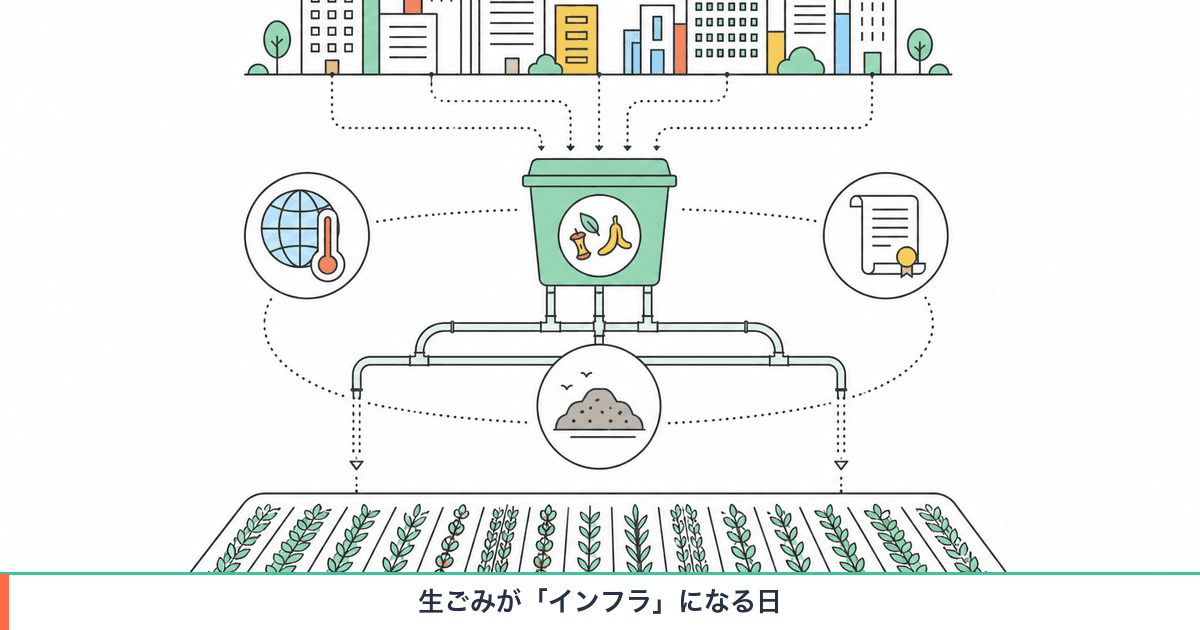
The day food scraps become infrastructure — a map for seven days on composting→
What changed when a corner of the kitchen was wired into climate targets, statute books and the remaining capacity of landfills
For a long time composting was a hobby: a bin at the end of the garden, the timing of the turn, arguments about the carbon-to-nitrogen ratio. Then, in the 2020s, the practice began to be discussed in the vocabulary of policy. The EU made separate collection of biowaste an obligation across the union with a deadline of 31 December 2023; France extended source separation to every producer of waste, household or business, from 1 January 2024. California wrote into law a 75 per cent cut in landfilled organic waste against a 2014 baseline by 2025, and Japan brought a food-loss reduction act into force in 2019. What happened? This article's answer is that three currents met in one place: climate targets — methane above all — the codification of food-waste reduction, and the physical limits of the container we call a landfill. Where those three converge, food scraps stop being something individuals ought to reduce and become something a city collects and processes: infrastructure. An earlier column, Composting: the science and the societies, covered why decomposition happens and what systems the world has built. This series takes up what comes after. Where have mandates stumbled, who is paying, and is compost actually good for the environment? Today is the map.
2026-08-19 · 19 min read
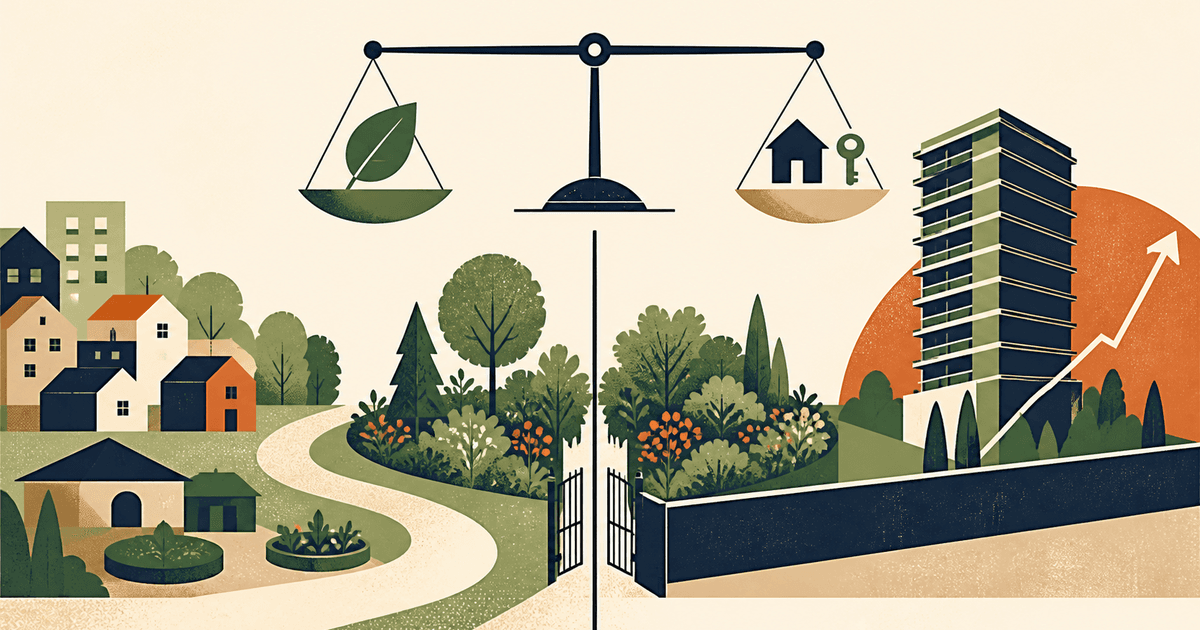
Who was the farm planted for — the case against the green premium→
Greenwash, gated green, displacement — and the design conditions still standing after all three objections
The sixth instalment read the tax machinery that keeps a field a field from the side of money. So when policy works to protect a field, whose field does it remain? This closing instalment takes the opposite chair. The more a farm can be counted as a premium on a property, the closer it comes to being green that exists in order to sell — the objection urban agriculture's advocates find hardest to answer. This article first sets out that objection in three parts: ① the gap between the brochure and the operation (greenwash); ② the inequality of access, in which green enclosed for residents or tenants is not the same object as a public farm anyone can enter; and ③ the structure by which the very people who needed the green can no longer afford to stay once the premium works. It then sets out what still holds after those three objections, in working language: how to fix the rights to the land, who holds the keys and the budget, and where in the first contract the conditions for removal are written. Finally it draws the week's seven instalments into a single line.
2026-08-18 · 23 min read
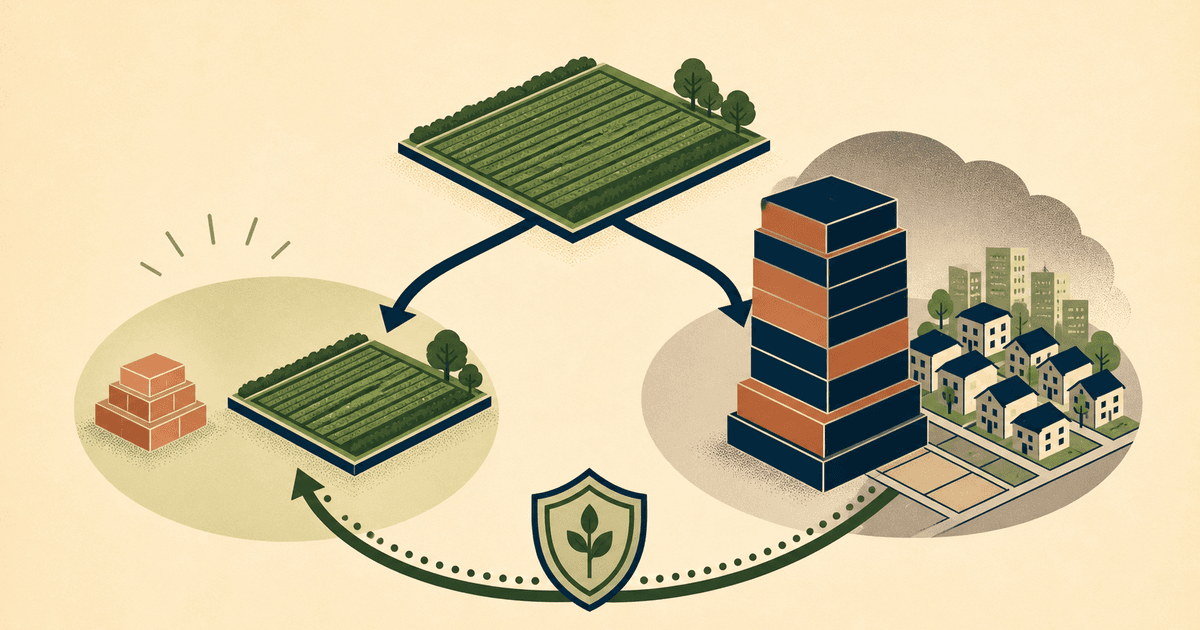
Leave it a field, and the tax divides — the arithmetic of not selling→
A thousand yen per tenth of a hectare, or the low hundred-thousands. Inheritance tax is halted at a separate yardstick called the agricultural investment price. What sets the size of the break is not the farm's margin but the price of the building plot next door
Our previous instalment followed what actually happened to Japan's productive green land after 2022, the year it was all supposed to be released at once. One of its conclusions was that most owners chose to keep the field rather than sell it. This article dissects that choice from the side of the tax bill rather than the sentiment. Japanese tax law puts two different prices on one and the same field. According to the Ministry of Agriculture, Forestry and Fisheries, property tax on ordinary farmland runs to roughly a thousand yen per tenth of a hectare a year; on farmland inside an urbanisation promotion area in a designated city of the three major metropolitan regions it leaps to the low hundred-thousands. Designate the same plot as productive green land and it returns to farmland valuation and farmland taxation, while sitting in the same zone. Inheritance tax is more extreme still: the land is re-measured at an agricultural investment price — a figure that only makes sense if farming continues — and everything above it is deferred outright. That price, set by the National Tax Agency by prefecture and land type, runs from about 200,000 to 900,000 yen per tenth of a hectare. So what is this enormous gap actually payment for? This article's position is that it is not a subsidy for keeping a field, but a price placed on the choice not to sell — and that the price is set not by what farming earns but by what the housing plots around it would fetch. The higher land values climb, the fatter the relief grows, and the fatter the incentive to sell grows with it. We follow the numbers through Japan's green land and deferral regime, America's use-value assessment and conservation easements, the ceiling Britain imposes from 6 April 2026, and the reason farmland REITs stop at the edge of the city.
2026-08-17 · 22 min read
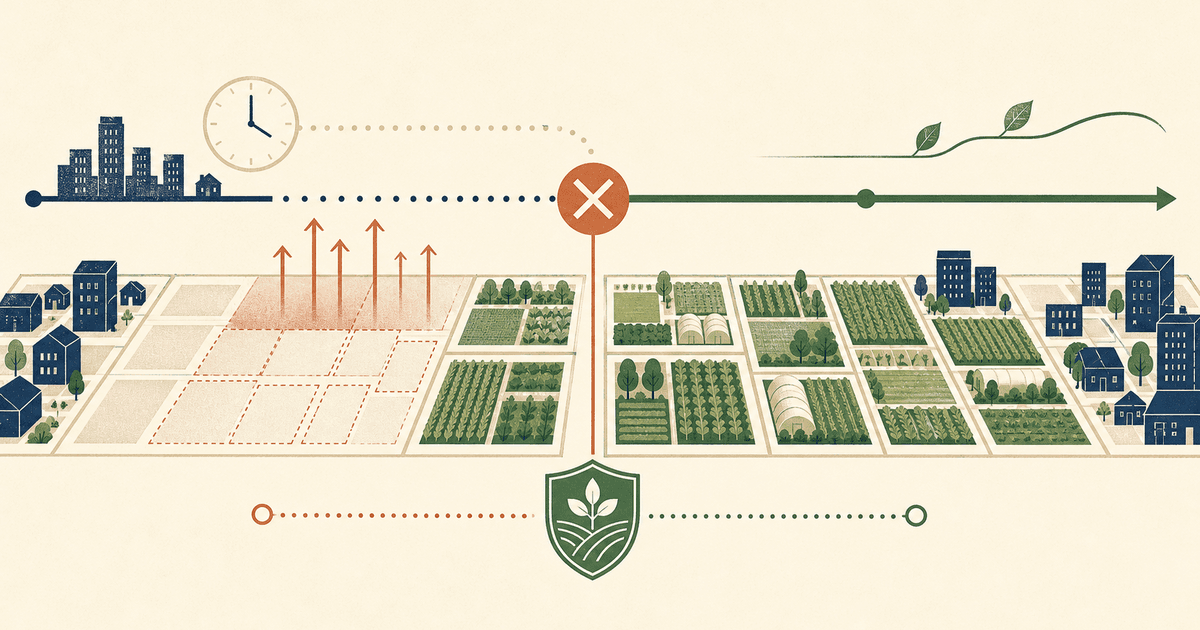
In 2022, Tokyo's fields were all supposed to go on sale — what became of productive green land→
9,273 hectares hit their thirty-year deadline in the same year. The government's survey answered 89.3% — a look inside a forecast that missed
Yesterday's fourth instalment argued that when a developer builds a farm, the produce is not the point: greenery moves the asking price, and a garden can be engineered as a sales device for real estate. So what about Japan? Japan has one institution designed expressly to push back against the logic of property. It is called seisan-ryokuchi — productive green land. In 1992, more than ten thousand hectares of farmland inside the urbanisation-promotion areas of the three major metropolitan regions were designated all at once. In exchange for thirty years of continued farming, the land was taxed as farmland rather than as building plot, and inheritance tax could be deferred. Those thirty years expired, for nearly all of it, in 2022. A flood of farmland would come onto the market as building land, the forecast ran, and urban land prices would break. That is the '2022 problem'. Start with the answer: the forecast missed. In a survey published by the Ministry of Land, Infrastructure, Transport and Tourism on 14 February 2023, 89.3% of the 9,273 hectares designated in 1992 had moved into the successor category, tokutei seisan-ryokuchi. This article follows, through public data, how that 89.3% was manufactured, what the failed forecast had failed to see, and what waits for the remaining 10.7% — and for everyone else, ten years from now.
2026-08-16 · 22 min read

Developers do not build farms for the vegetables→
From Agritopia to Porte de Versailles — line them up under the same question and you can see what is actually being recovered
Yesterday's third instalment followed how the fields around cities became housing, and how some of that ground is now going back the other way. The actors who reverse it are usually a city government or a group of residents. But there is a third actor building farms, and it is not either of those: the private developer who buys land, services it, and sells or leases what is built on it. The Urban Land Institute counts more than two hundred such farm-centred communities in the United States alone. What is odd is that the vegetables from those farms do not cover even the farm's own upkeep. At The Cannery in Davis, California, the company selling 547 homes was also writing a cheque each year to the non-profit running the farm. If the farm does not stand up as a business, what exactly is being recovered? This article lines up eight cases — four American, one French, one Singaporean and two Japanese — under the same three questions. Who pays. Who receives the benefit. And if the farm were removed, what would pull the trigger.
2026-08-15 · 22 min read
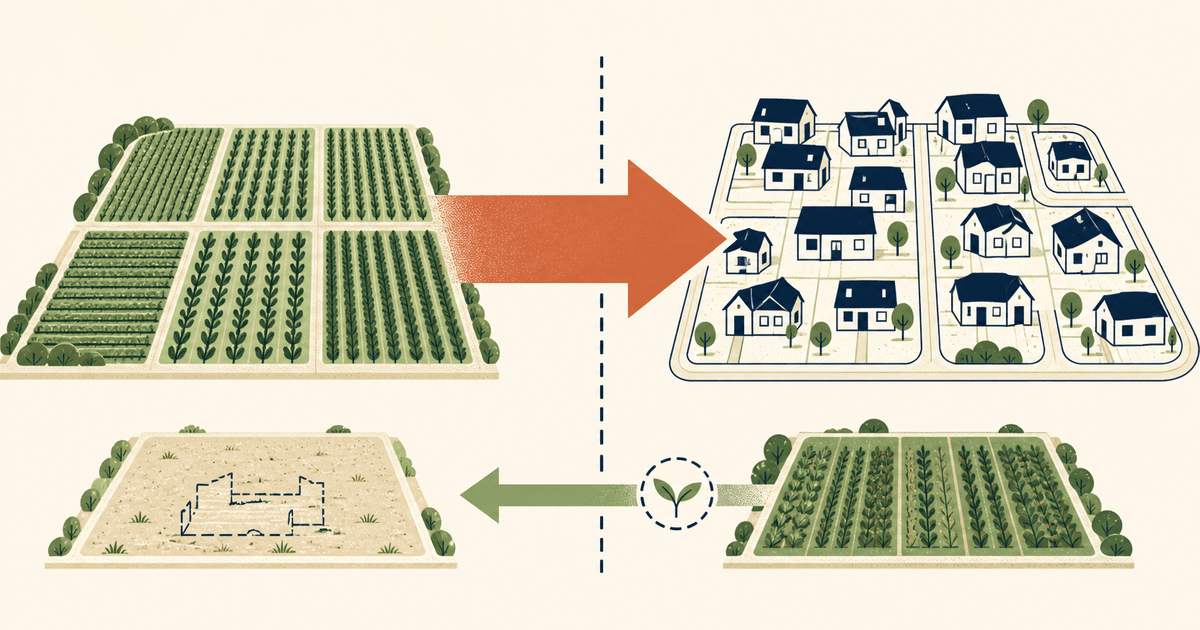
How farmland became housing — and how a little of it is coming back→
The countries that drew a line, the countries that bought the right, and the land that lost its price
Yesterday's second instalment tracked the fight over hedonic estimates: does living next to a garden really raise the price of your house? Every one of those studies takes one thing for granted — that the garden is there at all. This article questions that premise. Urban farmland did not simply survive; it was left, or not left, by decisions someone made. In Japan, the 1968 City Planning Act drew a line across the country and redefined the farmland inside it as land that had not yet become housing. Britain codified the wrapping of green belts around its cities with a single 1955 circular. Several American counties went further and detached the right to build from the land itself so it could be bought and sold. And conversion is not a ratchet. In Detroit, vacant lots turned into tree farms at under $350 a lot; in Leipzig, land turned green because owners agreed to leave their building rights unused for a fixed term. But the reverse flow comes with a condition attached: the land that comes back is almost always land that has lost its price. That asymmetry is what this article is about.
2026-08-14 · 22 min read
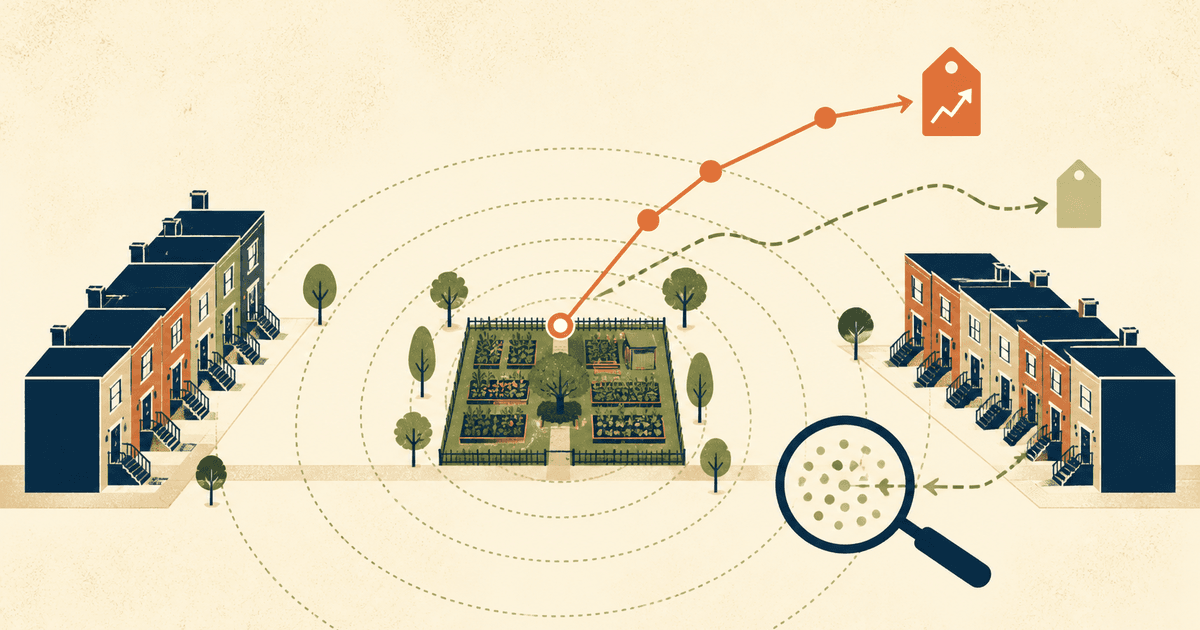
Does a farm next door make a house worth more? The fight over the evidence→
A thousand feet, 9.4 percentage points, and the caveats nobody ever quotes
Yesterday's opening instalment, What is the land under that farm worth, showed that every urban farm sits on somebody's land, and that the land brings rent, tax and the permanent possibility of disposal along with it. Does the farm, then, move the price of the land it sits on? The sentence 'community gardens raise nearby property values' now turns up in grant applications and municipal plans alike. Trace it back and it usually leads to a single New York paper. This article rereads that paper, and the wider body of empirical work around it, from both the supporting and the sceptical side. What is being measured, and what is not? The figure of 9.4 percentage points — which neighbourhoods, which distance, over what period? And how badly does the plain fact that gardens tend to appear in particular kinds of places complicate the whole exercise? The short answer: the evidence exists. Just not in the shape in which most people quote it.
2026-08-13 · 23 min read
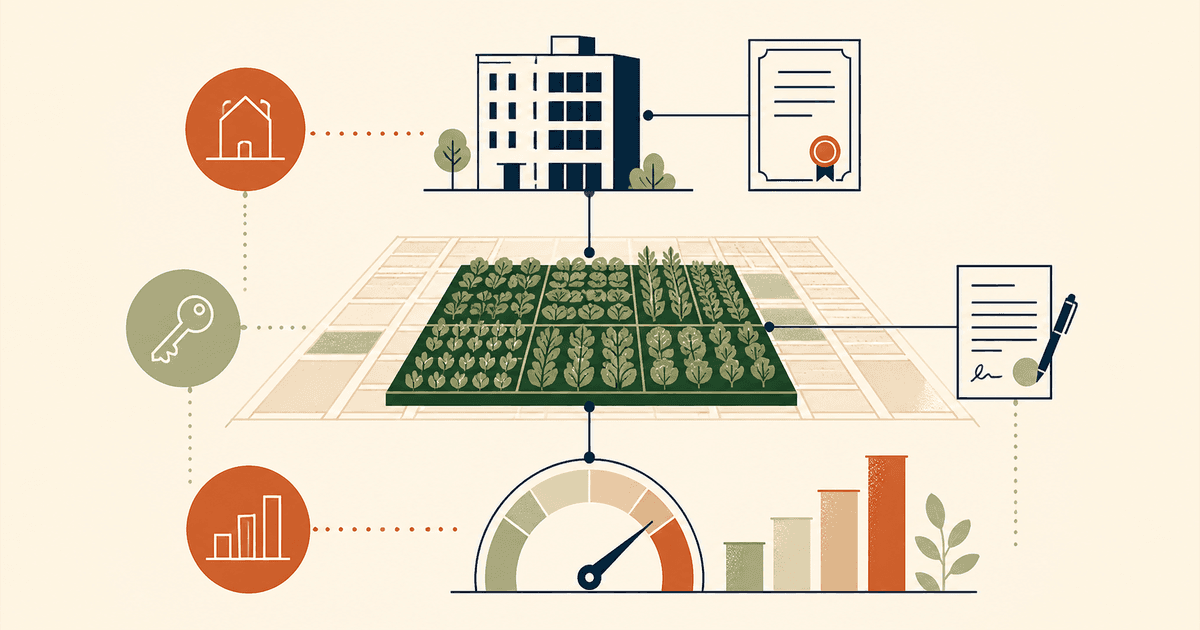
What is the land under that farm worth — a map of urban farming and real estate→
The place we describe with community, harvest and green is moved by another vocabulary: title holder, ground lease, assessed value
Writing about city farms tends to use the same words: community, harvest, green, belonging, generations. Yet every one of those farms sits on somebody's land — and that land is kept in a ledger that has nothing to do with the farm's story. Who holds the title, how the parcel is classified, what the zoning says, what the termination clause of the lease says, what the tax assessor thinks it is worth, who actually pays the property tax. Whether a farm is still a farm next year is usually settled not by agriculture but by real estate. In New York the city's garden licence states that it may be revoked at will on sixty days' notice; in Amsterdam the city has, since 1896, leased rather than sold most of the ground under its housing; in Detroit more than 1,500 city-owned lots changed hands at roughly three hundred dollars apiece. This week we spend seven days looking at urban agriculture from the property side. Today's opening piece is the map: three separate layers — ownership, tenure and valuation — and a preview of what the rest of the week will test.
2026-08-12 · 19 min read
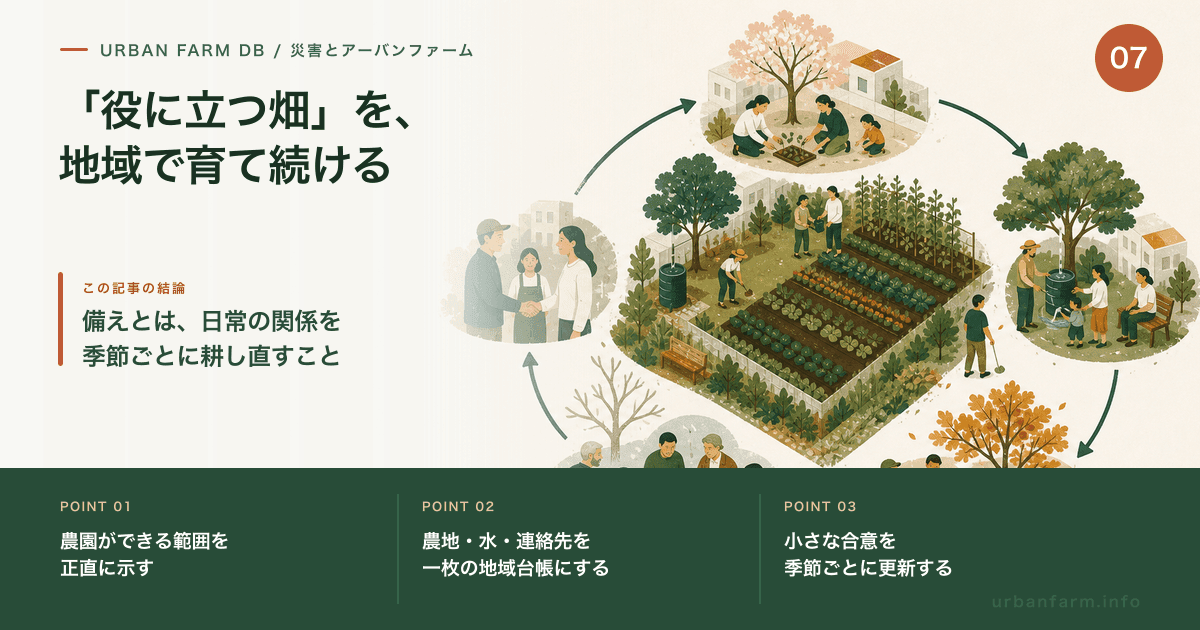
Disaster and urban farming ⑦ — Keep growing a farm that is useful to its community→
The seven-day conclusion: preparedness cultivates everyday relationships
In this final article, the earlier arguments return to one practical picture. A disaster-resilient farm is not simply one with special equipment; it is one where people, land and knowledge circulate in ordinary times.
2026-08-11 · 15 min read
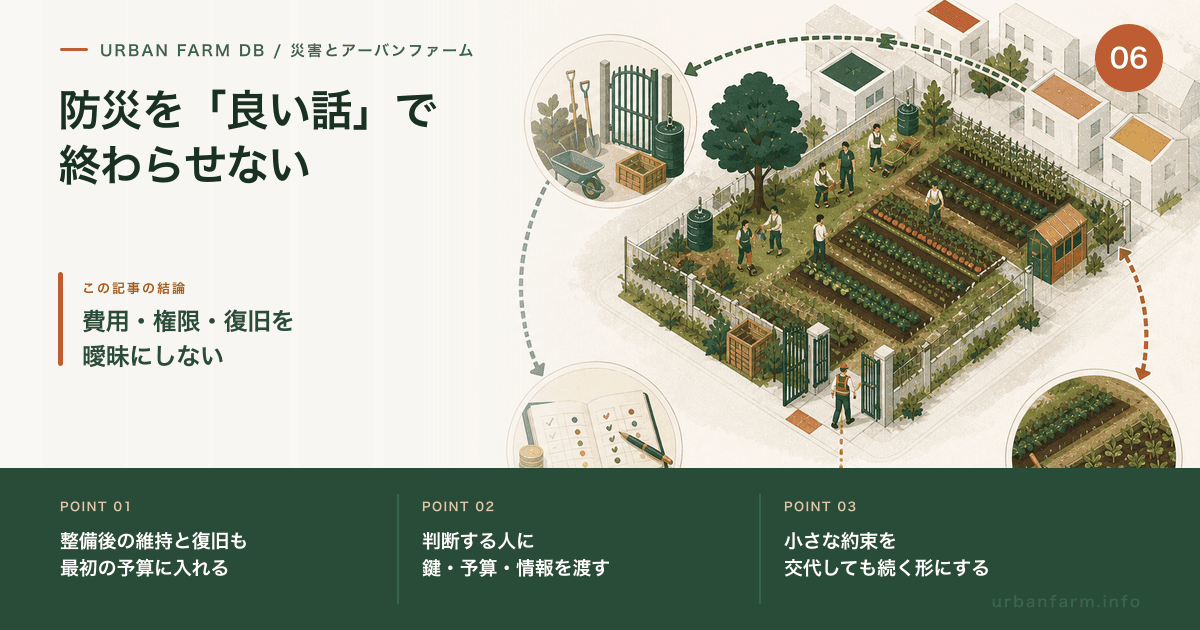
Disaster and urban farming ⑥ — Costs and authority that keep preparedness from becoming a nice story→
Who pays, who decides, and who restores
A farm's preparedness function cannot persist on goodwill alone. This sixth article addresses funding, insurance, responsibility and decision-making. It is less glamorous, but clarity here is a condition of continuity.
2026-08-10 · 15 min read
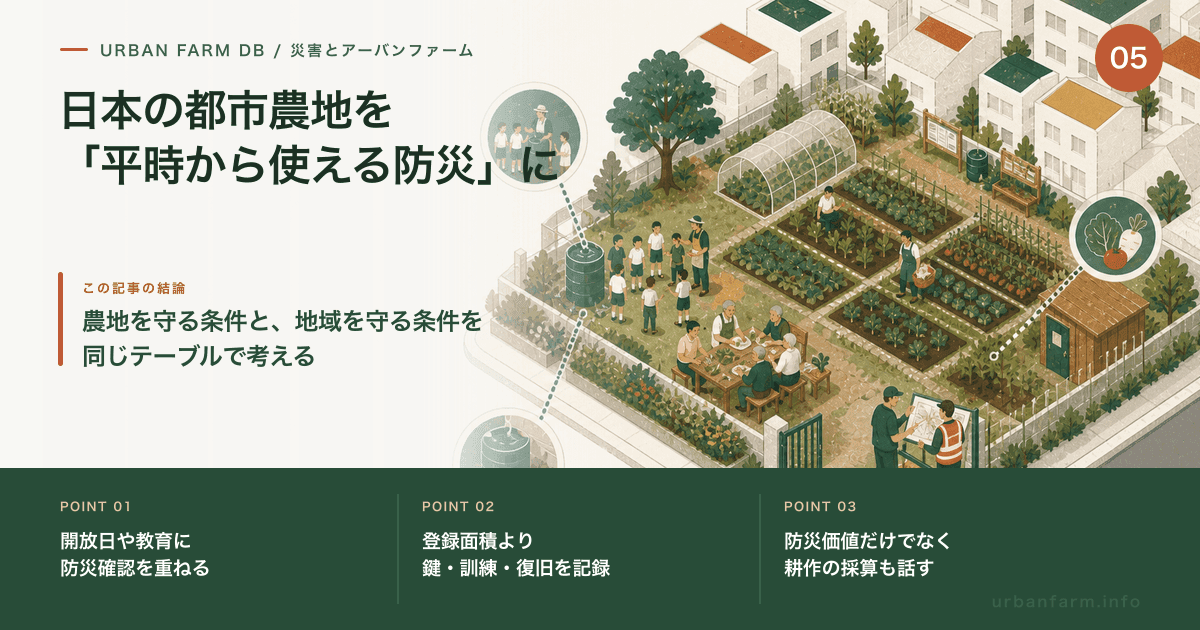
Disaster and urban farming ⑤ — Make Japanese urban farmland preparedness usable every day→
Do not separate disaster-cooperation farmland, wells and open days
Japan already has policies and practices for using urban farmland in disaster preparedness. This fifth article asks how to reconnect them to everyday farm life instead of treating them as a distant special project.
2026-08-09 · 15 min read
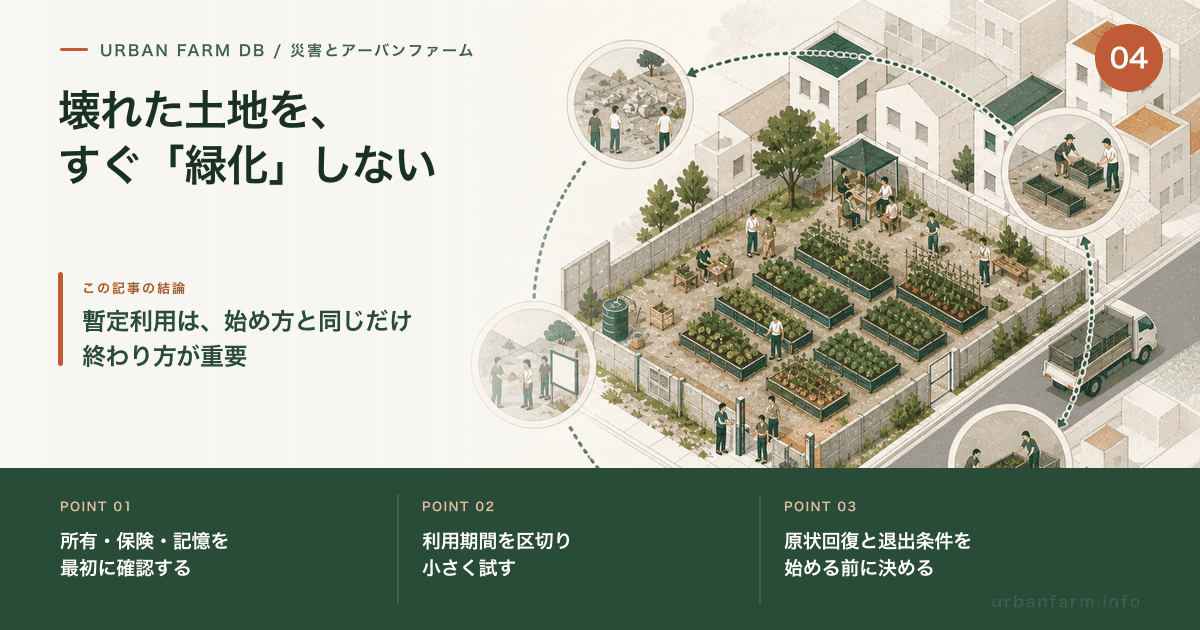
Disaster and urban farming ④ — Do not rush to ‘green’ damaged land→
Christchurch and the time needed for temporary use and recovery
Vacant land after disaster can become a symbol of hope or an object of speculation. This article resists consuming an overseas case as a model and asks whose land it is, for how long, and who maintains it.
2026-08-08 · 15 min read
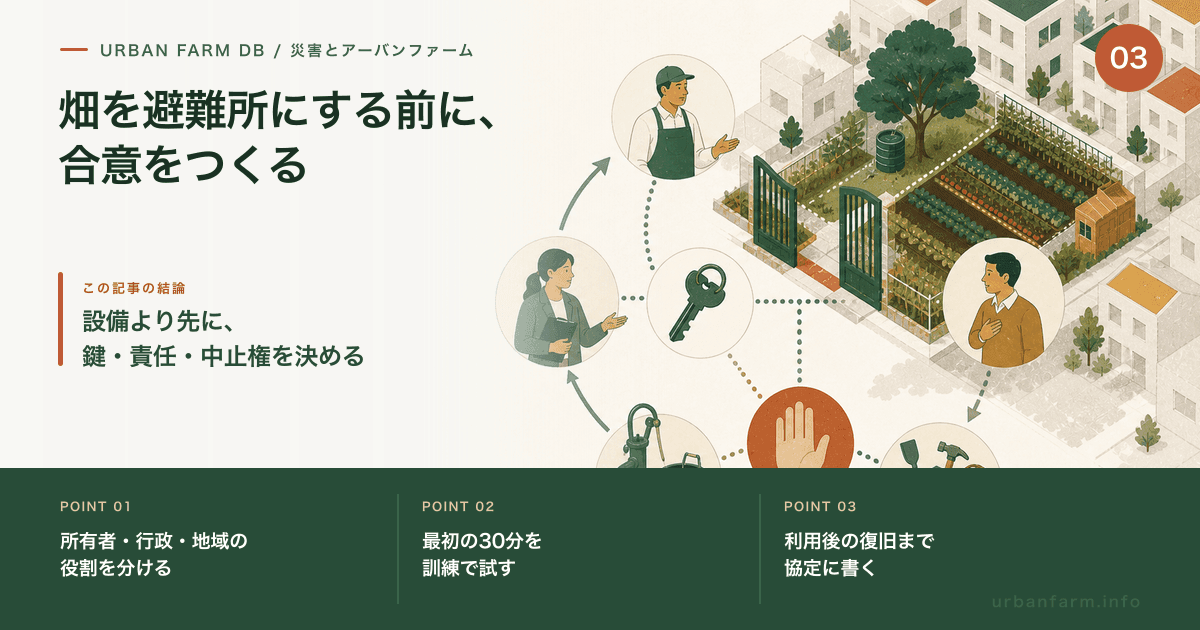
Disaster and urban farming ③ — Build agreements before calling a farm an evacuation site→
Keys, responsibility, water and communication: lessons from implementation
‘Please use it in an emergency’ may be generous, but it is not enough to operate. This third article uses Japan's disaster-cooperation farmland as a starting point for making concrete the agreements needed to open land in a crisis.
2026-08-07 · 15 min read
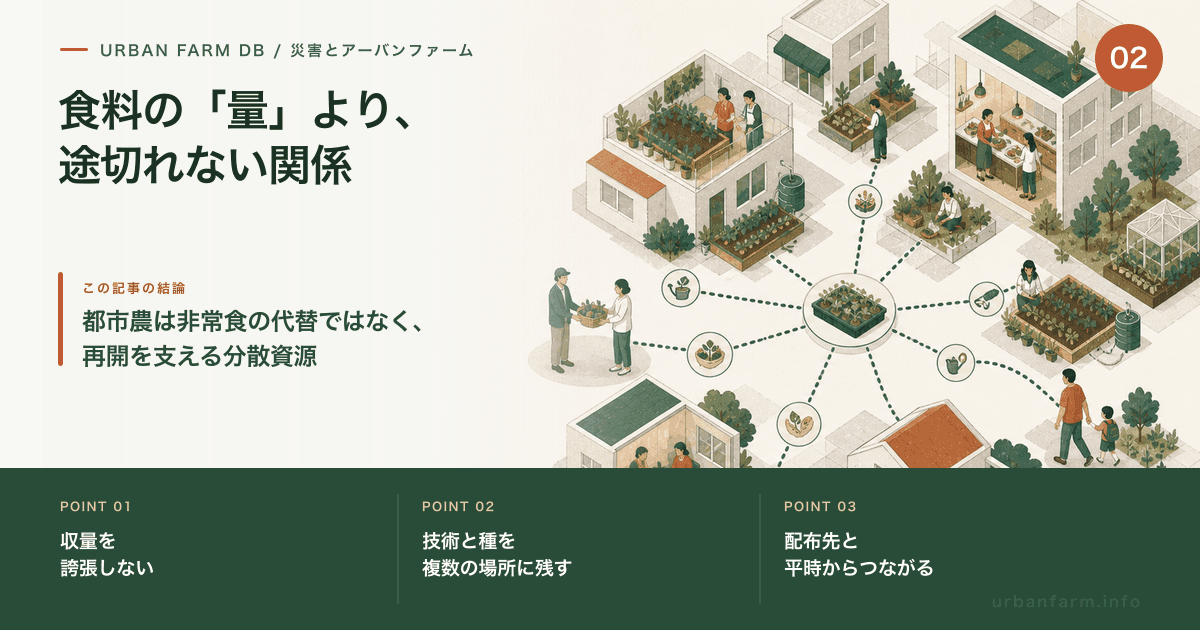
Disaster and urban farming ② — Build continuity, not promises of food volume→
Not a substitute for emergency rations, but a distributed food-and-knowledge network
How much food can urban farming provide immediately after a disaster? Avoiding an inflated answer is the key to seeing its real role. This second article steps away from the story of yield and looks at seeds, growing knowledge and relationships with recipients.
2026-08-06 · 15 min read
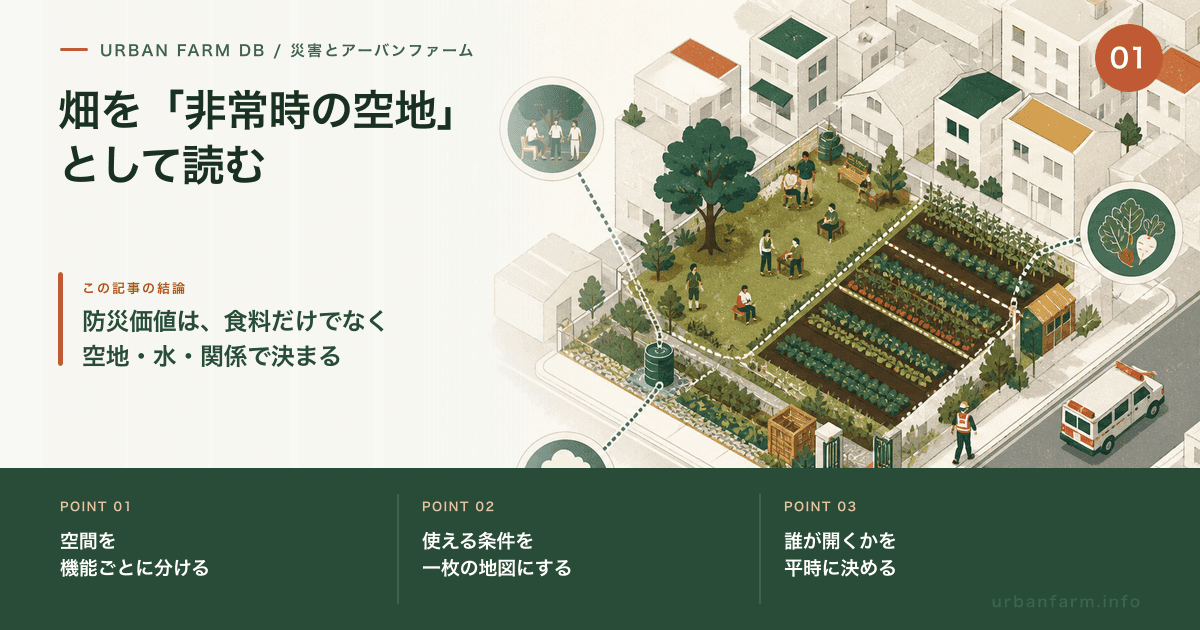
Disaster and urban farming ① — Reading a farm as emergency open space→
From food production to evacuation, firebreaks and neighbourhood hubs
It is appealing to say that farms help in disasters, but the phrase is not yet a plan. This opening article separates the functions urban farmland has in ordinary times and asks what each can become in an emergency.
2026-08-05 · 15 min read
Urban farming in Spain — the water court that sits at noon on Thursday, and the plot you hand back after five years→
What this country refined was neither ownership nor a boundary but the turn — and a turn appears on no balance sheet
Day one of this series ('Farming a dry city') described a technique for keeping farmland as farmland by drawing a boundary rather than buying the ground. Day two ('Urban farming in Italy') looked inside that boundary and found a city that does own the buildings, does let them, and has let close to one in five fall into ruin. A line you do not buy is cheap but abstract; an inventory you do own is concrete but sends a bill every year. What Spain has refined is a third instrument, neither of these: deciding who uses how much, and when. In Valencia, at noon every Thursday, eight representatives gather at a cathedral door and settle disputes over the order of the water entirely by speech. Nothing is written. No record is kept. The same idea descends to the scale of a city allotment, where Barcelona lends plots of twenty to forty square metres to residents aged 65 and over, by lottery, for five years, and takes them back when the term ends. This article follows the cheapness of the turn as an instrument — and what that cheapness costs.
2026-08-04 · 20 min read
Urban farming in Italy — the 59 farmsteads a city owns, and the 41 meadows it counted→
Drawing the line is not enough: of the roughly 100 cascine left in Milan, 59 belong to the city and 18 are already derelict
Yesterday's instalment — 'Farming a dry city: Southern Europe has held its farmland without owning it' — described a Southern European technique: keeping farmland as farmland by drawing a boundary rather than buying the ground, with the Parco Agricolo Sud Milano as the exemplar. Stand inside that line, however, and what you find is not an abstract quantity of hectares. It is buildings with names, watercourses with names, meadows with names. Roughly a hundred cascine — the courtyard farmsteads of the Po plain — survive in Milan, and 59 of them are municipal property. Milan is not only the authority that decides how farmland may be used; it is the landlord of the farms themselves. Of that same hundred, 18 are already derelict. What Italy has taken on is not a boundary but an inventory, and an inventory, in exchange for being concrete, always sends a maintenance bill. Following Milan, this article traces how owning, letting and maintaining fit together — and where they stop fitting.
2026-08-03 · 19 min read
Farming a dry city — Southern Europe has held its farmland without owning it→
Water is short. Land sells. And still Milan fixed some 46,300 hectares at the city's edge in 1990, and Barcelona 3,473.26 in 1998 — without buying any of it
When urban farming in Southern Europe comes up, we tend to draw one of two pictures. One is the tourist's: Mediterranean light, stone streets, pots on a terrace. The other is the story of people who lost their jobs in an economic crisis and took to tilling vacant lots. Neither is wrong, and neither explains a mechanism. This short series enters from somewhere else: what binds urban farming here most tightly is water, and what the region invented most distinctively is not the allotment plot but the agricultural park. According to the European Environment Agency, water scarcity conditions covered 28% of EU land area and 32% of its population in 2023, and in southern Europe around 30% of people live under permanent water stress with up to 70% under seasonal summer stress. Meanwhile total EU freshwater abstraction fell 14%, from an average of 224,000 million cubic metres in 2000–2009 to 192,600 million in 2020–2023 — and yet agricultural groundwater abstraction alone rose 52%, from 11,000 to 16,500 million cubic metres. As water thins, farming reaches downwards. On top of that constraint Southern Europe placed the Parco Agricolo Sud Milano (1990, about 46,300 hectares, over 1,400 farm businesses) and the Parc Agrari del Baix Llobregat (1998, 3,473.26 hectares, some 621 holdings). In neither case did the authorities buy the land. Holding it without buying it — this article unpacks that technique, and prepares the ground for visiting Italy and Spain over the next two days.
2026-08-02 · 19 min read
What is a rooftop farm good for? — between 633 hectares and 1,284→
Twenty-four years have put about 633 hectares of greenery onto Japan's roofs. On the ground, allotment gardens hold twice that, in 188,000 plots. If there is still a reason to climb, it is not the harvest
This series has handed out, one at a time, the tools for seeing a roof as farmland. We counted the area, took the physics of weight and water down to the level of design, traced the genealogy, and followed the allocation of cost. This final instalment puts to all of that the question hardest to answer: what, then, is a rooftop farm good for? Does it genuinely contribute to a city's food? Have mandates become an alibi for the greenery lost at ground level? The answers are not comfortable. According to the latest survey, published by Japan's transport ministry on 12 December 2025, green roofs accumulated to about 633 hectares between 2000 and 2024, with roughly 14.5 hectares newly built in 2024. Meanwhile the agriculture ministry counts 4,273 allotment gardens nationwide in fiscal 2024, comprising 188,713 plots over 1,284 hectares. The gardens on the ground hold about twice the area of twenty-four years of rooftop greening — and all of it is soil meant for eating from. Eight years of measurement on a university roof in Barcelona found that greenhouse gas per kilogram of tomato swung from 0.54 to 12.05 kilograms, a factor of more than twenty, in the same greenhouse. Even so, this article does not tell you to give up on roofs. On a school roof in Rome, six planted species had been joined by sixty-two that arrived on their own — there is something up there that the harvest cannot measure. Having fixed the limits in figures, we set out, in order, the first steps a citizen can actually take.
2026-08-01 · 26 min read
Who pays for the roof — mandates, subsidies, and repeal→
From two hundred Canadian dollars a square metre in lieu to forty-six euro cents a year off a sewage bill — what put greenery on roofs was always somebody's purse
In the first instalment of this series we said that what put greenery on roofs was regulation, not the market. This sixth instalment turns that regulation over and reads it from the side of cost. Who fronts the money to put soil on a roof? And where does the coolness it creates, and the rainwater it keeps out of the sewer, actually land? That these two answers do not match is what governs every institutional design in this field. The construction cost falls on the building's owner, while most of the benefit flows outside the building, to the city. Left alone, therefore, roofs stay bare, and regulation has stepped in. It has only three instruments: mandates, subsidies and prices. This article compares all three, down to their actual figures. Toronto charged two hundred Canadian dollars a square metre to buy out of greening, and used that money to grant a hundred dollars a square metre to other roofs. In Germany the saving from a reduced sewage charge comes to about forty-six euro cents per square metre a year, against a construction cost of thirty to sixty euros — it never repays. Tokyo imposes the duty while the money comes separately, from the wards and cities. We then look at how an operator's books actually balance, and finally return to Toronto in October 2025. Why did the first city in North America to mandate green roofs become the first to lose the mandate? Having gone through the money, we reread the fact that the repeal was argued in the language of cost.
2026-07-31 · 25 min read
The rooftops nobody counts — what Japan's green-roof statistics do not measure→
The cumulative 633 hectares is not a stock. Reading where Japan's rooftops stand, through the design of its two numbers
What has become of Japan's rooftops? Try to answer and you run almost at once into something strange. The numbers exist. Since 2000 the Ministry of Land, Infrastructure, Transport and Tourism has surveyed the nation's green-roof construction every year, and it reports that about 14.5 hectares were newly built in 2024, bringing the twenty-five-year total to some 633 hectares. Tokyo publishes its own rooftop-greening record going back to fiscal 2000. Yet neither of these figures measures what is on the roofs today. The ministry's survey counts area newly constructed; nothing is subtracted for roofs removed or gardens dead. Tokyo's figure comes from filed plans, and the metropolitan government itself notes that it differs from what was actually built. This fifth instalment re-reads where Japan stands by starting with the structure of that measurement, then sets the annual figure's fall — from about 26.9 hectares in 2014 to about 14.5 in 2024 — beside the work that continues outside the statistics.
2026-07-30 · 23 min read
Four motives, four roofs — why the world reached for its rooftops→
New York, Chicago, Basel, Singapore — on the same rooftops, four cities are counting entirely different things
Yesterday's third instalment, A genealogy of the roof garden, showed that the idea of putting soil on a roof began three separate times, out of three different motives: fire safety, architectural idea, and drawing customers. Different motives make different things. That observation is not only historical. The reasons cities are reaching for their rooftops today are not one reason either. This article visits four of them. In New York commerce came first and regulation caught up a decade later. In Chicago the roof of City Hall was itself an instrument. What Basel wanted from its roofs was not green but the creatures living on it. Singapore counted its roofs in tonnes and tried to add them to its territory. All four are called rooftop greening or rooftop farming, yet who pays, how many centimetres of soil go down, and what counts as success differ in every case. And three of the four have not run as the opening story said they would. Reading that gap — between the announcement and the present — is what this article is for.
2026-07-29 · 24 min read
A genealogy of the roof garden — from idea to technique, and on to the department-store roof→
From Berlin in 1867 to Nihonbashi in 1907 — the notion of putting soil on a roof began three separate times
Yesterday's second instalment, Designing for weight and water, read the rooftop farm as a problem of equipment: load, waterproofing, drainage, irrigation. Where, then, did that body of technique come from? The notion of putting soil on a roof did not branch out from a single source. It began at least three separate times, from different places and out of wholly different motives. The first was Berlin in 1867, where the master mason Carl Rabitz argued for the greened flat roof on grounds of fire safety and durability, and exhibited one at that year's Paris World Exposition. The second was Stuttgart in 1927, where Le Corbusier made the roof garden the second of his Five Points Towards a New Architecture and gave it an idea: return on the roof the ground the building has taken away. The third was Tokyo between 1903 and 1907, where Shirokiya and Mitsukoshi installed a games room and a 'garden in the air' on their roofs — inventing the rooftop not as a garden but as a sales floor. This article follows those three lineages, watches them bound together into a single technical system in postwar Germany, and traces the different fate Japan's rooftops met: a heyday as amusement parks, and an exit forced by fire. It is an article about the pedigree carried by yesterday's numbers and standards.
2026-07-28 · 24 min read
Designing for weight and water — the physics that turns a roof into farmland→
From a ceiling of 1,800 newtons to the cooling engine of transpiration — reading a rooftop farm's drawings from the bottom up
Yesterday's first instalment, The roof as farmland, recounted the roof as area. Today we take that area down to the level of design. The drawings of a rooftop farm must be read not from the top — which vegetables shall we plant — but from the bottom. First, how much weight will the slab permit? Then, how will the waterproofing be protected? Only after that do soil depth and crop choice follow. Article 85 of Japan's Building Standard Law Enforcement Order sets the imposed load for roof plazas and balconies at 1,800 newtons per square metre — roughly 180 kilogram-force — when the floor structure is calculated. That is a number for people standing, not a number for soil. Starting from this single ceiling, the article traces the stack of waterproofing, root barrier, drainage and filter layers; why a lightweight aggregate fired from clay at around 1,200°C can be light and still hold water; why wind destroys a roof at its edge rather than in its middle; and what the cooling engine of transpiration actually depends on. A roof comes into focus more clearly when it is read as a piece of equipment than as farmland.
2026-07-27 · 23 min read
The roof as farmland→
The last flat land left in the city — who is counting the area above our heads, and how
There is no vacant land left in the city, people often say. Land prices rise, farmland is whittled away, and the places where citizens can touch soil recede year by year. And yet we have forgotten to count one surface: the roof. It exists in the same number as our buildings, goes almost entirely unused, and has taken nothing but sun, wind and rain — a flat land overhead. This series, The roof as farmland, spends seven days digging into that overlooked area. Today, on the first day, we begin by sorting out the words: what exactly separates roof greening, a rooftop kitchen garden, a rooftop farm and a rooftop plant factory? Then we count the area. In Japan, green roofs have accumulated to about 615 hectares over the twenty-three years since 2000, while the annual addition sits at roughly 15.7 hectares (2023) — growth that has already levelled off. We then survey the two physics that govern any roof, weight and water, and finally establish that what built this area was not the market but regulation, and that the regulation is now meeting a backlash. Here we build the eye that sees the space overhead as farmland.
2026-07-26 · 22 min read
Green gentrification — when 'making it greener' pushes residents out→
How parks, greenways and community gardens raise land values and displace the very people they were meant to serve
Turn a vacant lot into green space, start a community garden, regenerate a derelict viaduct into a greenway — each looks unambiguously good. Yet research around the world keeps documenting how such greening drives up land values and rents and displaces the low-income residents who lived there first. This paradox — 'green' or 'environmental' gentrification — is one of the hardest failure cases for urban-agriculture advocates to face. This column lays it out without flinching: the scholarship that named it, the hard numbers from the High Line, Chicago's 606 and Barcelona, the way community gardens get caught in it, and the counter-strategy of staying 'just green enough' — not to argue against greening, but to ask who it is for, and to redesign it so it stops pushing people out.
2026-07-24 · 17 min read
The vertical-farm bubble — why a multi-billion-dollar dream collapsed one by one→
From AeroFarms to Infarm, Bowery and Plenty: the hype of controlled-environment agriculture and the reality of the electricity bill
'Grow vegetables inside a city building, without pesticides or soil, unaffected by weather' — in the 2010s, vertical farming attracted enormous investment as the future of urban agriculture. Then, from 2022, its standard-bearers went bankrupt one after another: AeroFarms, AppHarvest, Kalera, Fifth Season, Infarm, Bowery, and even Plenty, once hailed as the next unicorn. This column examines the hype and collapse of the vertical-farm bubble from two sides — a roll-call of the failures, and the research explaining why the economics never worked. The aim is not to mock vertical farming but to separate what genuinely works from what was overhyped, and to rebuild the value of soil-based urban and community farming on reality rather than illusion.
2026-07-24 · 15 min read
The fragility of urban farmland — why beloved gardens end up as bulldozed lots→
Eviction, defunding and policy failure — the cases where the land was lost, and the mechanisms that let gardens last
A community garden where hundreds grew vegetables, where children touched soil, that was the pride of its neighbourhood — bulldozed to bare ground one day. This has recurred around the world: South Central Farm, once among the largest in the US; Manor Garden Allotments, evicted for the London Olympics; city farms shut across the map by municipal budget cuts. This column sorts real cases of lost urban farmland into three types — forced eviction, slow erosion, and the withdrawal of public support — and reveals the shared weakness beneath them all: insecure land tenure. It then surveys the mechanisms the world has devised to keep gardens from being one-offs: community land trusts, permanent preservation, and Japan's productive green-land system.
2026-07-24 · 16 min read
Urban farming in Cuba — 'farming from necessity,' raised by crisis→
The organopónico born of scarcity after the Soviet collapse, and a city's choice to grow its own vegetables
Few countries have lived out the proverb 'necessity is the mother of invention' quite so literally. The collapse of the Soviet Union in 1991 rendered Cuban agriculture — propped up by imported oil, chemical fertiliser and pesticides — unworkable almost overnight. Food and energy alike shrank sharply, and people went hungry. Out of the scarcity of this 'Special Period' (Período especial) came the organopónico — a raised bed of concrete walls packed with compost — and the practice by which Havana and other cities grew their own vegetables with their own hands. This report reads Cuban urban agriculture as a single arc: 'invention out of crisis.' How did an island from which oil had vanished steer toward farming without agrochemicals, and support its tables on the vacant lots, compost and labour of the city? And how did a farming that began in necessity come, in time, to be spoken of as a philosophy — agroecology? We trace that, carefully, within the bounds of what can be verified. Set beside a Germany that guarded its fields with law, a Japan that grew toward experience, and a Netherlands that solved smallness by design, Cuba offers another answer: that scarcity itself can call farming back into the city.
2026-07-24 · 23 min read
Walking the Edible Forest: Urban Food Forests and the Culture of "Picking Allowed"→
From Seattle to Atlanta, Todmorden to Andernach — visiting the food forests as they are actually run
A food forest is, at bottom, a garden you are allowed to eat — a designed, layered, edible ecosystem of mostly perennial plants that mimics a young woodland, and whose most radical feature is social. This column walks the ground first. It follows how a handful of real places — the Beacon Food Forest in Seattle, the Urban Food Forest at Browns Mill in Atlanta, Incredible Edible in Todmorden, and Andernach's "edible city" — actually run: who owns the land, who volunteers, what the harvest rules are, and how "food for free" survives past its first season. A compact section explains the science of seven layers and guilds, and the whole idea is traced back to the centuries-old tropical homegardens from which it was borrowed. The numbers are kept cautious; the attention stays on the people tending the beds.
2026-07-23 · 22 min read
Closing the ring of nutrients — the science and society of nitrogen, phosphorus and the organic cycle→
The nutrients carried from field to city in the shape of food — where do they vanish to? The science, and the world's systems, trying to close a ring that has been cut
A single harvest is also an act of carrying nutrients out of the soil. As they grow, crops draw up the nitrogen, phosphorus and potassium in the earth to set their fruit, and that fruit is carried to the city as food. Once, the excreta and residues of people and livestock returned to the fields, and nutrients circulated in a ring between field and table. Modern cities, however, re-routed that return path into sewers that run to rivers and the sea. This column unpacks this 'organic cycle' first from the science of two elements — nitrogen and phosphorus: the nitrogen fixation that made bread from air, phosphorus as a finite resource with no substitute, and the idea of a 'metabolic rift' where nutrients hit a dead end in the city. It then traces, at a considered pace, from Edo's night soil that once closed the ring so beautifully, to today's attempts to win phosphorus back from sewage, to the urban farms and compost that close the ring at our feet. A keep-it-forever survey of the science and society of not wasting — and of returning.
2026-07-22 · 19 min read
Urban farming in the Netherlands — farming as design, born of a small country→
From volkstuin plots to rooftop farms — how the Netherlands turns scarce land into ingenuity
The Netherlands is a small, flat country that won much of its land from the sea, and yet it is known as one of the world's leading exporters of agricultural produce by value. Scarce land, water close at hand, a densely packed population — these conditions bred a culture that solves farming through ingenuity rather than sheer space. This report reads Dutch urban agriculture through concrete cases on the ground, while setting it on the long foundation of the volkstuin, the citizens' allotment born in the nineteenth century: school gardens (schooltuinen), children's farms (kinderboerderij), and the recent movement of 'city farming' (stadslandbouw), right up to rooftop farms. Placed beside a Germany that protected its fields with the weight of law, and a Japan that grew toward selling experience, the Netherlands offers a third answer: how to redesign a limited place. We trace how a country that refuses to treat smallness as an excuse gets city and farm to live together.
2026-07-21 · 21 min read
Urban farming and DIY — how making it yourself reclaims sovereignty over growing→
From hydroponic windows to home-built farm tools — tracing how open-source and do-it-yourself culture have reshaped farming in the city
When people set out to grow vegetables in the city, the first wall many of them hit is the problem of tools. Planters, watering systems, stakes, compost bins — buying them costs a fair amount, and something that fits your own space and conditions exactly is hard to find. So people began to build planters from scrap wood, to rig self-watering systems from plastic bottles, and to share their drawings over the internet. This report reads that activity of 'DIY' — doing it yourself — not as a mere thrift technique but as a movement to take the tools and knowledge of farming back into one's own hands. Windowfarms, which began at a New York window; Farm Hack, which turns tool designs into a commons; FarmBot, which holds up the world's first open-source farming robot; and L'Atelier Paysan, where French farmers build their own machines — through these four cases we consider why 'making' can become a central theme of urban agriculture. Behind it lies a lineage of thought stretching back more than half a century: appropriate technology and technical sovereignty.
2026-07-17 · 34 min read
Urban farming in France — how the City of Paris turned land it does not farm into farmland→
From a 1952 law to the 2016 Parisculteurs. Reading the urban farming that public institutions built, through the lens of policy
Urban farmland is usually created by farmers who till it. In France, and in Paris above all, one of the leading actors that rooted farming in the city was, curiously, not a farmer at all — it was the municipal authority. The city does not till plots; it does not sow seed. And yet, through the power of institutions — by-laws and charters, calls for projects and agreements — it has turned roofs, walls and vacant ground into 'farmland.' This report reads France's urban farms not as a scene of individual gardens but as a timeline of policy, in which public institutions have rearranged the use of land: the history by which the worker gardens born in 1896 were institutionalised as 'family gardens' by a law of 1952; the 'Main Verte' governance model for citizen gardens that the City of Paris began in 2003; and the 2016 call-for-projects programme 'Parisculteurs' with its 'Objective 100 hectares' charter. One question runs through it. How does a city that does not farm govern land into becoming farmland? We trace the design.
2026-07-13 · 29 min read
Urban farming in Singapore — '30 by 30', a city-state that made farming national policy→
A country that imports about 90% of its food is trying to reclaim it on rooftops and in towers — read through its institutions and policy
Singapore is a city-state no larger than the core of a big metropolis, and it has long depended on imports for about 90% of its food; less than 1% of its land is said to be given over to farming. Yet in 2019 this country set a bold goal — '30 by 30', to produce 30% of its nutritional needs at home by 2030 — and placed agriculture squarely at the centre of national policy. This report reads Singapore's urban farms not merely as a scene of rooftop plots and high-tech farms, but along a timeline of institutions and policy: from the Garden City vision, through the founding of the Singapore Food Agency (SFA), the public tenders that turn the rooftops of HDB (public-housing) car parks into farms, the Sky Greens vertical farm, and on to the citizens' 'Community in Bloom'. Why has a small nation, short of both land and water, now turned toward food self-sufficiency? We trace the thinking behind the design.
2026-07-11 · 23 min read
Urban Farming and Community: The Social Capital that Soil Grows→
How strangers become neighbours — read through social science and the world's gardens
The largest harvest an urban farm yields may not be vegetables at all. As people work the same soil, neighbours who never knew each other's faces become acquaintances, and acquaintances become companions who lend a hand — an invisible harvest that social science calls 'social capital.' This column unpacks, from first principles, why a garden binds people together, drawing on ideas like trust, reciprocity and weak ties, and then surveys the real community gardens that citizens have built in Seattle, New York, Britain and Japan. It also faces honestly not only the light but the shadows: exclusion and green gentrification.
2026-07-11 · 21 min read
Food loss: the science and the societies — prevent, share, return→
Where and why food is lost — from the science of the food chain to the world's systems for not throwing it away
We are said to lose roughly a third of the food we grow before it ever reaches our mouths. It happens a little at a time, all along a long chain: spoilage in the field, shrinkage in transport and processing, and outright disposal at the shop and the table. This column unpacks food loss from the biology of why food spoils in the first place, then turns to the hierarchy the world has built up — prevent, share, return — to survey France's law against destroying unsold food, South Korea's separated collection, and Japan's Act on the Promotion of Food Loss and Waste Reduction. Urban farming sits at the end of this chain, both as a loop that returns scraps to the soil and as a way of growing close to home that cuts loss. A keep-it-forever exploration of the science and society of not wasting.
2026-07-04 · 18 min read
Disaster and the urban farm — in every crisis, cities have turned to the soil→
From Japan's disaster-cooperation farmland to the pandemic gardening boom: the history and science of growing in emergencies
Depression-era potato patches, wartime victory gardens, post-Soviet Cuba, and the worldwide gardening boom of the pandemic — trace the history of urban farming and you find a crisis at every turning point. This column surveys the lineage of urban agriculture born of emergency, Japan's distinctive 'disaster-cooperation farmland' system built up since the 1995 Kobe earthquake, what the pandemic left behind in the world's gardens, and the research on why community gardens strengthen resilience. Reframing urban farmland as infrastructure for 'what if' gives operators, municipalities and property owners a powerful language for the value of urban farming to come.
2026-07-01 · 18 min read
Urban farming in Germany — 150 years from Schreber's garden→
From the poor man's plot to leisure, and on to a civic ecology — reading Germany's urban agriculture through its history and culture
Walk through a German city and you will find them along the railway lines and at the edges of residential districts: clusters of small gardens divided by hedges. These plots — called Kleingarten, or Schrebergarten — trace their origin to the 'gardens for the poor' that the industrial cities of the nineteenth century produced, and they have survived for more than 150 years as one of the world's rarest institutions of urban agriculture. This report reads Germany's urban farms not as a single present-day scene but along a timeline that runs from the Schreber movement of 1860s Leipzig through two world wars and hunger, the East–West division, the 1983 Federal Allotment Gardens Act, reunification, and on to the mobile gardens and 'edible cities' of recent years. Why did so many fields remain in German cities, protected by law? Why did self-supply, leisure and the association (the Verein) become inseparable? Using history and culture as our guide, we trace the background.
2026-06-30 · 16 min read
Connecting city and countryside→
From food miles to migration: the science of the urban-rural continuum and how the world builds it
On a map, 'city' and 'countryside' are painted in different colours. In reality, food, people, money, water and information cross that boundary every day, and the two are linked as a single continuous gradient. Starting from this idea of the urban-rural continuum, this column reads the four threads that tie them together — the flow of food, the movement of people, the peri-urban frontier, and the institutions that connect them — through both the science and how the world (and Japan's Kansai region) puts it into practice. The urban farm is the city-side knot in this long loop.
2026-06-27 · 19 min read
Hitler and Migge: subsistence gardens in the age of 'Blood and Soil'→
Two dreams loaded onto the garden — from Weimar idealism to the agrarian ideology of National Socialism
In early-twentieth-century Germany the garden was a political front line. Amid the hunger and housing crisis after the First World War, the landscape architect Leberecht Migge declared 'Everyone self-sufficient!' and—together with Bauhaus modernists and architects such as Bruno Taut and Ernst May—built 'productive Siedlungen' that designed housing and food gardens as one. Yet the same vocabulary of 'soil' and 'self-sufficiency' was also appropriated by the Nazis' 'Blood and Soil' (Blut und Boden) ideology. Drawing on a range of historical scholarship, this column traces how a tool of emancipation was bent toward agrarian nationalism, pivoting on Migge's life (1881–1935) and the closure of the Bauhaus (1933). Hitler and Migge—two names that should never meet—mark the opposite poles of a twentieth-century question about city and land.
2026-06-24 · 24 min read
Pollinators and Urban Biodiversity — Building a City for Pollinators, Starting from the Ground→
Beyond the rooftop hive: the hands-on practices that actually support wild bees
Oslo's "bee highway," rooftop hives in Ginza, the UK's "No Mow May." Cities can be surprising refuges for pollinators. This column leads not with theory but with practice: concrete things an urban farm or community garden can do, each grounded in just enough science to explain why it works. The quiet thread running through it is a careful distinction — keeping honeybees is not the same as conserving pollinators.
2026-06-24 · 20 min read
Urban farming in Japan — the country where fields stayed in the city→
From Edo's circular city to productive green zones, experience farms and rooftop beekeeping — reading Japan's urban agriculture through its history and culture
Japanese cities still contain a surprising number of fields. Farmland sprawling in the middle of residential districts, honeybees humming on the roofs of office towers, rental allotments attached to apartment blocks beside the station — these are not accidents of scenery but the accumulated result of centuries of history and a distinctive relationship to land and food. This report reads Japan's urban farms not as a single 'present-day' snapshot but along a timeline that runs from the circular city of Edo through the postwar land reform, the suburbanisation of the high-growth era, and the recent revisions to the Productive Green Land Act. Why did fields remain in Japan's cities? Why did farms that sell 'experience' rather than 'ownership' take root? Using history and culture as our guide, we trace the background. This database holds roughly 133 Japanese cases; the specific examples discussed here are a selection from them.
2026-06-23 · 21 min read
Urban Farming in the United States: Reading the Memory in the Soil, from Wartime Gardens to Reclaimed Lots→
A history-and-culture reading of why American urban agriculture grew up as a movement
American urban farming is often narrated through its newest faces — rooftop farms, data-driven vertical operations. Yet its roots run deeper than that. Relief gardens of the depressions, the victory gardens of two world wars, community gardens born alongside the civil-rights era, and the reclamation of vacant lots in declining industrial cities: growing food in the city has surfaced again and again as a response to the social crisis of the moment. This report reads the United States along a timeline rather than a trend line. By peeling back the layers of history and culture one at a time, we hope to show why today's varied actors and institutions took the shape they did.
2026-06-23 · 18 min read
Canada — Reading the City's Farms from the Ground Up→
From rooftop hives to portable farms on vacant lots and gardens on former hospital land — a country report walking through real sites
Urban farming in Canada looks less like a system designed from above than a practice built up from individual sites on the street. A hotel employee tending bees on a rooftop, a formerly homeless resident working a vacant lot, neighbours marking out plots on the grounds of a former hospital — follow their handiwork in turn, and the shape of the country's urban agriculture rises from the bottom up. Using the roughly nine Canadian cases in our database as guideposts, this report reads Canada's urban-farm scene through the stories of the sites and the people who gather at them.
2026-06-23 · 14 min read
Urban Farming in South Korea: From Rooftop Boxes to an Island on the Han→
A decade of city farming, read from the ground up through the people who built it
South Korea's urban agriculture is best told not from a grand master plan but from a single growing box set on a rooftop. After Seoul issued its policy call in 2012, the number of gardens jumped from roughly one hundred to more than 1,600, yet the substance of the movement lives in individual sites. Keeping law and figures as a spine, this report reads Korean city farming through eight real places and the people who put their hands in the soil there, from the reclamation of an island on the Han River to a returned U.S. military base, a Seoul National University estate, and provincial school gardens, told as a bottom-up story.
2026-06-23 · 14 min read
China — Resident-Made City Gardens, Spreading from a Narrow Vacant Lot→
From Shanghai's community gardens to Shenzhen's We Garden and the rooftops of Chengdu and Chongqing — a country report walking through real sites
Try to talk about urban agriculture in China and the eye is drawn to national food self-sufficiency or large-scale protected horticulture. Yet look closely within the city and what comes into view is something smaller and more human. A narrow strip of vacant land left over a tunnel, a corner that was once a rubble dump, the roof of an apartment block — such awkward gaps have been cultivated, furrow by furrow, by residents, non-profits and university researchers. Using the roughly eight Chinese cases in our database as guideposts, and centred on Shanghai's community-garden (shequ huayuan) movement, this report reads China's urban-farm scene from the bottom up, through the stories of the sites and the people who gather at them.
2026-06-23 · 15 min read
Urban farming in India — reading a megacity nation's food self-provision through its institutions→
From state horticulture subsidies to wetland conservation law and Smart City programmes — an India report that reads urban farming as a system
The shortest route to understanding India's urban agriculture is to look first at its institutions. Behind the household growing vegetables on a rooftop, and behind the fishers who turn sewage into fish in a wetland, mechanisms work in less visible form — the subsidies of a state horticulture department, a city government's by-laws, a law for conservation. This report reads everything from Bengaluru's terrace gardens to Kolkata's wetland aquaculture not as individual goodwill or a passing boom, but along the axis of institutions, policy and municipal programmes. How does the distinctive structure of governance — in which the union and the states share authority over agriculture — work; what is the national mission for promoting horticulture; and where does urban farming sit within the Smart Cities programme? Why did India's urban agriculture grow not as a single, monolithic national policy but as a mosaic that differs from state to state and city to city? Using the system as our guide, we trace its outline. This database holds roughly eight Indian cases; the specific examples named here are a selection from them.
2026-06-23 · 22 min read
Urban Farming in Indonesia: The Soil of the Kampung and a City Tilled by Togetherness→
Reading the present through history and culture: why a heritage of homegardens and mutual aid is rising again in the city
To understand urban agriculture in Indonesia, it is best to begin with one word: kampung. Denoting the dense residential quarters that persist within cities, the term has never meant mere geography; it has meant a society of mutual aid and sharing itself. A tradition of homegardens cultivating the houseyard; the hands and seedlings carried out into the alley. This country's urban farming was not first designed by institutions — it sprouted, before anything else, from the soil of the kampung and the ties between its people. This piece follows that timeline.
2026-06-23 · 14 min read
Urban Farming in Taiwan: How Institutions Cultivate the Margins of a Dense City→
Reading the present through laws, municipal programs, and subsidies: where an island that engineered urban farming as a system now stands
The key to understanding urban agriculture in Taiwan lies not in passion or chance but in institutional design. Citizens' grassroots gardening was, over time, lifted into formal municipal programs, and then into national law. Following that trajectory reveals how this island has assembled urban farming not as a private hobby but as a public system. Anchored in Taipei's Garden City Initiative, this piece reads Taiwanese urban farming through its skeleton: laws, ordinances, subsidies, and administrative bodies.
2026-06-23 · 14 min read
United Kingdom — From the Memory of the Allotment to Today's Urban Farms→
From Victorian enclosure to wartime victory gardens, then social prescribing and meanwhile use — a country report tracing the strata of history
To understand urban farming in the United Kingdom, one must first travel back in time. Here, the act of cultivating soil within the city was institutionalised as a movement to grant land to workers during the Industrial Revolution, sustained the nation through allotment cultivation in both world wars, contracted under post-war housing policy, and is now sprouting again alongside new vocabularies such as social prescribing and meanwhile use. With the distinctive institution of the allotment as its backbone, this country's urban farming carries, in each layer of its present landscape, the clear growth rings of history. Using the roughly six UK cases held in our database as clues, this report reads, along a timeline, why the country's urban farming has 'come to be as it is now'.
2026-06-23 · 15 min read
Urban Farming in South Africa — Reading the 'Garden for Survival' through Its Institutions→
Urban-agriculture policy, food-resilience strategy, and municipal programmes — a country report that reads South Africa's cities and farms through the mesh of its institutions
Urban farming in South Africa is, before it is a matter of hobby or amenity, a matter of survival and dignity. Among people whom apartheid pushed to the edges of the city, the home plot and the community garden have long been a response to hunger and a foothold toward self-reliance. This report places at its centre the 'institutions' that have sustained — and at times constrained — these sites: Cape Town's urban-agriculture policy, Johannesburg's food-resilience strategy, and the national policy on food and nutrition security, reading South Africa's 'edible city' through a policy lens.
2026-06-23 · 15 min read
Heirloom, landrace and traditional vegetables: the science and the societies→
What it means to pass on a seed — from the science of genetic diversity to the systems that safeguard heirloom vegetables in Japan and worldwide
Most vegetables on supermarket shelves are F1 hybrids, whose seed must be bought anew from seed companies each year. Alongside them are open-pollinated heirlooms, landraces and traditional vegetables — kept alive by generations of farmers who saved their own seed and selected it, year after year, for their own land. These are not merely nostalgic vegetables but living genetic resources, shaped over long stretches of time by local climate, food culture and human hands. Drawing on some fifty studies, this column moves from first principles — the difference between an open-pollinated variety and an F1 hybrid — through the science of genetic erosion, the research on flavor and nutrition, the conservation machinery of genebanks and seed sovereignty, the traditional vegetables of Japan such as Kyo-yasai and Edo-Tokyo vegetables, and finally the gardens around the world where cities themselves have become places that keep heirloom seeds alive.
2026-06-23 · 26 min read
Composting: the science and the societies→
From the microbial chemistry of decay to the world's collection-and-compost systems
Composting is one of humanity's oldest forms of recycling: returning the organic matter from kitchens and gardens to the soil through the work of microbes. This column unpacks the science from first principles — why decomposition happens, why a pile heats up, why the resulting soil is fertile — and then surveys the collection-and-composting systems that Japan, South Korea, Taiwan, the United States, Europe, India and the Global South have built. A keep-it-forever deep dive for anyone who handles compost on an urban farm.
2026-06-22 · 22 min read
Care farming and horticultural therapy→
Why contact with soil heals body and mind — the science, and the world's systems of care farming
Tilling soil, sowing seeds, harvesting — these seemingly ordinary acts are used as 'treatment' in the care of people living with depression, dementia, social withdrawal and disability. Care farming and horticultural therapy frame farm work and contact with plants as instruments of health and welfare. This column unpacks, from first principles, the physiology and microbiology of why touching soil calms us, and then surveys the social systems of care farming that the Netherlands, Japan, the United Kingdom and the Nordic countries have built. A deep dive for anyone who wants to extend urban farming from 'a place to grow' into 'a place that supports people.'
2026-06-22 · 20 min read
Water and soil in the city→
Where does the rain go? The science of soil and the water cycle, and the world's 'cities that drink'
In a city paved with concrete and asphalt, where does the fallen rain go? Water that ought to soak into the soil, evaporate slowly with the support of roots and microbes, and return to the rivers instead loses its way in the city, rushing all at once into the sewers and causing floods. This column first unpacks, from first principles, what soil is and how water moves through it, then examines how cities have broken water and soil, and surveys the 'cities that drink the rain' being built in Japan, the United States, Europe and Asia. A study of the invisible infrastructure beneath the feet of urban farming.
2026-06-22 · 21 min read
Food education and school gardens→
Why do children eat the vegetables they grow themselves? The science of taste and learning, and the world's school gardens
A child who supposedly hated tomatoes eats one the moment they grow it themselves — behind this 'miracle,' told again and again in school gardens, lies real science. Food education is not only teaching nutrition as knowledge but cultivating the ability to choose food through the experience of growing, cooking and tasting. This column unpacks, from first principles, the science of taste and learning that explains why we eat the vegetables we grow, and surveys the school-garden and food-education systems that the United States, Japan, Europe and the Global South have built. As the close of the series, it ties together the previous three studies — composting, care and water-and-soil — into a single cycle.
2026-06-22 · 20 min read
This week in urban farming — every Wednesday
A weekly digest of new cases, research, events and columns. Start free.