A worldwide database of citizen-driven urban farms
Grow food in the city. Grow a community. Make it last.
A place to understand citizen-driven urban farming through real-world cases, evidence and policy — from the first spark of an idea to methods you can use.
URBAN FARM ATLAS
A living atlas of urban farming worldwide.
START WITH YOUR SITUATION
What are you working on?
One click takes you to cases closest to your question.
I have a rooftop
Examples for buildings and facilities
I have vacant land
Cases that cultivate city gaps
I need interim use
Meanwhile-use examples
I work in welfare
Cases that create participation and work
I am starting a school garden
Cases connecting children and place
I want a compost loop
Cases turning scraps into a resource
DAILY COLUMN
Dig into urban farming, worldwide.
A new theme each week, explored daily — tracking practical ingenuity and the changes unfolding in cities around the world.
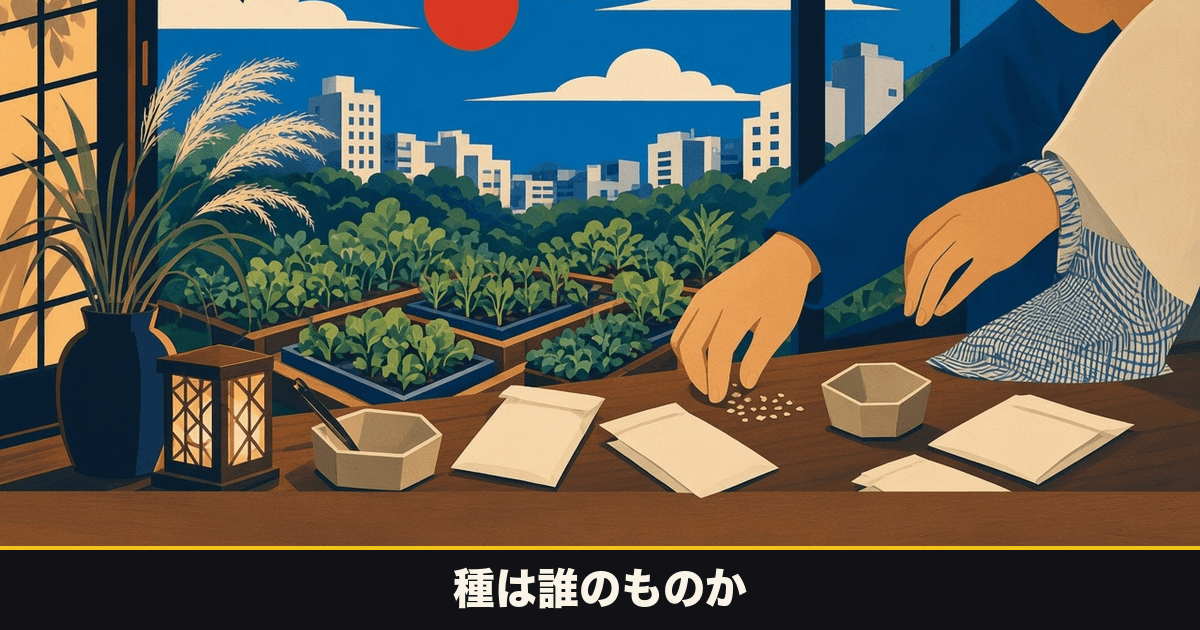
It is not one law that draws the line around a seed — breeder's rights, patents, contracts and custom
The four overlap on the same plant, and each of them bites in a different place
Saving seed was, for a very long time, simply part of farming. Yet almost no law writes it down as a right. Where seed saving survives inside the rules today, it survives as an exception — less protected than not yet cut away. So may you sow next year the seed in your hand? No single law decides. A breeder's right protects the variety itself; a patent holds a gene, a trait or a technique; a contract binds whoever receives the seed; and saving seed is a custom. The four overlap on the same plant, and each bites in a different place. The international footing for breeder's rights, the UPOV Convention, was adopted in Paris on 2 December 1961; as of 27 February 2025 it has 80 members. On the first of seven days, what this series hands over is not a conclusion but a ruler for telling the four lines apart.
Read → 15 min read
CASES IN THE FIELD
Start with one place.
Ginza Honey Bee Project
JPTokyo, Japan
A citizen project keeping bees on Ginza rooftops to make urban green networks visible. Linked to rooftop gardens and local food culture, it helped spark urban beekeeping across Japan.
gin-pachi.jp+3
Prinzessinnengärten
DEBerlin, Germany
A mobile community garden reviving a vacant lot in Berlin-Kreuzberg. Its DIY container growing and composting made it a flagship example of reusing idle urban land through citizen participation.
prinzessinnengarten.net+2
Incredible Edible Todmorden
GBTodmorden, United Kingdom
A citizen movement in a small UK town planting free-to-harvest crops in public gaps. Its 'edible town' concept has spread to communities worldwide.
incredible-edible-todmorden.co.uk
Ask AI
Ask before you start searching.
Put a question to the research and reports in this collection.
Ask about urban farming — answers are grounded only in our research papers. Try a question below.
PLACES TO LEARN FROM
Browse by country
Look across places to find ideas that travel.
- Japan179
- United States67
- United Kingdom29
- India17
- Canada14
- France13
- Netherlands13
- Germany11
- South Africa11
- South Korea10
715 cases across 129 countries and regions.
Weekly newsletter (free)
This week in urban farming — every Wednesday
A weekly digest of new cases, research, events and columns. Start free.