Does a farm next door make a house worth more? The fight over the evidence
A thousand feet, 9.4 percentage points, and the caveats nobody ever quotes
2026-08-13 · 23 min read
Series · Urban Farming and Real Estate2 / 7
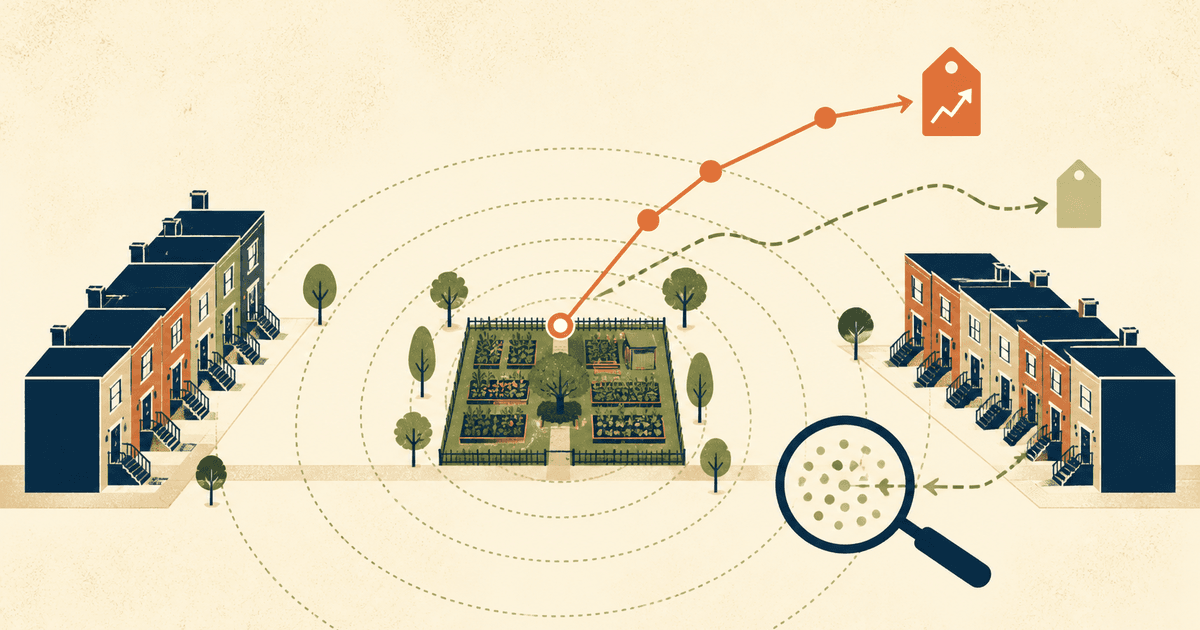
Yesterday's opening instalment, What is the land under that farm worth, showed that every urban farm sits on somebody's land, and that the land brings rent, tax and the permanent possibility of disposal along with it. Does the farm, then, move the price of the land it sits on? The sentence 'community gardens raise nearby property values' now turns up in grant applications and municipal plans alike. Trace it back and it usually leads to a single New York paper. This article rereads that paper, and the wider body of empirical work around it, from both the supporting and the sceptical side. What is being measured, and what is not? The figure of 9.4 percentage points — which neighbourhoods, which distance, over what period? And how badly does the plain fact that gardens tend to appear in particular kinds of places complicate the whole exercise? The short answer: the evidence exists. Just not in the shape in which most people quote it.
This article in 3 minutes
- The most-cited evidence is Voicu & Been (2008, Real Estate Economics 36:2, 241–283): using a difference-in-differences design on homes within 1,000 feet of community gardens opened in New York City between 1977 and 2000, it reports gains of up to 9.4 percentage points within five years of opening — in the poorest neighbourhoods.
- The same paper's other result is that the effect is not uniform: largest in the most disadvantaged neighbourhoods, largest for higher-quality gardens, and growing over time. Lifting the average and applying it to another city runs against the paper's own conclusion.
- Magnitudes shift by an order of magnitude between neighbourhoods. Anderson & West (2006, Regional Science and Urban Economics 36:6, 773–789) estimate for the Minneapolis–St. Paul area that proximity to open space is worth more in places that are dense, close to the central business district, higher-income, higher-crime, or home to many children.
- What gets capitalised may not be greenery but the guarantee of no development. Irwin (2002, Land Economics 78:4, 465) finds for central Maryland a premium of 0.6–1.9% for permanently preserved open space, and no equivalent premium for farmland and woodland that remains developable.
- The field's central weakness is endogeneity. Walsh (2007, Journal of Urban Economics 61:2, 319–344) applies a Hausman test and concludes that measures of privately held open space are endogenous, leaving their coefficients biased and inconsistent.
- The one large randomised trial measured safety, not prices. Branas et al. (2018, PNAS 115, 2946) randomised 541 vacant lots in Philadelphia across 110 clusters and report a 29% drop in gun violence and a 13.3% drop in overall crime in below-poverty neighbourhoods. The strongest causal design in this literature never looked at price.
Starting point
One paper became the evidence base for grant applications everywhere
'Community gardens raise nearby property values.' Follow that sentence carefully back to its source and it usually arrives at a 2008 paper by Ioan Voicu and Vicki Been of NYU's Furman Center, published in Real Estate Economics, volume 36, issue 2, pages 241–283. Looking at community gardens opened in New York City between 1977 and 2000, it tracks the sale prices of surrounding homes before and after opening, and reports a statistically significant increase within 1,000 feet — about 305 metres. Its strongest figure is the one for the poorest neighbourhoods: up to 9.4 percentage points five years after opening. That '9.4' has been quoted ever since, for the better part of two decades.
Things fall away in the quoting, though. First, distance: the effect was observed within 1,000 feet, not across a district or a school catchment. Second, place: the largest effect appeared in the most disadvantaged neighbourhoods; nowhere does the paper say the same number turns up anywhere else. Third, time: the effect does not arrive on opening day, it accumulates year by year. Fourth, quality: better-kept gardens showed larger effects. Drop any one of those four qualifiers and the number has quietly become a different claim.
Framing the question
Between 'prices rose' and 'the garden raised them' lies a measurement cliff
Observing that homes near a garden became more expensive, and claiming that the garden made them more expensive, are assertions of quite different strength. The first can be checked by anyone with a map and a register of sales. The second demands a comparison against a number that does not exist in this world: what the price would have been had the garden never opened. Most of the technical machinery of empirical work goes into manufacturing that non-existent number. Difference-in-differences recruits the price movements of comparable areas as a stand-in; instrumental variables hunt for something that shifts where a garden lands without touching prices directly. Neither is universal, and both collapse if their assumptions do.
This article takes on only the measurement question. The normative argument — greening arrives, rents rise, the original residents leave — belongs to the final instalment and to our earlier piece on green gentrification, and the details of Japan's productive green land sit with day five. What is handled here is the earlier and unavoidable question: can the effect be measured at all? What follows works through the most-cited study, how effects vary across neighbourhoods, what is actually being capitalised, the endogeneity problem, the single randomised trial in this field, and finally the limits of the literature itself.
Sources & further reading
- Voicu, I. & Been, V. (2008) The Effect of Community Gardens on Neighboring Property Values. Real Estate Economics 36(2): 241–283
- The Effect of Community Gardens on Neighboring Property Values(NYU Furman Center 掲載版 PDF)
- Anderson, S.T. & West, S.E. (2006) Open space, residential property values, and spatial context. Regional Science and Urban Economics 36(6): 773–789
- Irwin, E.G. (2002) The Effects of Open Space on Residential Property Values. Land Economics 78(4): 465
- Brander, L.M. & Koetse, M.J. (2011) The value of urban open space: meta-analyses of contingent valuation and hedonic pricing results. Journal of Environmental Management 92(10): 2763–2773
- Kovacs, K., West, G., Nowak, D.J. & Haight, R.G. (2022) Tree cover and property values in the United States: A national meta-analysis. Ecological Economics 197: 107424
- Walsh, R. (2007) Endogenous open space amenities in a locational equilibrium. Journal of Urban Economics 61(2): 319–344
- Branas, C.C. et al. (2018) Citywide cluster randomized trial to restore blighted vacant land and its effects on violence, crime, and fear. PNAS 115: 2946
- Moyer, R. et al. (2019) Effect of Remediating Blighted Vacant Land on Shootings: A Citywide Cluster Randomized Trial. American Journal of Public Health 109(1)
The method
Hedonic analysis prices an attribute — 'being near a garden' — not the garden
The standard instrument here is the hedonic price method. The sale price of a house is decomposed into a bundle of attributes — floor area, age, distance to a station, floor level — and regression estimates what each attribute sells for. Add 'metres from the garden' to the bundle and its coefficient becomes the implicit price of proximity. The crucial point is what that coefficient measures: not the value of the garden, but the price at which the attribute of being near it trades in that particular market. The same garden in a different market yields a different coefficient. Where buyers are unwilling to pay for the attribute, even an admirable garden drives the coefficient towards zero.
Units differ from study to study. The 2011 meta-analysis by Brander and Koetse (Journal of Environmental Management 92:10, 2763–2773) tries to make comparison possible by defining the dependent variable across hedonic studies as the percentage change in house price for a 10-metre decrease in distance to open space. Others measure area, or canopy share, or simple visibility. When the denominators differ, the effect sizes are not comparable. Carry a headline figure of 'up 20%' without checking what sat underneath it and you are describing an entirely different situation from the one you think you are.
The same meta-analysis also reports something counter-intuitive: the value of urban open space rises significantly with population density, but does not vary significantly with income. That scarcity in a crowded city shows up in prices is easy enough to accept. The second half — no significant variation with income — does not sit comfortably with either the Minneapolis study discussed in the next section or the New York one. That the studies disagree with each other is itself an accurate statement of where the field stands.
The central evidence
A thousand feet in New York — what was shown, and what was not
Look more closely at how Voicu and Been built their study. They assembled the community gardens opened in New York City between 1977 and 2000, drew distance bands around each one, and compared the prices of home sales inside those bands before and after opening. The comparison group is sales in the same period, in the same city, a little further away. Citywide swings in the economy or in interest rates hit both groups alike, so taking a difference cancels them — that is the logic of difference-in-differences. The result: a statistically significant positive effect within 1,000 feet, growing larger as the years pass.
But the paper also showed that the effect is not uniform. The largest effects appeared in the most disadvantaged neighbourhoods, and 9.4 percentage points is the five-year estimate there. Higher-quality gardens, the paper further reports, produced the larger effects. Put those together and the claim narrows considerably from 'gardens raise property values' to something far more conditional: where vacant, blighted land is common and prices sit at the bottom of the market, a garden that is genuinely maintained, over a period of several years, is associated with a relative rise in the price of homes very close to it. Almost every citation drops that long subordinate clause.
Seen from practice, that conditional clause is arguably good news: if the effect is largest where the neighbourhood is poorest, that is a legitimate reason for public intervention. It is not, however, a basis for expecting the same figure in a Japanese suburb or in a central district where land is already expensive. The vacant lots of 1980s and 1990s New York were a vast inventory of land left by arson and foreclosure; the baseline being compared against is simply not the Japanese urban baseline. If you import the number, you have to import the conditions with it, or the number means nothing.
Heterogeneity
Carry the average to another city and you will be out by an order of magnitude
The study that confronts this variation head-on is Anderson and West (2006, Regional Science and Urban Economics 36:6, 773–789). Using home sales across the Minneapolis–St. Paul metropolitan area, they estimate how the effect of proximity to open space shifts with the characteristics of the surrounding neighbourhood. Their conclusion is blunt: proximity is worth more where density is higher, where the centre is closer, where incomes are higher, where crime is higher, and where there are more children. And the implication they draw matters more than the coefficients — applying a metropolitan average to a particular neighbourhood can substantially overstate or understate the value of open space there.
The same non-linearity shows up in the quantity of greenery itself. The 2022 meta-analysis by Kovacs and colleagues (Ecological Economics 197, 107424) pools 21 US hedonic studies and 157 observations to estimate the elasticity of house value with respect to a one per cent change in tree cover. In neighbourhoods with more than 25% canopy the elasticity is 0.013 — roughly four times the 0.003 found where canopy runs between 0 and 10%. That inverts the naive expectation that scarce green should be dear: additional trees pay best where trees are already plentiful. The same analysis reports that canopy off the property outweighs canopy on it. Greenery someone else has to maintain is valued more highly.
Transpose those two findings into urban farming and an uncomfortable implication appears. If proximity effects depend heavily on local conditions, and if greenery one does not have to maintain is valued more highly, then what registers in price may be the view rather than the shared work and relationships a farm generates. The hedonic method certainly cannot separate the two. What market prices pick up is the scene a buyer saw through the window during a viewing. Who is doing what on the plot never enters the regression.
What gets capitalised
What carried the premium was not the greenery but the promise of no development
One of the most suggestive studies for urban farming is Irwin's 2002 analysis (Land Economics 78:4, 465). Examining home sales in suburban and exurban central Maryland, it estimates a premium of 0.6% to 1.9% for houses near permanently preserved open space. So far, so consistent with the rest of the literature. What matters is what comes next: in the same region, land that remained developable — farmland, woodland — carried no equivalent premium.
From this Irwin reads a hypothesis: open space is valued less as a particular bundle of amenities than as an assurance that development will not arrive. It is not the greenery that carries the price but the credibility that the greenery will persist. If that reading holds, the effect of an urban farm on land value is decided less by what happens on the farm than by the legal form under which it is held. A farm on a five-year lease, with no guarantee of renewal and an owner free to sell at any time, is something a market has good reason to treat as different from permanent open space.
This has direct bearing for practitioners in Japan, where allotments and corporate CSR farms alike usually begin as interim uses. Before explaining that a farm will lift nearby asset values, ask whether you can explain how securely the farm will continue. Irwin's result suggests that what neighbours are willing to pay for is not that a field exists but that it will go on existing. District plans, green-space covenants, land trusts, outright purchase — the instruments taken up in the closing instalment are continuous with this empirical finding.
The hard part
Gardens appear in promising places — and that one sentence breaks the estimates
The central weakness of this literature is endogeneity. Gardens do not land where they land by the roll of a die. They arise more readily where residents are organised, where a city has begun investing, where redevelopment has come into view. If so, a rise in prices around a garden may be caused by the garden — or by whatever brought the garden. Regression alone cannot tell them apart. The reverse also happens: if gardens appear precisely where prices have been falling and vacancy rising, the estimate is biased downward instead. Which way it tips cannot be known in advance, and that is what makes it hard.
The problem has been recognised inside the field for a long time. Walsh (2007, Journal of Urban Economics 61:2, 319–344) treats open space explicitly as something that emerges endogenously from land-market outcomes, and applies a Hausman test to conclude that measures of privately held open space and privately owned conservation land are endogenous, their coefficients biased and inconsistent. Read the open-space coefficient off a naive hedonic regression, in other words, and you are reading the value of proximity plus the value of whatever proximity is correlated with. Irwin's use of instrumental variables answers the same worry.
Difference-in-differences solves this only partly. Comparing before and after opening removes anything about the neighbourhood that stays fixed. What remains is the possibility that neighbourhoods where gardens appear were already on a different price trajectory from those where they did not. Break that parallel-trends assumption and the estimate captures a pre-existing trend rather than the effect of the garden. Voicu and Been are careful precisely because they build their comparison group with this in mind — but the assumption is still one that cannot be tested directly.
The one randomisation
One city put 541 lots into a lottery — and then measured something other than price
There is only one way to cut endogeneity off at the root: decide where to intervene by lottery. Philadelphia did exactly that. Branas and colleagues (2018, PNAS 115, 2946) took 541 vacant lots across the city, grouped them into 110 geographically contiguous clusters, and randomly assigned them to a greening arm — debris removal, grading, hydroseeded grass and continuing maintenance — a mowing-and-cleanup arm, and a no-intervention control. Assignment took place in 2013 and follow-up ran to March 2015. Crime data came from police records, 445 residents living near the lots were interviewed repeatedly, and the 18 months before and after completion were compared.
The results were strong. In below-poverty neighbourhoods, gun violence fell by 29% and total crime by 13.3%. A related analysis is finer still, reporting a 6.8% reduction in shootings for the greening arm (95% CI −10.6% to −2.7%) and 9.2% for mowing and cleanup (−13.2% to −4.8%), with interval estimates attached. As a causal design this stands well clear of anything else in the field. That intervening on urban vacant land does something is, on this evidence, reasonably well established.
It needs reading carefully, though. What the trial measured was violence, crime and fear of going outside — not land value. The strongest available design was pointed at safety rather than at price. So the honest summary of where we stand is asymmetric: that intervening on vacant land improves safety has been shown under randomisation; that it raises prices has been shown only in observational work that cannot fully purge endogeneity. Borrowing the authority of the randomised trial to shore up the price claim is a substitution of evidence, not a use of it.
Limits of the literature
The gardens that did nothing rarely become papers
The first limit is publication bias. Statistically significant results get written up, published and cited; analyses that failed to detect an effect often stay in a drawer. Recent meta-analyses try to correct for it — the Kovacs canopy meta-analysis cited above explicitly controls for publication bias alongside housing-market and canopy heterogeneity and the methods of the primary studies. Which is to say the field concedes that, uncorrected, the pooled estimate may run high. The summary 'most studies report a positive effect' has to be read net of the fact that positive effects are the ones more likely to be reported.
Second, the definition of the effect is not standardised. A percentage change per 10 metres of distance; an elasticity per one per cent of canopy; a percentage-point difference five years after opening — different units, periods and reference points get rounded, at the summarising stage, into the same phrase: 'raises values by X%'. Third, the object is not standardised either. Community gardens, allotments, urban parks, conservation land and street trees differ in area, management and use, yet reviews routinely bundle them as 'urban green space'. Citing a meta-analysis of parks when the question is about urban farms may not even qualify as an approximation.
Fourth, house prices are an imperfect proxy for social benefit in the first place. Price registers the willingness to pay of those who can buy in that market, and nothing else. The benefit accruing to renters, and the loss borne by those who left, appear nowhere in the coefficient. To read a larger increase as a better policy is itself a value judgement. Fifth, there is external validity. The studies cited here are New York, Minneapolis, Maryland, Philadelphia and a pooled set of US canopy studies. Land-use regulation, taxation and market structure all differ in Japan, and there is no warrant for carrying the coefficients across. What the Japanese context needs is not an imported number but domestic work of the same design.
In practice
Getting the proposal approved without promising that land values will rise
Proposing a farm to a municipality or a landowner, the sentence 'this will raise property values' is a strong temptation. As we have seen, it only holds once four qualifiers have been stripped away. There are things you can write instead. First, cite with the conditions attached: 'a New York study estimated a relative increase of up to 9.4 percentage points five years after opening, within 1,000 feet of continuously maintained gardens, in low-income neighbourhoods with substantial vacant land.' It is a longer sentence, and safer than being contradicted later and losing the room.
Second, fight on ground other than price. What the Philadelphia trial demonstrated was improvement in safety and in fear of going outside, obtained under a far stronger design than any price estimate. For a landowner's own bottom line, maintenance costs, complaint counts and the vacancy rate nearby are all easier to verify than an estimated land-value effect. Third, turn Irwin's suggestion around: if what the market prices is the credibility of continuation, then the unglamorous work — extending the term, writing renewal into the lease, embedding the plot in a district plan — is precisely the work that creates whatever price effect there is to create.
Finally, get on the measuring side. There is very little published Japanese work estimating the proximity effect of urban farms with a difference-in-differences design. Simply matching published land-price and transaction data against the opening dates of municipal allotments would already support a descriptive comparison. Producing one number about your own city contributes more to this field than redistributing an imported coefficient. Before the argument about price, though, there is something prior to establish: how did that land become building land in the first place? Tomorrow's third instalment follows how Japanese cities converted farmland into housing — and how some of it is now going back the other way.
Key takeaways
- The much-quoted 9.4 percentage points is an estimate conditional on four things at once: within 1,000 feet, in the poorest neighbourhoods, five years after opening, for higher-quality gardens. Quoted without them, it has become a different claim.
- Effect sizes vary by an order of magnitude between neighbourhoods; Anderson and West themselves warn that applying a metropolitan average to a specific place can substantially over- or understate the value.
- What is capitalised may be the assurance of no development rather than the greenery. On Irwin's result, an interim-use farm and permanently preserved open space are different objects to a market — the lease term and the tenure may matter more than what happens on the plot.
- The strongest causal evidence in this area — the randomised trial across 541 Philadelphia lots — measured crime and fear, not price. The authority of that randomisation cannot be transferred to claims about prices.
- What belongs in a proposal is not 'land values will rise' but a citation with its conditions intact, verifiable indicators other than price, and contract design that raises the credibility of continuation.
This column is free to read
As new columns publish, older ones move into the members' archive. Join the free newsletter to get every new column and the week's urban-farming news by email.
Reader feedback
Was this article useful?
No sign-in required. One vote per article on this device; you can change your choice.
Related columns
Disaster and urban farming ① — Reading a farm as emergency open space
From food production to evacuation, firebreaks and neighbourhood hubs
15 min readWhat is a rooftop farm good for? — between 633 hectares and 1,284
Twenty-four years have put about 633 hectares of greenery onto Japan's roofs. On the ground, allotment gardens hold twice that, in 188,000 plots. If there is still a reason to climb, it is not the harvest
26 min readWho pays for the roof — mandates, subsidies, and repeal
From two hundred Canadian dollars a square metre in lieu to forty-six euro cents a year off a sewage bill — what put greenery on roofs was always somebody's purse
25 min readThe rooftops nobody counts — what Japan's green-roof statistics do not measure
The cumulative 633 hectares is not a stock. Reading where Japan's rooftops stand, through the design of its two numbers
23 min read