It is not one law that draws the line around a seed — breeder's rights, patents, contracts and custom
The four overlap on the same plant, and each of them bites in a different place
2026-09-16 · 15 min read
Series · Who owns a seed — ownership drawn by registration, patents and landraces1 / 7
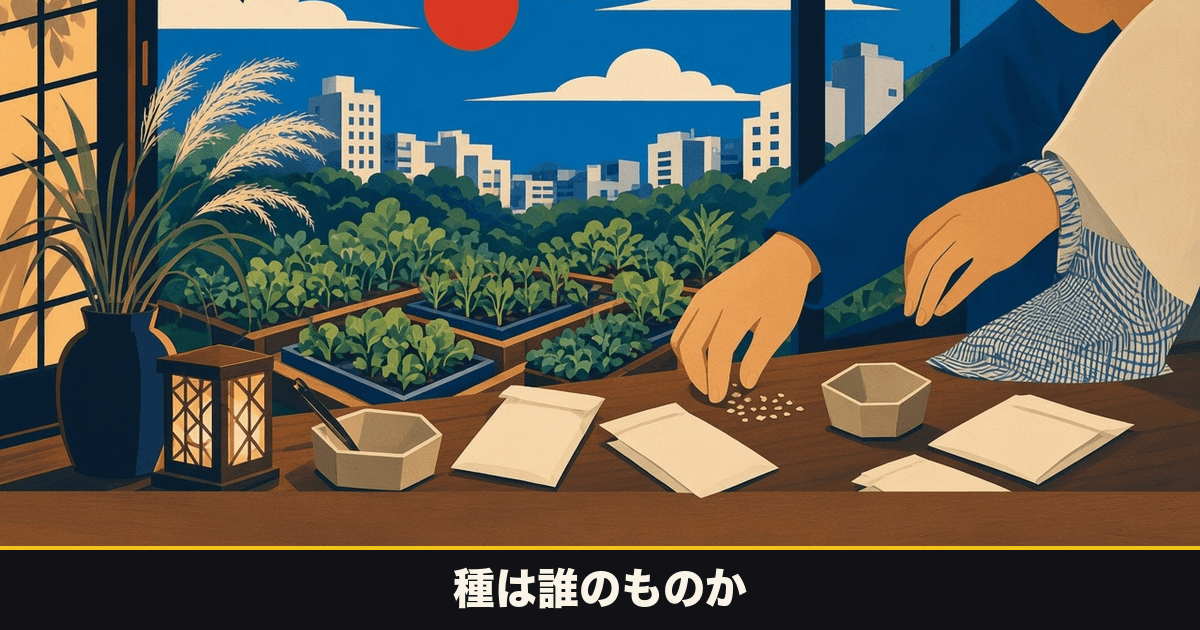
Saving seed was, for a very long time, simply part of farming. Yet almost no law writes it down as a right. Where seed saving survives inside the rules today, it survives as an exception — less protected than not yet cut away. So may you sow next year the seed in your hand? No single law decides. A breeder's right protects the variety itself; a patent holds a gene, a trait or a technique; a contract binds whoever receives the seed; and saving seed is a custom. The four overlap on the same plant, and each bites in a different place. The international footing for breeder's rights, the UPOV Convention, was adopted in Paris on 2 December 1961; as of 27 February 2025 it has 80 members. On the first of seven days, what this series hands over is not a conclusion but a ruler for telling the four lines apart.
This article in 3 minutes
- Four separate mechanisms, not one law, draw lines around a seed — the breeder's right, the patent, the contract and custom — and each bites in a different place. The UPOV Convention was adopted in 1961 and had 80 members as of 27 February 2025.
- A breeder's right reaches only registered varieties. Figures from Japan's agriculture ministry put the share of registered varieties at 17 per cent for rice, 13 for grapes, 10 for potatoes, 9 for vegetables, 5 for apples and 3 for mandarins.
- A patent holds a gene, a trait or a technique rather than a variety. The US plant patent, created by a 1930 statute, is confined to asexually reproduced varieties; a utility patent reaches the seed itself, as with the lettuce variety 79-40 RZ.
- A contract works from outside the statute book. The Standard Material Transfer Agreement under the International Treaty on Plant Genetic Resources for Food and Agriculture was used more than 84,000 times between 2007 and mid-2021.
- Saving seed is not written down as a right. The 1991 Act of the UPOV Convention treats farm-saved seed as an optional exception, and each member decides whether to put it into national law at all.
- The value lies in keeping the four apart. Roll the UPOV Convention, the patent and the contract into one and the question 'is a seed free?' will always produce answers that contradict each other.
Opening
No single law decides whether you may sow the seed you saved
Grow a tomato in a home plot, take seed from the fruit, sow it again next year. Does that long-ordinary act touch anyone's rights? It depends on the variety. Under Japan's Plant Variety Protection and Seed Act, a breeder's right attaches only to a variety that has been through registration — a 'registered variety'. A variety that was never registered, one whose registration term has run out, a landrace: all are called 'general varieties', and all sit outside the right. So how many registered varieties are there? Material the agriculture ministry handed out at its briefings on the amended Act gives the share as 17 per cent for rice, 13 for grapes, 10 for potatoes, 9 for vegetables, 5 for apples and 3 for mandarins. Most of the seed in your hands is a general variety. But the shares are built differently crop by crop: the rice figure comes from planted area, the vegetable figure from the number of varieties listed in a trade catalogue.
Nor does checking the register finish the job. Quite apart from variety registration, a gene, a trait or a growing method may be under patent. A contract signed when you buy or are given seed can restrict what you do with it, owing nothing to any statute. And the long custom of saving seed is written into none of them as a right. Breeder's right, patent, contract, custom: all four can sit on the same plant at once, yet they differ in what they cover, what they rest on and how long they last. Blur them together and all that is left is a blunt question — is a seed free or not? Whichever way you answer, you are only half right.
Over seven days the series opens the four lines one at a time. Tomorrow looks at why the seed of an F1 hybrid scatters in the second generation — a story in which what encloses the seed is not law but biology. Day three traces, historically, how a system for granting rights over varieties was assembled. Day four goes to the places where seed nobody owns is being kept alive, and asks who is doing the keeping. Day five checks how far Japan's seed statute actually reaches into a home plot. Day six asks which crops breeding money gathers around, and what is lost when publicly funded breeding thins out. Day seven closes on whether saving seed is a right or an infringement, by way of a library that lends out seed. What you should carry away today is not a conclusion. It is a ruler: the habit of asking which of the four lines a given claim belongs to.
Four lines
The four lines differ in what they cover, what they rest on and how long they last
The first line, the breeder's right, protects the variety itself. Is it clearly distinguishable from what already exists? Is it uniform? Is it stable? Examination settles those questions, the variety is registered, and the breeder gains the exclusive right to exploit it commercially. The second line, the patent, does not hold a variety at all. It holds technique — a gene, a trait, a method of breeding or of growing. The one exception is the US plant patent: under the Plant Patent Act of 1930 it covers the variety itself, provided it is reproduced asexually, by grafting or from cuttings. The same word, 'patent', can be holding entirely different things.
The third line, the contract, works from outside the statute book. Conditions are attached when the seed changes hands, and whoever receives it is bound by them. No state enacted it, so the same wording carries across borders unchanged. The fourth line, custom, stands somewhere else entirely. Sowing next year the seed you saved this year was, for a very long time, simply part of farming. It has almost never been written into law as a right; what it has now is the status of an exception. It would be more accurate to call it the part that has not yet been cut away than to call it protected. Lay the four side by side and the argument about seed splits in two: an argument about rights, and an argument about exceptions.
Sources & further reading
- UPOV — Members of the International Union for the Protection of New Varieties of Plants (status on February 27, 2025)
- UPOV — Explanatory Notes on Exceptions to the Breeder's Right under the 1991 Act of the UPOV Convention (UPOV/EXN/EXC/1, October 22, 2009)
- FAO / FAOLEX — International Treaty on Plant Genetic Resources for Food and Agriculture (treaty text, Article 9 Farmers' Rights)
- FAO Plant Treaty — The Standard Material Transfer Agreement (SMTA)
- USPTO — Plant patent (Plant Patent Act of 1930; 35 U.S.C. 161)
- US Patent 9,770,005 B2 — Lettuce variety 79-40 RZ (Rijk Zwaan, granted September 26, 2017)
- 農林水産省 — 改正種苗法説明会資料(第一部)法改正の概要と留意点(令和3年11月)
- 農林水産省 — 種苗法の一部を改正する法律案の概要(育成者権の存続期間の延長ほか)
- e-Gov 法令検索 — 種苗法(平成十年法律第八十三号)第19条・第20条・第21条
- Open Source Seed Initiative — About OSSI and the OSSI Pledge
Line 1 — the breeder's right
The breeder's right protects the variety itself, and it reaches only varieties that have been registered
The instrument that lines up national systems for granting rights over varieties is the UPOV Convention. It was adopted in Paris on 2 December 1961 and revised at Geneva on 10 November 1972, 23 October 1978 and 19 March 1991. UPOV's own membership table, in the version dated 27 February 2025, lists 80 members. Japan joined on 3 September 1982 and became party to the 1991 Act on 24 December 1998; the United States joined on 8 November 1981 and moved to the 1991 Act on 22 February 1999. Read 80 as a count of countries, though, and you will get it wrong. Members include organisations as well as states: the African Intellectual Property Organization runs one system covering the territory of its 17 member states, and the European Union one covering its 27. The 80 counts systems. The number of countries the Convention reaches is larger.
What the right confers is a monopoly on commercially propagating or selling the propagating material of a registered variety. Its term has a floor. According to the agriculture ministry's summary of the 2026 amendment bill, the UPOV Convention requires at least 20 years, and the longest term among members stood at 30 years, or 35 for perennial plants. That amendment added ten years to Japan's term: the current Act sets 35 years, or 40 for perennials such as fruit trees. Among the ministry's stated reasons were that breeding several traits into a single variety — heat tolerance together with high yield, say — has become harder, and that building a producing region around a good variety takes a long time. The line is not fixed. It is still being redrawn.
And the right does not sit on every variety. It comes into being at registration, so varieties that were never registered, varieties whose term has expired and landraces all stay outside the system as general varieties. Japan amended the Act in December 2020, and the provision requiring the holder's authorisation to propagate a registered variety took effect on 1 April 2022. How far that reaches into a home plot is the business of day five. What matters here is the order of the questions. First: is this a registered variety? Second: is the use commercial? Skip those two steps, read it as 'saving seed has been banned', and you will badly misjudge how wide the rule actually is.
Line 2 — patents
What a patent holds is not the variety but the gene, the trait or the technique
Treat a patent and a breeder's right as the same thing and the argument stops making sense. The US Patent and Trademark Office explains that the plant patent rests on the Plant Patent Act of 1930. What qualifies is a distinct and new variety that has been asexually reproduced — fruit trees and roses propagated by grafting or from cuttings belong here. Tuber-propagated plants such as the potato, and plants found in an uncultivated state, are excluded. There is a single claim, and it covers the whole plant. The term runs 20 years from the filing date. Japan has no category called a plant patent at all; this shape is peculiar to the United States. Hearing that 'a plant is under patent', then, tells you neither which country nor which system is meant.
The other route is the utility patent. It carries no requirement of asexual reproduction, so it reaches crops grown from seed. Consider a US patent titled 'Lettuce variety 79-40 RZ'. It was filed on 16 September 2015 and granted on 26 September 2017; the assignee is the Dutch seed company Rijk Zwaan. The specification is written to cover not only the seed and the plant but parts of the plant including pollen, ovules and cells, and the seed was deposited with NCIMB under the Budapest Treaty on 22 August 2014. A breeder's right takes one variety as its object. A utility patent that holds a gene or a trait can reach across many. Two lines with different reach are being drawn on the same plant at the same time.
The difference between the two lines shows most clearly when someone sets out to breed the next variety. The 1991 Act of the UPOV Convention lists three acts the breeder's right does not extend to, and the third is acts done for the purpose of breeding other varieties. Japan's seed statute likewise places outside the right 'the use of a variety for breeding a new variety or for other experimental or research purposes'. The road from a registered variety to the next variety is deliberately left open in the text. A patent, though, belongs to a different statute, and its exceptions are set separately. So neither 'it is registered, therefore research is barred' nor 'it is patented, therefore breeding is allowed' holds up. Which line applies has to be established first.
Line 3 — contracts
A contract works from outside the law, and binds whoever receives the seed to its terms
The third line is not a law at all. It is the contract signed when seed changes hands. The largest such system is the Standard Material Transfer Agreement, the SMTA, used under the International Treaty on Plant Genetic Resources for Food and Agriculture. That treaty, adopted in 2001, put the genetic resources of the crops listed in its Annex I into a multilateral system so that they could be used for research, breeding and training. Every transfer carries the same contract text. The Food and Agriculture Organization explains that the agreement exists to prevent misuse of the material and to ensure that any commercial benefits arising are shared fairly and equitably. More than 84,000 SMTAs were used between 2007 and mid-2021. Because it is a contract and not a statute, the same terms carry across borders intact.
A contract is not only a tool for tying people down; the same machinery has been turned the other way. The pledge used by the Open Source Seed Initiative reads: 'You have the freedom to use these OSSI-Pledged seeds in any way you choose. In return, you pledge not to restrict others' use of these seeds or their derivatives by patents or other means, and to include this Pledge with any transfer of these seeds or their derivatives.' It hands over the freedom to use and, in exchange, passes an obligation not to close things down on to the next person. Kloppenburg's 2014 paper, held in this site's database, examines both the legal method of the attempt and its limits. It is enclosure being met with enclosure's own tools.
What separates a contract from a breeder's right or a patent is how it ends and whom it binds. Rights and patents have terms fixed in the text; a contract as such has no comparable uniform expiry. A patent or a breeder's right binds everyone who touches the variety or the technique, whereas a contract binds only the party who signed it and whoever took the terms on. So a contract can keep conditions running after the right itself has lapsed — and it never reaches anyone who never signed. That asymmetry is not unique to seed. With seed, though, it bites hard, because seed multiplies itself. A contract is an attempt to follow the multiplied seed: where it went, and into whose hands.
Line 4 — custom
Saving seed is not written down as a right; it survives only as an exception
The fourth line is custom. The text of the law almost never uses the word 'right' for sowing next year the seed you saved. What it offers instead is an exception. The 1991 Act of the UPOV Convention lists three exceptions every member must provide, and the first is acts done privately and for non-commercial purposes. According to the explanatory note UPOV issued on 22 October 2009, propagation of a variety by an amateur gardener for exclusive use in his own garden may fall inside it — on condition that no material of the variety is provided to others. Turn that round: hand some to a neighbour and you are outside the example's condition. The same note says that propagation by a farmer solely to produce a food crop eaten entirely by that farmer and the dependants living on the holding may also fall within the exception.
Sowing on your own holding the seed you harvested there was put in a separate box, under the heading 'Optional exception'. Quoting the wording 'each Contracting Party may', the same explanatory note states that it is for each member to decide whether to bring that exception into national law. Farm-saved seed, in other words, sits not among what is permitted but among what may be permitted. The other treaty takes the same stance. The International Treaty on Plant Genetic Resources for Food and Agriculture, adopted in 2001, has an article on Farmers' Rights, and it reads: 'Nothing in this Article shall be interpreted to limit any rights that farmers have to save, use, exchange and sell farm-saved seed/propagating material, subject to national law and as appropriate.' That is not a provision that creates a right. It is a promise not to reduce one that already exists.
So where does Japan draw this line? The seed statute says the holder has 'the exclusive right to exploit the registered variety as a business'. That phrase — as a business — is doing real work. A home plot producing only what goes on your own table sits outside it. Selling the seedlings you raised, or selling the harvest on a continuing basis, moves towards commercial exploitation. The text puts no number on where a business begins, so the boundary is decided case by case. Day five follows this line in detail through the Japanese system. What to carry away here is the procedure alone: check whether the variety is registered, and check whether the use is commercial, as two separate questions.
How they overlap, and where we are
The four lines land on the same plant, so work out which one applies, in order
Why take the four apart? Because in practice they overlap. A single variety can carry a breeder's right and a utility patent at once. A contract can come attached when you buy the seed. And growing only what you will eat in your own garden falls under the exception for private, non-commercial acts. With all four in play, asking whether this seed is free gets you nowhere. Working through them in order gets you there faster. Is the variety registered? Is the use commercial? Does a separate right sit on a gene or a trait? And were any conditions attached when the seed reached you? Those four steps can be walked without a lawyer.
The lines are also moving. In Japan the December 2020 amendment made propagating a registered variety subject to the holder's authorisation, a provision in force since April 2022. The 2026 amendment then extended the term of a breeder's right from 25 years to 35, and for perennial plants from 30 to 40. The ministry's reasons for the extension also included that climate change has made breeding varieties with traits such as heat tolerance urgent, and that the number of new varieties bred and registered in Japan has been trending down. The line is moving in the direction of strengthening the protected side. That is where we stand. How far the shift reaches a home plot or an allotment cannot be seen without first separating which of the four lines is in question.
'About one in ten varieties is registered' points in the right direction. As evidence, it is far too coarse. Look again at the ministry's material. The 17 per cent for rice is a share of planted area; the 9 per cent for vegetables is a share of the varieties listed in a trade catalogue. Count by area or count by number of varieties, and the same word 'share' carries two different meanings. The reference dates do not line up either: the 5 per cent for apples and the 3 per cent for mandarins were built from 2017 planted area. Cut loose from where it came from, a number travels on its own. If you use one, carry with it what was counted, and how.
Recap
What today hands over is not an answer but a ruler for telling the four lines apart
It started with a question from the plot: may I sow next year the seed I saved? What separated one answer from another turned out to be not a single law but four mechanisms, each biting in a different place. The first, the breeder's right, takes the variety itself as its object; its international footing, the UPOV Convention, was adopted in Paris on 2 December 1961, revised in 1972, 1978 and 1991, and had 80 members as of 27 February 2025. The second, the patent, holds a gene, a trait or a technique — the US plant patent alone, under the 1930 statute, taking asexually reproduced plants themselves. The third, the contract, works from outside the law, and the SMTA was used more than 84,000 times between 2007 and mid-2021. The fourth, custom, survives not as a right but as an exception.
First, a breeder's right reaches only registered varieties. The ministry's figures put the registered share at 17 per cent for rice, 13 for grapes, 10 for potatoes, 9 for vegetables, 5 for apples and 3 for mandarins, so most of what is in your hands is a general variety. Second, a patent and a breeder's right are different things. The lettuce variety 79-40 RZ is covered by a US utility patent whose specification extends to seed and to parts of the plant — a different reach from the 1930 plant patent, confined to asexual reproduction. Third, saving seed is not written down as a right. Under the 1991 Act of the UPOV Convention farm-saved seed is only an optional exception each member decides whether to adopt, and the Plant Treaty's article on Farmers' Rights is likewise phrased as a promise not to reduce those rights rather than as a grant of them.
Some lines remain undrawn. One is where 'as a business' begins in Japan. That the phrase sits in the seed statute can be confirmed in the text, but the text puts no number on the threshold, and this article has not drawn that line either. Another is how the registered share is counted: the 17 per cent for rice comes from planted area and the 9 per cent for vegetables from a count of catalogued varieties, and the reference dates differ by crop, so the same word 'share' covers different things. The third is the obvious objection. This article drew its four lines from the side of the institutions — and tidying the field into four systems is itself a way of pushing aside the seed exchanges that never enter any system, the swap over a garden fence and the seed a locality has kept going. Days four and seven look back from that side.
Today's place in the series is the map. Each of the six days that follow enlarges one point on it. Day two reads from the mechanics of the F1 hybrid why its seed scatters in the second generation — an enclosure made by biology, not law. Day three traces, from the Plant Patent Act of 1930, how rights over varieties were built. Day four goes to the places where people keep alive landraces that belong to nobody. Day five asks how far Japan's seed statute reaches into a home plot, and takes up in detail the April 2022 provision touched on today. Day six asks which crops breeding money gathers around, and what disappears as public breeding thins out. Day seven takes the case of a library that lent out seed to ask whether saving seed is a right or an infringement. Now suppose there is a paper packet at the back of a drawer: seed you saved last year. Is that variety registered? Will you sow it in your own garden, or in a field whose harvest you sell? Were you going to give some to a neighbour? When the packet reached you, did you agree to anything? Sowing saved seed was ordinary for a very long time; now it rests on those four questions. Can you say which of the four lines runs through that one packet?
Key takeaways
- Four mechanisms draw lines around a seed. The breeder's right, the patent, the contract and custom differ in what they cover, what they rest on and how long they last, and all four can sit on the same plant at once.
- A breeder's right reaches only registered varieties. Agriculture ministry material puts the registered share at 17 per cent for rice, 13 for grapes, 9 for vegetables and 3 for mandarins.
- The UPOV Convention was adopted in Paris on 2 December 1961 and revised in 1972, 1978 and 1991. As of 27 February 2025 it has 80 members.
- A patent holds a gene or a trait rather than a variety. The lettuce variety 79-40 RZ is covered by a US utility patent whose specification extends to seed and to parts of the plant.
- A contract works from outside the law. The SMTA was used more than 84,000 times between 2007 and mid-2021, while the OSSI pledge runs the other way, passing on an obligation not to restrict others' use.
- Saving seed survives as an exception, not a right. Under the 1991 UPOV Act farm-saved seed is only an optional exception, and Japan's seed statute grants exclusivity only over use as a business.
Don't miss the rest of the series
Columns publish one each morning, seven to a series. The free weekly email wraps up the series that just ended and introduces the one that's starting — every Wednesday.
Reader feedback
Was this article useful?
No sign-in required. One vote per article on this device; you can change your choice.
Related columns
Developers do not build farms for the vegetables
From Agritopia to Porte de Versailles — line them up under the same question and you can see what is actually being recovered
22 min readDisaster and urban farming ① — Reading a farm as emergency open space
From food production to evacuation, firebreaks and neighbourhood hubs
15 min readHeirloom, landrace and traditional vegetables: the science and the societies
What it means to pass on a seed — from the science of genetic diversity to the systems that safeguard heirloom vegetables in Japan and worldwide
26 min readFood education and school gardens
Why do children eat the vegetables they grow themselves? The science of taste and learning, and the world's school gardens
20 min read