A Munich foundation that links 1,000 gardens — anstiftung and the network of self-making
Who keeps the gardens that no law protects?
2026-09-07 · 18 min read
Series · How Germany became a country of gardens — 150 years of law, associations and foundations6 / 7
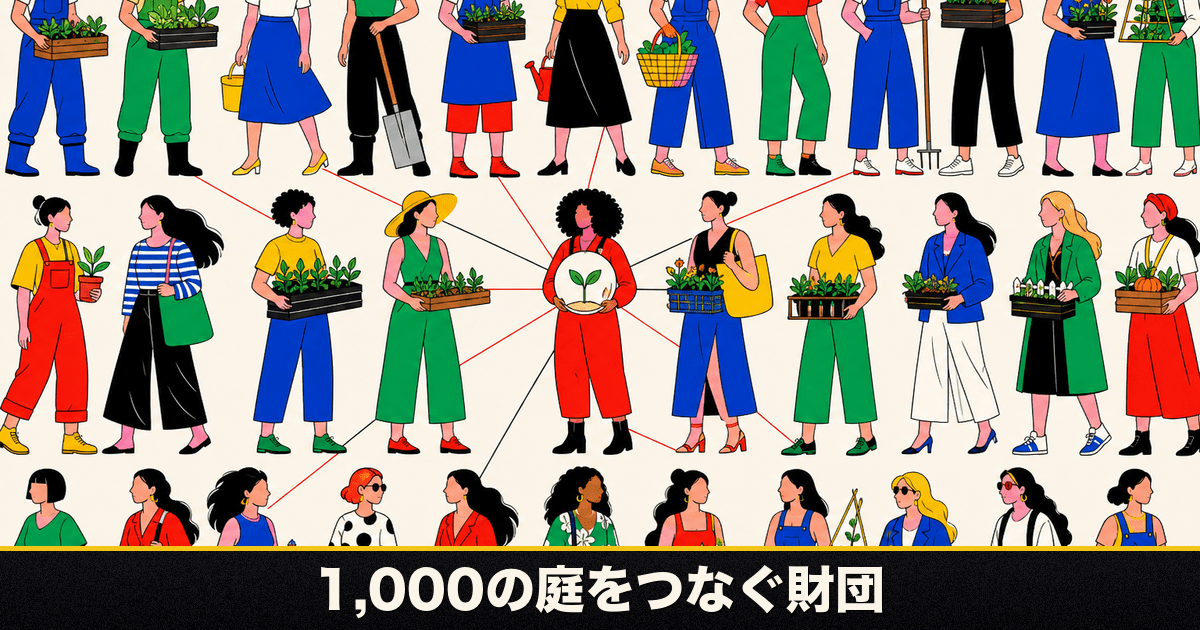
The first five days of this series looked at how law keeps gardens in the city. But the Federal Allotment Gardens Act of 1983 protects allotments and nothing else. The community gardens on vacant lots, in the gaps between housing blocks, on the grounds of disused cemeteries, all sit outside it. So who holds those up? There is a foundation in Munich. anstiftung began as a research body set up in 1982 by Jens Mittelsten Scheid, born into the family that ran Vorwerk, the Wuppertal firm known for vacuum cleaners and kitchen machines; since 2017 it has operated as a charitable foundation, linking a nationwide network of 1,000 community gardens, more than 400 intercultural gardens as of 2025, and over 1,800 repair initiatives. Its grant applications take no set form, must not exceed three pages and must contain no photographs. It buys no land and pays neither rent nor salaries. The gardens keep multiplying anyway. This instalment examines that second mechanism — the one that works outside the law — through its origins, its money, its programmes and its ideas.
This article in 3 minutes
- anstiftung is a charitable foundation in Munich. Erich and Charlotte Mittelsten Scheid, of the family that ran Vorwerk, founded ertomis in 1973; their son Jens founded anstiftung in 1982; the two merged in 2008 and re-emerged as an independent foundation in 2017.
- A thousand community gardens are registered in the foundation's national network, and more than 400 intercultural gardens existed as of 2025. The prototype was the garden migrant families started in Göttingen in 1996; the foundation has driven its replication since launching Stiftung Interkultur in 2003.
- The design of the grant is itself an argument. Applications take no set form, run to three pages at most, and carry no photographs. Tools, plants and seed and materials for self-built infrastructure are funded; rent, salaries, land purchase, contracted-out construction and ready-made raised beds are not.
- It is not only a garden foundation. Of the roughly 2,000 repair initiatives founded in Germany by 2024, more than 1,800 belong to the network anstiftung started in 2014. Gardens, repair and open workshops are bound together under one idea: Selbermachen, making it yourself.
- The land stays precarious. Berlin's Prinzessinnengärten has rented its site from the city on a yearly basis since 2009, and in 2019 moved its base to a disused cemetery in Neukölln. This is a model in which a network, not a statute, keeps a garden going.
- This article's position is not that the foundation model beats the 1983 act. The two protect different things: the law protects plots, the foundation protects the knowledge of how to start one. What marks Germany out is that both layers are present at once.
Opening
The 1983 act protects allotments and nothing else
The Federal Allotment Gardens Act examined yesterday bundles into a single statute a cap on plot size, a limit on shed dimensions, a ceiling on rent and restrictions on termination. That is strong protection — but it reaches only gardens that fit the legal definition of a Kleingarten: form a club, divide the ground into numbered plots, enter into a lease. A garden that does not take that shape is, legally, simply a use of land. And the gardens that multiplied in German cities from the 2000s onward were precisely the ones that did not take that shape: worked in common, undivided, with the harvest shared and the land re-leased each year. Gardens the law never anticipated.
So in the absence of law, what keeps these gardens going? A large part of the answer is a Munich foundation called anstiftung. It owns no gardens and buys no land. It nonetheless puts community gardens on a national map, runs a knowledge base, advises people setting one up, hands out small start-up grants, and brings people together at meetings around the country and at a summer camp. Not ownership, not statute, but a map, a grant and a gathering. What follows examines what that model actually does — and where it runs out.
Origin
A vacuum-cleaner fortune was turned toward research into self-provisioning
The foundation has two lineages. The first is the ERTOMIS foundation, set up in 1973 by Erich and Charlotte Mittelsten Scheid. Erich had taken over the running of the Wuppertal firm Vorwerk with his brother in 1943; the family did not found the company but came to own and lead it during the twentieth century. ERTOMIS made research into the Nazi era, architecture and medicine its priorities — not gardens. The second is anstiftung, the charitable research body founded in 1982 by their son Jens Mittelsten Scheid, born in 1941. Raised in a Calvinist business family, he served an internship at the family firm, read philosophy, sociology and politics in Heidelberg and Munich, and worked as a social pedagogue in a Munich church parish; he broke off a doctorate. The purpose he set was to research and support self-directed work, subsistence and sustainable everyday practice.
The two merged in 2008 into the Stiftungsgemeinschaft anstiftung & ertomis gGmbH, and in 2017 re-emerged under the anstiftung name as a charitable foundation under civil law. The executive board today consists of two people: the sociologist Christa Müller, and Daniel Überall, a co-founder of the Munich community-supported agriculture cooperative Kartoffelkombinat. The board of trustees comprises the founder's children Anna Mittelsten Scheid, who chairs it, and Jonas Mittelsten Scheid, with the lawyer Nina Petrasch. Kartoffelkombinat, begun in 2012, now supplies vegetables to more than 2,300 households and ranks among Germany's largest such cooperatives. The point is that a researcher and a practitioner run the foundation together.
One feature of that history is easy to skip past and worth pausing on. The foundation's capital is a business family's private fortune, earned in the market — not public money. So it need not align its grant conditions with any government policy target, and no one obliges it to measure results. The pressure examined in last week's series, where nothing gets funded that cannot be evaluated, barely operates around this foundation. Whether that is a good thing is a question for later; as a fact it is worth fixing first. In May 2010 Jens Mittelsten Scheid received the German Founders' Prize from the Federal Association of German Foundations.
Sources & further reading
- anstiftung — 財団トップページ(Wir fördern, vernetzen und erforschen Räume und Netzwerke des Selbermachens)
- anstiftung — Urbane Gärten(都市共同菜園の事業紹介、2014年マニフェストと約200プロジェクトの署名)
- anstiftung — Förderrichtlinien für Gemeinschaftsgartenprojekte(共同菜園助成要綱・PDF)
- anstiftung — Reparieren(2014年設立の修理イニシアチブ・ネットワーク、2024年までに約2,000団体・1,800超が参加)
- anstiftung — Forschung(コモンズ・コンヴィヴィアリティ・都市サブシステンスの研究部門)
- Netzwerk Urbane Gärten — 1000 Gemeinschaftsgärten im bundesweiten Netzwerk
- Netzwerk Urbane Gärten — Urban-Gardening-Sommercamp(2024年ドレスデン、2026年ライプツィヒの記録)
- Urban Gardening Manifest — Die Stadt ist unser Garten(2014年のマニフェスト本体と署名一覧)
- Wikipedia (de) — Anstiftung (Stiftung):1973/1982/2008/2017 の沿革、理事・評議会、刊行物一覧
- Wikipedia (de) — Interkultureller Garten:2025年時点で400超、ゲッティンゲン国際庭園の3か所11,000m²・25か国約70家族
Programme 1 — Networking
What the foundation did was not build gardens but pass on how to start one
The earlier country report on Germany devoted a section to the founding of the international garden that migrant families started in Göttingen in 1996. That story is not retold here; what matters is what came next. Incorporated as an association in 1998, the Göttingen gardens today occupy three sites totalling 11,000 square metres, worked by some 70 families from 25 countries. Not large in itself. It is called the prototype because the same form was replicated nationwide — and the replication was the foundation's work. In 2003 anstiftung launched a project called Stiftung Interkultur, whose specific remit was to research and support intercultural gardens.
The work itself is unglamorous: connect garden projects across the country, advise people setting one up, help with publicity and fundraising, and in some cases provide start-up money. Not going out to build gardens, but handing whoever wants to build one a precedent, a procedure and a small sum. The result is that more than 400 intercultural garden projects existed across Germany as of 2025, with more in preparation. The earlier country report cited roughly 190 as the figure for around 2013. That is close to a doubling in twelve years.
By the foundation's own account, anstiftung has accompanied this new urban garden movement from its beginnings as the Network of Intercultural Gardens. In time intercultural gardens came to be handled alongside every other kind of community garden, and the national network now lists 1,000 garden projects. They differ widely: some exist for environmental education, others for biodiversity or climate work, and they are spreading beyond cities into small municipalities and villages. The foundation's role is not to standardise that variety but to make the projects visible to one another.
Programme 2 — Money
Three pages, no photographs — the design of the grant is itself the argument
The foundation's funding guidelines are short and concrete. Applications take no set form — the stated reason being that the foundation wants projects to have an effect rather than process mountains of paperwork. There is still a minimum: aims, content, measures, a cost and time plan, and a 22-digit IBAN. The project description must not exceed three A4 pages, and must contain no photographs. Submission is by email only, with a copy of a current tax-exemption certificate attached. Only charitable bodies may apply.
The line on what gets funded is equally clear. Eligible: garden tools, materials for the group to build its own infrastructure, materials for craft activities and practical workshops, plants, peat-free soil, and seed of open-pollinated varieties. Not eligible: ongoing operating and personnel costs, land acquisition, contracted-out construction and other services, fences, and bought-in finished products such as composting toilets or raised beds. It will not pay for a finished product but will pay for the materials to build the same thing yourself — that single line contains nearly the whole of the foundation's thinking. Three further conditions apply: the people who will use the garden must take part from the planning stage; no synthetic fertiliser or pesticides; and short-term interim uses of land are not funded.
The reporting demand is distinctive too. Grants are non-repayable; goods bought with them must be used for the stated purpose; immobile investments such as a well must remain in use for at least five years; items must be inventoried. Accounting is discharged by a short factual report, and the receipts stay with the project. Set that against the four-stage cycle of pre-, interim, post- and follow-up evaluation examined in last week's series. There is a cost, though. No personnel costs means no one can be paid out of this grant. The funding is designed on the assumption that unpaid labour is already there.
Programme 3 — Places and words
A map, a knowledge base and a summer camp turned 1,000 gardens into one movement
The platform the foundation runs, urbane-gaerten.de, carries a national map of community gardens, each garden's own short description and contact details, and a knowledge base organised into organisation and communication, infrastructure and garden design, horticultural questions, and other practical themes. There is a self-study course on how to start a community garden. New gardens register themselves. The repair side has a platform of the same shape at reparatur-initiativen.de, covering events, materials and how to found an initiative. Most of the foundation's day-to-day work is these two sites and the advice desks behind them.
The movement found its words in 2014. Berlin community gardens — Allmende-Kontor, Prinzessinnengarten, Kiezgarten — together with Neuland in Cologne, the group Another World Is Plantable, and anstiftung, produced a manifesto whose final version was presented at the third summer camp of urban community gardens in Nuremberg at the end of that August, and published in October. Its motto: the city is our garden. More than 60 garden initiatives signed at launch and the figure later reached around 200 projects. The demands are plain: recognise community gardens as public commons; keep public space usable without an obligation to consume; support the gardens in urban planning; and oppose the privatisation of public space and public goods.
The summer camp continues: Dresden from 30 August to 1 September 2024, Leipzig from 12 to 14 June 2026. Scan the programmes and, alongside the technical sessions — mycelium in the garden, fertilising with urine, fruit trees, irrigation, coping with heat and drought — sits an item titled securing gardens: ideas and strategies for holding on to land. How to keep hold of the ground is an annual agenda item in this movement. In the law-protected world of the Kleingarten, it is an item that scarcely arises.
Ideas
Gardens, repair and workshops bound by one word — Selbermachen
anstiftung does not support only gardens. Its remit covers three kinds of initiative: urban and intercultural community gardens; open workshops, including fab labs and bike kitchens; and repair initiatives, the repair cafés. What they share is a non-commercial orientation, the opening and sharing of knowledge, and the democratisation of tools and technologies along open-source principles. The repair side is not small either: of the roughly 2,000 initiatives founded in Germany by 2024, more than 1,800 are active in the network the foundation started in 2014. A national network conference, regional education and exchange events, and joint webinars and workshops run there in the same shape as they do for gardens.
The word that binds the three is Selbermachen — making it yourself. The foundation's research arm treats that binding as an academic question too, working with concepts such as conviviality, the commons, self-provisioning and urban subsistence, and drawing on feminist and postcolonial theory and the care economy. It describes its own stance as methodically controlled proximity: sympathetic engagement with the projects while keeping scientific distance. It conducts accompanying research, joins publicly funded transdisciplinary projects, and runs studies of its own. The research department is led by Christa Müller, who also chairs the board, and Robert Jende.
The vocabulary of the movement came from a run of books out of this foundation. Christa Müller's Putting Down Roots in a Foreign Land (oekom, 2002) took up intercultural gardens; her Urban Gardening: On the Return of Gardens to the City (oekom, 2011) took up the urban garden as such. Stadt der Commonisten, by Andrea Baier, Müller and Karin Werner (transcript, 2013), framed gardens as a practice of making commons, and Die Welt reparieren, edited by Baier, Tom Hansing, Müller and Werner (transcript, 2016), extended the argument to repair. A further volume, on urban gardens as sites of transformation, appeared in 2024. A foundation that funds gardens has also, in the same hand, built the language in which gardens are discussed.
The contrast
A network, not a law, keeps these gardens — but they are re-leased every year
The limits of the model are visible at Berlin's Prinzessinnengärten. The earlier country report covered its founding in 2009, so only the land question concerns us here. The roughly 6,000 square metres at Moritzplatz had lain empty for over sixty years, and the site is rented from the city on a yearly basis. That is why the beds themselves were built to move — planted in recycled baker's crates, Tetra Paks and rice sacks so the whole garden can be shifted at any time. This was not a poetic flourish but a technical answer to the absence of legal protection. Under the 1983 act, an allotment enjoys protection from termination. Here there is none.
That answer was actually used. Preparation began in 2018, and in spring 2019 a new garden opened on a disused part of the New St Jacobi cemetery in Neukölln. Nomadisch Grün, the non-profit company that had run the site, moved there at the end of 2019 and continues as the Prinzessinnengarten Kollektiv Berlin. The reasons given were too little space and too little quiet at Moritzplatz, together with a reading that changing burial culture is freeing up cemetery land across central Europe. The Moritzplatz site itself remained as a Kreuzberg initiative, working with an association called Common Grounds to keep the ground green. The garden did not disappear — but in ten years it moved.
From here the two-layer structure of German gardening comes into view. The lower layer is law: the 1983 act protects plots, but reaches only gardens shaped as a club holding a lease. The upper layer is the network: the foundation cannot protect land, but it protects the knowledge of how to begin, and it introduces the people who have begun to one another. Neither layer suffices alone. With only law, gardens that do not fit the legal definition die before they are born. With only the foundation, a garden that loses its land is finished. And the foundation's own guidelines state plainly that short-term interim uses will not be funded — so even it does not back the yearly-lease garden unconditionally.
Recap
What today established is that a second kind of support exists where the law does not reach
Retrace today's path. It began with yesterday's fact: the Federal Allotment Gardens Act of 1983 protects allotments and nothing else. From there the question was who holds up the community gardens outside that law, and the Munich foundation anstiftung was examined from four angles. First its origins — ertomis in 1973, anstiftung in 1982, the 2008 merger, independent foundation status in 2017, capital drawn from the owning family's private fortune rather than the public purse. Second how it gives money — an application of no fixed form, three pages maximum, no photographs; a line that funds tools and materials but not rent or salaries; accounts discharged by a short factual report. Third its programmes — the map, the knowledge base, the advice, the 2014 manifesto, the annual summer camp. Fourth its ideas — gardens, repair and workshops bound under self-making, and studied as commons.
Three figures are worth restating. First, scale: 1,000 community gardens are registered in the foundation's national network, and intercultural gardens numbered more than 400 as of 2025 — while the Göttingen prototype is only three sites, 11,000 square metres, some 70 families from 25 countries. Second, reach beyond gardens: of the roughly 2,000 repair initiatives founded in Germany by 2024, more than 1,800 belong to the network started in 2014. Third, the precariousness of land: Prinzessinnengärten rents about 6,000 square metres on a yearly basis, and after preparing from 2018 moved to a former cemetery in Neukölln in 2019. What the numbers show is a model good at producing spread and poor at fixing a location.
The uncertainties belong on the record too. First, the foundation's annual grant total and endowment could not be confirmed from public sources, so this article cannot state what supporting 1,000 gardens amounts to per project. Second, the figure of 1,000 on the map is a count of self-registered entries and may not match the number of gardens actually active. Third, the more-than-400 figure for intercultural gardens does not rest on a unified definition or a register. Fourth, there is a counter-argument: a grant that funds no salaries presupposes unpaid labour, and can be criticised for entrenching that burden as a matter of design. The foundation offers no explicit answer on this point.
Today's place in this series is as the complement to the story about law. Days two through five followed how law and organisation kept gardens, from the 1919 allotment ordinance to the 1983 federal act. Today took up the ground that law does not reach. Tomorrow's final instalment tests whether this two-layer structure is peculiar to Germany by setting it beside the neighbours: Britain has placed a duty of provision on councils through its Allotments Acts since 1908; France has its jardins familiaux under the 1952 law; Poland's family gardens match Germany on registered gardeners. Does any other country have both the law-protected garden and the foundation-networked one? And when Japan imported the Kleingarten through its 1990 allotment-promotion act, what did it take and what did it leave behind? What keeps a garden in the city — law, a network, or both? Tomorrow answers the question this series has been building toward.
Key takeaways
- A second mechanism holds gardens up outside the law: the Munich foundation anstiftung owns no land yet links 1,000 community gardens and more than 400 intercultural gardens (2025) in a national network.
- Its capital is a business family's private fortune, not public money: ertomis (1973) and anstiftung (1982) merged in 2008, and since 2017 it has operated as an independent charitable foundation.
- The grant design states the philosophy: no set application form, three pages maximum, no photographs. It will not buy a ready-made raised bed but will pay for the materials to build one. A short factual report closes the accounts.
- Support extends beyond gardens: of the roughly 2,000 repair initiatives founded in Germany by 2024, more than 1,800 belong to the network anstiftung started in 2014, run in the same shape as the garden side.
- The movement's vocabulary came from the same place: books by Christa Müller and colleagues, running from 2002 to 2024, framed gardens as a practice of making commons. It is unusual for the funder to build the language too.
- The network model produces spread but cannot fix a location: Prinzessinnengärten has rented about 6,000 square metres on yearly terms and moved its base to a former cemetery in Neukölln in 2019.
- German gardening runs on two layers: the 1983 act protects the plot, the foundation protects the knowledge of how to begin. With only one of them, a garden either never starts or ends the day it loses its ground.
This column is free to read
As new columns publish, older ones move into the members' archive. Join the free newsletter to get every new column and the week's urban-farming news by email.
Reader feedback
Was this article useful?
No sign-in required. One vote per article on this device; you can change your choice.
Related columns
Germany among its neighbours — what is actually different from Britain, France and Poland?
Allotments are no German monopoly. What differs is not the number of plots but the rent cap, the closed list of termination grounds and the legal standing of the association
19 min read1.5 million in the East, a 1983 law in the West — the two gardens that division made
In the East an organisation kept the gardens; in the West a statute did. What unification left standing was the statute, plus a set of exemptions written for the East
18 min readA Reich league of one million — how the Nazis organised the allotment
Nuremberg, 29 July 1933: an allotment federation was replaced by a Reich league in a single day
18 min readWalking Migge's gardens — what became of the plots at Britz, Römerstadt and Törten a hundred years on
The thinking was covered in an earlier column; today the subject is area, dates and present condition
18 min read