Disaster and urban farming ⑤ — Make Japanese urban farmland preparedness usable every day
Do not separate disaster-cooperation farmland, wells and open days
2026-08-09 · 15 min read
Series · Disaster and Urban Farming5 / 7
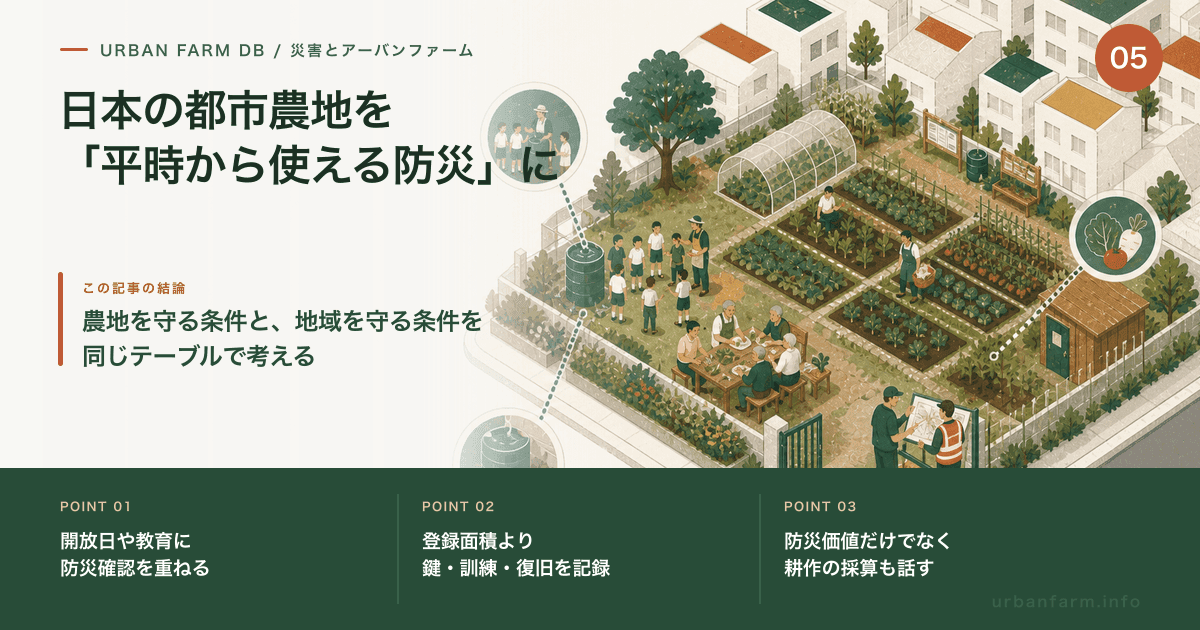
Japan already has policies and practices for using urban farmland in disaster preparedness. This fifth article asks how to reconnect them to everyday farm life instead of treating them as a distant special project.
This article in 3 minutes
- Adopting a policy alone does not make a site usable in an emergency.
- Open days, education and local events can become operational preparedness practice.
- Do not treat farmland preservation and local safety as separate stories.
Opening
An existing entry point
Japan's Ministry of Agriculture describes urban farmland as having functions including limiting fire spread and providing space for evacuation and recovery. This does not mean turning farms into disaster facilities. It is an entry point for connecting the openness, soil, water and human activity that farms already have to local safety.
The key to Japan's policy is not adding preparedness from outside agriculture, but connecting the openness, water and exchange urban farming already has to safety planning.
The map
Layer it onto ordinary activities
Check entrances and paths at a harvest event, share a well's location in a school lesson, or use a farm roof during a community cooking drill. These are not extra work that diminishes a farm's appeal; they layer preparedness checks onto ordinary activity. Repeated small checks often build operations better than one annual large drill.
Harvest events, school lessons and cooking drills need not be separate. Checking entrances, wells and routes through ordinary activity handles farm appeal and preparedness in the same time.
Sources & further reading
Examination
The preservation question
When urban farmland decreases, so does the spare space available for preparedness. But fixing land in place solely for disaster value will not preserve it if farming livelihoods cannot continue. Farm income, inheritance and leases, neighbourhood agreement and emergency use need discussion at the same table.
The value of disaster-cooperation farmland is not decided only in disasters. Without solutions for inheritance, leases, income and ageing farmers, designated land may remain while usable sites shrink.
Examination
Return the question locally
When looking at local farmland, ask not only ‘could this be an evacuation site?’ but ‘what will let this land still be farmed in ten years?’ The answer connecting those questions differs by site. That is why occasions for owners, farmers, neighbourhood groups, children and older residents to speak in the same place matter.
A grant case in Settsu City, Osaka, installed signs for disaster-cooperation farmland and linked public awareness with conservation of farmland and citizen gardens. A sign is small equipment, but it turns a designation from an internal register into public information neighbours can know.
How to read the evidence
Put preparedness value and farming viability on the same table
The objection that farmland need only be preserved for preparedness meets the reality of farm economics. Public value requires showing how cost and authority return to the farmer who maintains it.
Practice
Record keys, drills and restoration, not only registered area
Registered area is not enough as an evaluation measure. Recording keys, drill dates, restoration and neighbourhood awareness reveals the gap between numbers and usability.
Recap
Reconnect the conditions that protect farmland and community
Day 5 returned Day 4's temporary use to Japanese policy and ordinary life. The next instalment addresses unavoidable economics: cost, subsidies and decision-making.
Public data comparing municipal operation are insufficient. Inferring evacuation or water effects from the existence of a policy requires caution.
The conclusion is to embed disaster-cooperation farmland in ordinary farm activity rather than stop at registration. Only then do farmland preservation and local safety become one agenda.
Key takeaways
- Layering preparedness onto ordinary farm activity makes it more workable.
- Discuss the conditions for preserving farmland and community together.
This column is free to read
As new columns publish, older ones move into the members' archive. Join the free newsletter to get every new column and the week's urban-farming news by email.
Reader feedback
Was this article useful?
No sign-in required. One vote per article on this device; you can change your choice.
Related columns
Urban farming in Japan — the country where fields stayed in the city
From Edo's circular city to productive green zones, experience farms and rooftop beekeeping — reading Japan's urban agriculture through its history and culture
21 min readDisaster and urban farming ④ — Do not rush to ‘green’ damaged land
Christchurch and the time needed for temporary use and recovery
15 min readDisaster and urban farming ① — Reading a farm as emergency open space
From food production to evacuation, firebreaks and neighbourhood hubs
15 min readFarming a dry city — Southern Europe has held its farmland without owning it
Water is short. Land sells. And still Milan fixed some 46,300 hectares at the city's edge in 1990, and Barcelona 3,473.26 in 1998 — without buying any of it
19 min read