Disaster and urban farming ⑥ — Costs and authority that keep preparedness from becoming a nice story
Who pays, who decides, and who restores
2026-08-10 · 15 min read
Series · Disaster and Urban Farming6 / 7
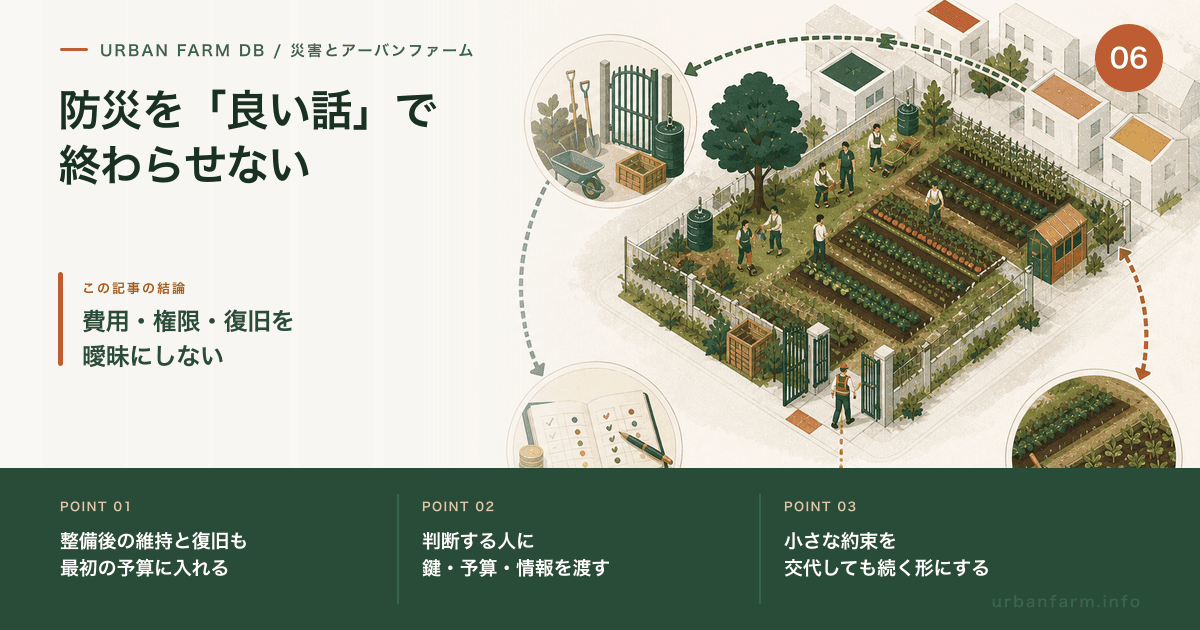
A farm's preparedness function cannot persist on goodwill alone. This sixth article addresses funding, insurance, responsibility and decision-making. It is less glamorous, but clarity here is a condition of continuity.
This article in 3 minutes
- Preparedness use has maintenance and restoration costs, not only setup costs.
- Do not give responsibility to people without authority.
- A small budget and annual review are stronger than oversized promises.
Opening
Costs occur twice
Widening an entrance, installing signs or maintaining a well costs money. More easily missed is what follows: signs wear, tools need replacement and used land requires restoration. Put both restoration costs and time for an annual review in the first budget to reduce unpaid goodwill.
Preparedness costs more than installing an entrance or well. Budget signage updates, drills, insurance, restoration and the time needed when staff change.
The map
Match authority and responsibility
If the person deciding on site in an emergency has neither keys, budget nor contacts, they carry responsibility alone. Conversely, a system where only the owner decides may miss local realities. For activation, closure and cost, write the decision-maker and implementer together in the same table.
FAO treats risk reduction as prior investment rather than post-damage spending. Against the Sendai Framework's four priorities—understanding risk, managing it, investing in resilience and building back better—drainage and shade are both ordinary farm improvements and preparedness investment.
Sources & further reading
Examination
Investment that reduces risk
FAO frames disaster risk reduction in agriculture as investment made before damage, not only cleanup afterward. The same holds for urban farms: drainage, shade, contact networks and soil condition support not only emergencies but adaptation to ordinary days with more heat and heavy rain.
An agreement becomes paper when responsibility is given without authority. Name who activates, who can stop on site and who approves spending, with substitutes when contacts fail.
Examination
Make small promises that continue
There is no need to promise to receive an entire neighbourhood from the start. Make small commitments — open this entrance, mark this water point, update the contact tree monthly — in a form that continues when people change. Institutions become strong when they remain as transferable habits, not merely impressive prose.
A small annual budget can be stronger than a large one-off facility. Publishing where money goes also exposes differences in expectations between farm and government.
How to read the evidence
Count maintenance and restoration burdens beyond setup costs
The objection that spending is wasted if disaster does not come requires measuring ordinary benefits separately: shade, drainage, education and exchange, and which problems they ease.
Practice
Give operators authority to activate, stop and pay
Benefits cannot be fully converted into money. Evaluation must therefore include distributional fairness: who bears cost and who decides, not only a cost-benefit number.
Recap
Small budgets and transferable authority keep institutions alive
Day 6 moved preparedness from goodwill to budgets and authority. The final instalment turns the discussion into a local register and seasonal review, converting scepticism into practice.
Long-term comparative studies of urban farmland's disaster benefits are scarce, and there is no single optimal investment. Avoid false precision and publish the assumptions behind decisions.
This article argues against placing new duties on farms in the name of preparedness without returning budget, information and the right to stop to those who maintain them.
Key takeaways
- Budget setup, maintenance and restoration as one cost.
- Give decision-makers the authority and information they need.
This column is free to read
As new columns publish, older ones move into the members' archive. Join the free newsletter to get every new column and the week's urban-farming news by email.
Reader feedback
Was this article useful?
No sign-in required. One vote per article on this device; you can change your choice.
Related columns
Disaster and urban farming ④ — Do not rush to ‘green’ damaged land
Christchurch and the time needed for temporary use and recovery
15 min readDisaster and urban farming ③ — Build agreements before calling a farm an evacuation site
Keys, responsibility, water and communication: lessons from implementation
15 min readDisaster and urban farming ② — Build continuity, not promises of food volume
Not a substitute for emergency rations, but a distributed food-and-knowledge network
15 min readFarming a dry city — Southern Europe has held its farmland without owning it
Water is short. Land sells. And still Milan fixed some 46,300 hectares at the city's edge in 1990, and Barcelona 3,473.26 in 1998 — without buying any of it
19 min read