Disaster and urban farming ⑦ — Keep growing a farm that is useful to its community
The seven-day conclusion: preparedness cultivates everyday relationships
2026-08-11 · 15 min read
Series · Disaster and Urban Farming7 / 7
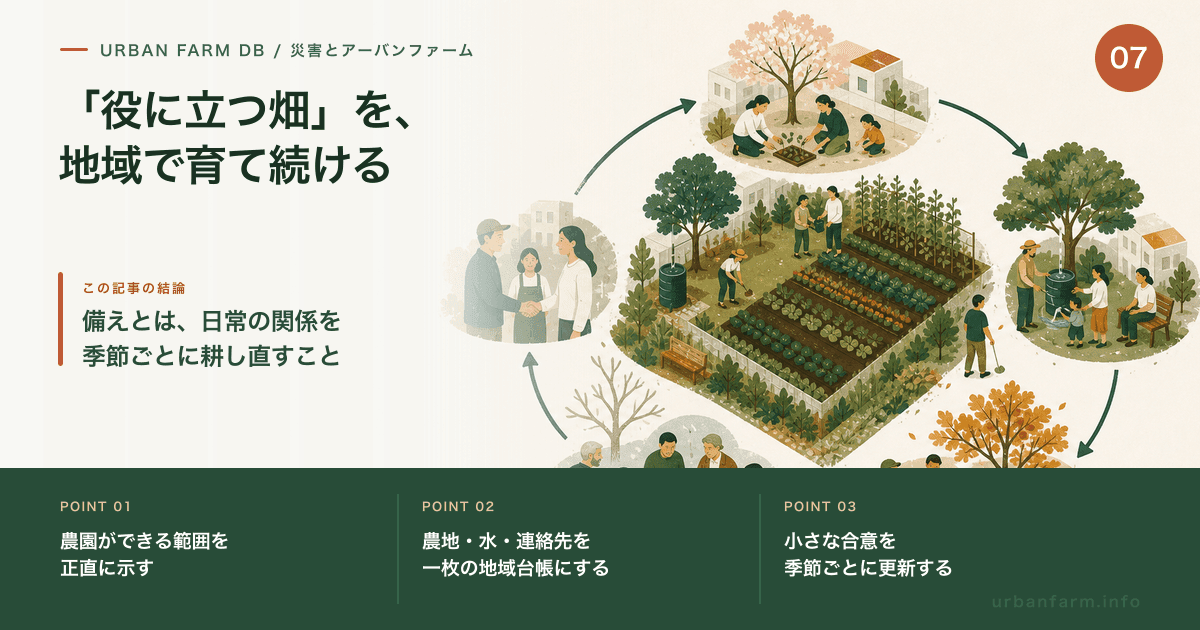
In this final article, the earlier arguments return to one practical picture. A disaster-resilient farm is not simply one with special equipment; it is one where people, land and knowledge circulate in ordinary times.
This article in 3 minutes
- A useful farm in disaster grows from one open in ordinary life.
- Treat food, open space, water, agreements and costs together.
- Begin with one small commitment sustained through the next season.
Opening
What seven days showed
We saw farms not only as sites of emergency food production but as open space, water, evacuation routes and places that cultivate relationships. We also established that farms alone cannot support a city, goodwill alone cannot open land, and overseas cases cannot simply be copied. Holding both truths lets us use possibility without inflated expectation.
The four priorities of the Sendai Framework organise this seven-day argument: understand risk, manage it, invest in resilience and build back better. A farm's value is not its equipment count but whether these priorities can be grounded in ordinary relationships.
The map
A one-page local register
The final proposal is a small register of local farms and gardens: location, manager, ordinary opening, available water, contacts, cautions and whom to consult in an emergency. Sensitive details may sit on a separate sheet. Its purpose is not control; it is mutual knowledge of resources the neighbourhood already has.
A local register records not only place and area but manager, opening conditions, water, contacts and restoration deadline. Sensitive details can be separate, but a custodian must be named.
Sources & further reading
Examination
From the farm side
Farm operators need not take on everything. State what is and is not possible, name a consultation contact and review once a year. That alone is valuable information for a neighbourhood. The honest boundary ‘this farm can open this far’ builds more trust than vague claims of universal capacity.
A farm need not promise to be a universal shelter. Posting its capacity and the situations in which it cannot open avoids directing people into danger.
Examination
Keep cultivating
Preparedness is not something stored away when finished. Just as soil is worked, crops change and participants rotate, contact trees and agreements need renewal. Walk the entrance again next season, check water, speak with a neighbour. That repetition creates a farm useful not only in disaster.
Government should budget keys, water, guidance and restoration before relying on farms. Residents participate not only as users but as people who inspect and update the plan.
How to read the evidence
Bind seven arguments into one local operation that can continue
To the scepticism that disaster farms are only symbols, answer with measurements that turn symbols into operation: unlock time, drill gaps, recipients reached again and contacts updated.
Practice
Ask a nearby farm what it can do, who decides and who restores
The limits are clear: urban farming cannot replace regional logistics and farmland can itself be vulnerable. It is still worth cultivating as a resource that slightly shortens restart and reduces isolation.
Recap
Keep preparedness unfinished and cultivate it again each season
Placed together, Day 1's open space, Day 2's distributed food and knowledge, Day 3's agreements, Day 4's temporary use, Day 5's Japanese policy and Day 6's cost and authority reveal a chain of work, not a universal fix.
The conclusion is not to erase objections. It is whether, after sharing limits, a community can choose small commitments it will still keep.
The next action is not to call a nearby farm a preparedness hub, but to ask its manager three questions: what can it do, who decides, and who restores it afterwards. The answers become next season's plan.
Key takeaways
- Make a farm's value concrete as a local resource without overstating it.
- Renew small agreements each season.
This column is free to read
As new columns publish, older ones move into the members' archive. Join the free newsletter to get every new column and the week's urban-farming news by email.
Reader feedback
Was this article useful?
No sign-in required. One vote per article on this device; you can change your choice.
Related columns
Disaster and urban farming ④ — Do not rush to ‘green’ damaged land
Christchurch and the time needed for temporary use and recovery
15 min readUrban Farming and Community: The Social Capital that Soil Grows
How strangers become neighbours — read through social science and the world's gardens
21 min readUrban farming in France — how the City of Paris turned land it does not farm into farmland
From a 1952 law to the 2016 Parisculteurs. Reading the urban farming that public institutions built, through the lens of policy
29 min readUrban Farming in South Africa — Reading the 'Garden for Survival' through Its Institutions
Urban-agriculture policy, food-resilience strategy, and municipal programmes — a country report that reads South Africa's cities and farms through the mesh of its institutions
15 min read