F1 seed scatters in the second generation — what stops it is biology, not law
Hybrid vigour, segregation and male sterility: three steps that explain why saved seed does not come back the same
2026-09-17 · 16 min read
Series · Who owns a seed — ownership drawn by registration, patents and landraces2 / 7
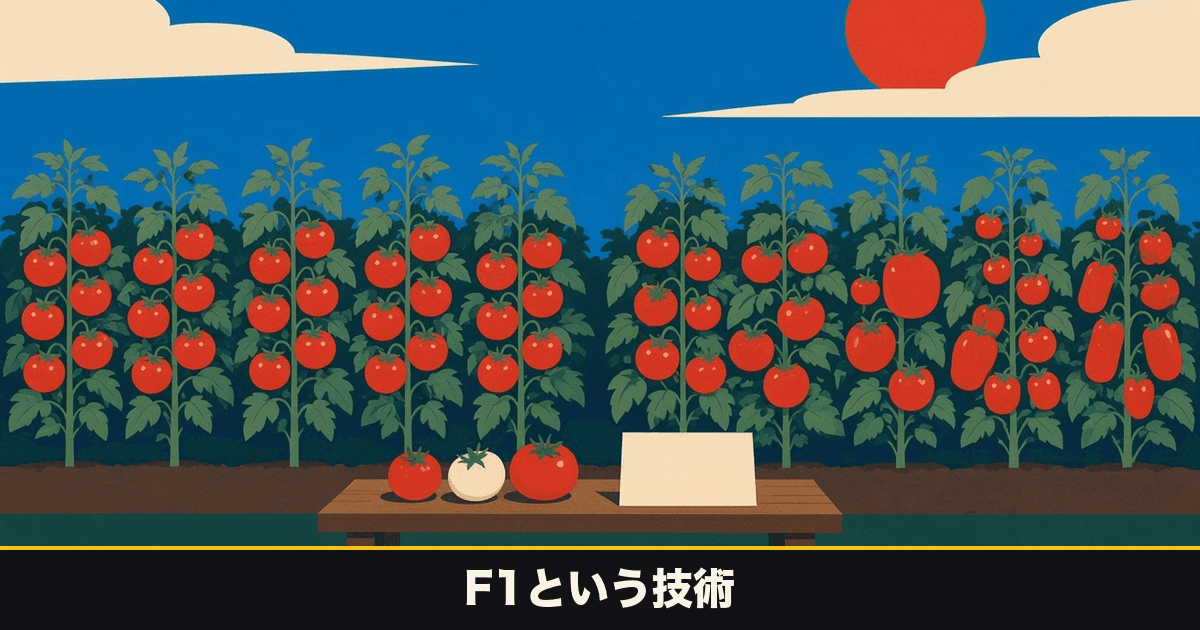
Saving seed from an F1 cherry tomato is not, in itself, forbidden by any law. Yet sow that seed the next spring and the plants come up at different heights, with fruit of different sizes and different flavours. That is not a mistake in the growing. If the packet you bought was printed with 'hybrid' or 'F1', the variety is an F1: the first generation from a cross between two parents of different make-up, and only that first generation is uniform. In the second, Mendel's law of segregation simply does its work, and shape and size come apart. What blocks the road to growing the same vegetable again is neither a breeder's right nor a patent. It is biology itself. What follows traces that mechanism in three steps — hybrid vigour, segregation and male sterility — and checks against sourced figures that enclosure is not the whole reason F1 hybrids spread across the world.
This article in 3 minutes
- F1 seed scatters in the second generation because of Mendel's law of segregation. Ten heterozygous gene pairs alone spread the next generation across three to the tenth power, 59,049 combinations, and no uniformity survives that.
- What binds an F1 is not law. Where a breeder's right or a patent draws its line on paper, an F1 makes reproduction difficult with no paper at all. That is why it is called enclosure by technology.
- Male sterility — using a parent that cannot make pollen — industrialised the production of F1 seed. The starting points are the 1936 report by Jones and Emsweller in onion and Ogura's 1968 report in Japanese radish.
- Uniformity came at a price. More than 85 per cent of the hybrids grown in the United States in 1970 carried the same cms-T cytoplasm, and southern corn leaf blight destroyed 15 per cent of the maize crop, a billion dollars at the values of the day.
- Nor is an F1 always better. In trials sown in the autumns of 1997 and 1998 at New Mexico State University, hybrid onions gave a marketable yield of 837 sacks per acre against 1,182 for the open-pollinated varieties.
- F1 hybrids are not the villain. Growers chose them for yield, uniformity and disease tolerance. The enclosure is a consequence, not the whole of the motive.
Opening
Same plot, same care, uneven plants: the seed you sowed was the second generation of an F1
You save seed from a cherry tomato that cropped well, dry it, and sow it the following spring. It germinates perfectly. Then summer comes and the row is a jumble of tall plants and short ones, the fruit differing plant by plant in size, colouring and taste. It is not the fertiliser and it is not the watering. The cause is the seed itself. The advice page of the Japanese seed company Takii says as much: sow seed taken from an F1 variety and the vegetables will not come back with the parent's shape or character, but will be very uneven and quite unlike the parent. To a seed company this is unremarkable. But all that knowledge is squeezed into the word 'hybrid' printed on the packet, and it never reaches the person who bought it. No law is stopping anyone from saving the seed. The same tomato still does not come back.
F1 is short for the first filial generation: the first generation produced by crossing two parents of different make-up, and only that first generation is uniform. Sow seed taken from an F1 plant and, in that second generation, shape, size and flavour all come apart. That coming-apart is not an impression. It has an explanation. There are three questions. Why is only the first generation uniform? Why does the second scatter? And how was that property built into the business of producing seed? Every technical term is put into ordinary words the moment it appears. By the third question the real nature of an F1 comes into view: not merely one way of making a variety, but the very shape of the industry that sells seed.
F1 hybrids are not the villain. They spread across the world because they raise yield, because size and harvest date come out even, and because they make it straightforward to build disease tolerance into a variety. Growers had clear reasons for choosing them. At the same time, whoever sows an F1 can no longer carry the seed forward in their own plot. Both are true at once. Pull out one half and you can write 'F1 hybrids are convenient', or 'F1 hybrids took seed away from farmers'. Each tells only half the story. So the mechanism comes first, and then the benefit and the cost alike are held up against sourced figures.
The line drawn today
What stops an F1 from being reproduced is not paper but biology
A breeder's right registers a variety and draws its line on paper. A patent passes examination as an invention and, again, draws its line on paper. Both stand on procedures the state has set down, and breaking them is a legal matter. Of the lines laid out on the first day of this series, these two live on paper. An F1 is different. No registration, no application. Next year's sowing will not be uniform, and that fact alone closes off, in practice, the road to making the same vegetable again. Nothing in law is touched, and the effect is the same. That is why it is called enclosure by technology. Enclosure originally meant fencing common land and turning it into private property. With an F1, biology does the fence's job. Put plainly: no one has to stand guard, because the seed itself makes remaking it difficult.
Two points are easily misread. First, saving seed from an F1 is not itself forbidden. Do it and no law is broken; you simply will not get uniform vegetables. Second, an F1 variety can also be registered as a variety, and where it is, the rules attached to a registered variety apply on top, so propagating it yourself may require the breeder's permission. The line drawn by the technology and the line drawn by law sometimes coincide and sometimes do not. How far Japan's seed and seedling law reaches into a home garden is the subject of day five of this series. What is followed here is the mechanism that works whether or not a law exists.
Sources & further reading
- 農林水産省 知的財産課「種苗をめぐる情勢」(令和5年3月)— 野菜種子は国内流通の約9割を海外生産・輸入、種苗産業の市場規模は約2,600億円
- USDA National Agricultural Statistics Service — Trends in U.S. Agriculture: Corn Hybridization (1935年1%、1940年30%超、1960年96%)
- Bruns, H.A. (2017) Southern Corn Leaf Blight: A Story Worth Retelling. Agronomy Journal 109(4) — cms-T、除雄、1970–71年の15%減収
- Cramer, C.S. — Comparison of Open-pollinated and Hybrid Onion Varieties for New Mexico (New Mexico State University) — 育成者の保護、種価格2〜3倍、可販収量837対1,182袋
- Kakizaki, Y. (1931) Hybrid Vigor in Egg-Plants and Its Practical Utilization. Genetics 16(1): 1–25
- Kumar, A. et al. (2020) Heterosis Breeding in Eggplant (Solanum melongena L.): Gains and Provocations. Plants 9(3): 403 — 柿崎の1923–1926年の試験、ナスは花が大きく手による除雄が容易
- Muñoz-Sanz, J.V. et al. (2020) Self-(In)compatibility Systems: Target Traits for Crop-Production, Plant Breeding, and Biotechnology. Frontiers in Plant Science 11:195 — SRKとSP11、1940年のサカタのタネのF1キャベツ
- Yu, H.-L. et al. (2020) Creation of fertility-restored materials for Ogura CMS in Brassica oleracea. Theoretical and Applied Genetics 133(10) — 小倉型雄性不稔(1968年、ダイコン)はアブラナ科野菜のF1採種で最も広く使われる
- Berlan, J.-P. (2018) Hybrid corn and the unsettled question of heterosis. Journal of Genetics 97(5) — ヘテロシスの定義と機構は未決着、デュービック2001年の記述
- タキイ種苗 Q&A「F1品種から採種したタネで、野菜を育てて収穫することはできますか?」
Mechanism 1: hybrid vigour
The first generation is uniform and vigorous because two lines purified by selfing were crossed
Making an F1 begins with making the parents — and the more uniform the parents become, the weaker they get. The method is repeated self-pollination: put a plant's own pollen on its own stigma, sow the seed that results, and do it again. Carry that on for generations and the combination of genes becomes the same from plant to plant. A line in that state is called an inbred, or pure, line. It is uniform. It is also weak: growth falls off, the fruit gets smaller, the seed set drops. This is inbreeding depression. In onion it has been reported that after only two cycles of self-pollination there are drastic decreases in growth, bulb size and seed production. Breeders keep these weakened lines going for years all the same, because the next move depends on them.
The next move is the cross. Cross inbred line A with inbred line B and every seed carries the same combination — half from A, half from B. Every plant holds the same blueprint, meaning the same combination of genes, so height, harvest date and fruit shape all come out even. And the plants grow larger than their weakened parents. This is hybrid vigour, or heterosis. The person who demonstrated the method in maize was George Shull, whose papers of 1908 and 1909 proposed breeding by combining selfing with crossing; in 1914 he coined the word heterosis itself. Change the partner and you get an F1 with quite different properties. Breeding therefore becomes a two-stage business: how to build the parents, and which parent to pair with which.
Why does hybrid vigour happen? More than a century on, nobody has settled it. The dominance and overdominance hypotheses have stood side by side for decades, and there is not even an agreed definition of the phenomenon. The maize breeder Donald Duvick wrote in 2001 that the genetic basis of heterosis was, and still is, unknown. Usable, yet unexplained: that is what an F1 actually is. It sits at the centre of world food production with its mechanism still open, and defenders and critics alike accept as much. On the farm, none of that shakes the decision. It can be reproduced and it produces numbers, and that is enough.
Mechanism 2: segregation
The second generation scatters because Mendel's law of segregation undoes the first generation's uniformity
A living thing carries two copies of each gene that does a given job: one from its father, one from its mother. When pollen or an egg cell is made, the two separate and only one of them goes in. So in the offspring, one copy from each parent is combined afresh. This is the rule Mendel found in peas. Round seed or wrinkled, tall plant or short: he showed such traits splitting in fixed ratios in the second generation. An F1 plant received one copy from each of two inbred lines, so at every gene pair the two copies differ. That state is called heterozygous. When F1 plants pollinate each other, the separating and recombining happens at every pair at once.
Look at the size of that lottery. Suppose ten gene pairs are heterozygous. The combinations that can enter a pollen grain or an egg cell number two to the tenth power, 1,024. Fertilisation brings two of those together, so the combinations that can appear in the second generation swell to three to the tenth power, 59,049. That is from ten pairs alone. In a real crop, the pairs bearing on height, leaf shape, disease tolerance, sugar content and harvest date are far more numerous, and several genes go into any one trait. So the second-generation plot does not split into a few tidy types; it spreads out continuously. Selfing is mixed in too, so plants visibly weakened by inbreeding depression turn up among them. That is the whole content of 'the seed you sow does not come back the same'.
Scattering is not a defect in an F1. It is the design behaving as designed. Set it beside an open-pollinated, or fixed, variety: one brought by generations of selection and selfing to the point where the seed you sow comes back like its parent. In a fixed variety, growers and breeders did the evening-out in the field, over many generations. An F1 moves that work forward into the parents and finishes it in one. Both are techniques for evening things out. The only difference is where the work is kept — in the field for a fixed variety, inside the seed company's parent lines for an F1. That difference in location is exactly the difference in who can make the seed again.
Mechanism 3: male sterility
Once a parent that cannot make pollen became available, producing F1 seed turned industrial
To produce F1 seed, the plant acting as mother must not be pollinated by its own pollen; if it is, what you get is selfed seed rather than a hybrid. In maize the method used for a long time was detasselling. On the mother rows the tassel — the male flower — is snapped off by hand before it sheds pollen. Fields were laid out with six to twelve rows of the mother parent and two rows of the father on either side, the pattern repeated across the field. The work has a deadline: it must be finished in the short window between the tassel emerging and the pollen flying. In the United States, the record notes, much of it was done by local teenagers working for the minimum wage. Behind the uniform seed stood hand work racing a deadline.
What made that hand work unnecessary is male sterility. A change in the genes of the mitochondria — the parts of the cell that handle respiration — leaves the plant unable to make pollen, and only pollen. The female side is normal, so seed sets as usual. The trait passes only down the maternal line. Put it into the mother line once, and that line makes no pollen of its own accord, year after year. In onion, Jones and Emsweller reported 'a male-sterile onion' in 1936, and that led to commercial hybrid onions. In radish, Ogura reported male sterility in a Japanese radish in 1968. That cytoplasm went on to become the most widely used male-sterile type in hybrid seed production for cabbage, broccoli and the other Brassica vegetables.
Which method is used depends on how big the flower is and on which part of the plant is eaten. Eggplant flowers are large, and removing the anthers by hand is easy. In Japan, Yôiti Kakizaki showed in trials from 1923 to 1926 that F1 eggplants outyielded a standard variety, and published the result in the journal Genetics in 1931. Cabbage and Chinese cabbage are another matter. Their flowers are small, and treating them one at a time by hand does not pay. What was used there is self-incompatibility and male sterility. Self-incompatibility is the property of refusing to be fertilised by one's own pollen; the judgement turns on whether a protein called SRK on the stigma side and one called SP11 on the pollen side are of the same type. The Japanese company Sakata Seed used that property to bring out an F1 cabbage in 1940.
The cost, 1970
Fifteen per cent of the United States maize crop was lost in 1970 because everyone had concentrated on the same male sterility
The male sterility the American seed companies took up was a single type, the Texas cytoplasm, written cms-T. The reasons were practical. It held the pollen-free state stably across a range of conditions. And at the final stage, a restorer gene brought in from the father side let the harvested generation make normal pollen again. Maize is eaten as grain, so that restoration is essential; in cabbage or radish, where the leaf or the root is eaten, no pollen is required for the harvest and no restorer is needed. cms-T was easy to handle and it cut labour costs. A later review says plainly that it was a money-maker for the industry. By 1970 between 75 and 90 per cent of the hybrid cultivars grown in the United States had that cytoplasm in their background.
In 1970 a new strain of fungus appeared. It was a race of the organism that causes southern corn leaf blight, and it hit hard only on maize carrying cms-T in its background. The cause was later traced: the toxin the fungus produces binds to the mitochondrial protein that makes cms-T what it is. Damage that began with reports from southern Florida spread north. Because more than 85 per cent of the hybrids grown that year carried the same cytoplasm, it became a national event. The epidemic of 1970 and 1971 destroyed 15 per cent of the United States maize crop, one billion dollars at the values of the day, put at six billion or more in 2015 terms. In parts of the south, some growing areas lost 30 to 50 per cent of their yield.
In 1971 the seed companies dropped cms-T and went back to snapping the tassels off by hand. The seed sold that year is recorded as roughly 25 per cent normal-cytoplasm hybrids, roughly 25 per cent cms-T hybrids, and about 50 per cent bags in which the two were blended. What to take from this is not that F1 hybrids are dangerous. It is a single point: uniformity is a strength and a weakness in the same breath. In a uniform field, every plant shares the same vulnerability. Since 1971 that race of the disease has not been a factor in maize, which is itself evidence that the cause was concentration on one cytoplasm.
What the enclosure actually is
An F1 protects the seed company, but it does not always win in the field
What did an F1 do for seed companies? The horticultural literature spells it out. In a comparison of onion varieties, Cramer at New Mexico State University notes that open-pollinated varieties gave the company that bred them almost no protection, since a grower could maintain them and another company could sell them under a different name. The F1 changed that. The identity of the inbred parents is kept back, and without those original parents the same F1 cannot be made. The paper uses the word protection explicitly. The price shows it too: a European review cited in the same paper puts the price of hybrid seed at two to three times that of open-pollinated seed. Enclosure is not a critic's metaphor. It is also how the function looks from inside the industry.
Yet the same paper also shows, in numbers, that an F1 is not always better. The comparison was sown in the autumns of 1997 and 1998 in southern New Mexico. The hybrid onions were taller, carried more leaves and matured seven days earlier — hybrid vigour behaving as advertised. But bolting, meaning the proportion of plants that run to a seed stalk before bulbing and so cannot be sold, was 38.5 per cent for the hybrids against 9.8 per cent for the open-pollinated varieties. Marketable yield came to 837 sacks per acre for the hybrids and 1,182 for the open-pollinated ones. The hybrids lost. The author explains that most of the open-pollinated varieties in the comparison had been bred in that area and were well adapted to it.
The two facts do not contradict each other. The effect of the enclosure is real. But the enclosure alone cannot explain why F1 hybrids were adopted. What Kakizaki recorded between 1923 and 1926 were yield figures, and American maize growers switched to hybrids because yield and disease tolerance went up. Conversely, there are situations in which a locally adapted open-pollinated variety does better. An F1 is neither a cure-all nor a villain; it is a technology that pays off in some conditions and not in others. What makes judgement awkward lies elsewhere. The pay-off comes bundled with a separate question: who is able to make the seed.
The shape of the industry
About nine-tenths of the vegetable seed sold in Japan is produced abroad because crossing has conditions attached
A field that produces F1 seed comes with conditions. The mother and father parents have to be laid out in a set ratio. They have to be kept far enough from other pollen and brought into flower at the same time. Someone has to check that the male sterility or the self-incompatibility is doing its job. Hands are needed too. Land that meets those conditions easily is limited, so seed production concentrated in the places around the world that suit it. Japan's seed is part of that pattern. According to material published by Japan's Ministry of Agriculture, Forestry and Fisheries in March 2023, the Japanese seed and seedling market is worth about 260 billion yen, of which vegetables account for 168.98 billion. And of the vegetable seed circulating in Japan, roughly nine-tenths is produced abroad and imported, with about a year's supply held in reserve inside the country.
The speed of the switch is on record too. According to the statistics service of the United States Department of Agriculture, hybrids accounted for 1 per cent of American maize acreage in 1935, more than 30 per cent by 1940, and 96 per cent by 1960. From 1 per cent to 96 in twenty-five years. A reservation belongs here. A review gives the same 1960 figure as nearly 90 per cent, so the count varies with the method. The statement that the major growing regions of the world are now above 97 per cent is an estimate rather than a measurement. The order of magnitude does not move, but no primary source was found that pins down the decimals. One thing is certain. Within a quarter of a century, seed went from something bought once to something bought every year.
For anyone working a plot in a home garden, this industrial shape shows up in two forms. One is choice. Most of the packets on the shelves of a garden centre or an online shop are printed with 'hybrid'; finding a fixed variety takes a deliberate search. The other is dependence. As long as you choose an F1, you will be buying that packet again every year. Neither has to be called a bad thing. But choosing without knowing which you have chosen is not the same as choosing knowingly, and that difference is what this series is about. Before deciding whether to save seed, be able to read what the seed you sowed was designed to do. That is the practical aim of this instalment.
Recap
What today traced is one route that stops seed being reproduced without using a law
It started with something felt in a home garden: sow seed saved from an F1 and it does not come back even. The reason comes in three steps. First, cross two inbred lines built by repeated selfing, and every plant of the first generation carries the same combination, so it is uniform — and it grows larger than either parent. George Shull set out the method in 1908 and 1909 and named it heterosis in 1914. Second, in the second generation Mendel's law of segregation goes to work, and ten heterozygous gene pairs alone split into three to the tenth power, 59,049 combinations. Third, to produce that seed in quantity, male sterility and self-incompatibility were brought in and the hand work of detasselling fell away. The starting points: 1936 in onion, 1968 in radish.
Three points stand out. First, what binds an F1 is not law. No breeder's right and no patent are involved; the law of segregation, a piece of biology, closes off reproduction in practice on its own. That is why it is called enclosure by technology. Second, that enclosure is described as protection from inside the industry as well. Cramer's paper at New Mexico State University states two things outright: open-pollinated varieties gave their breeders almost no protection, and an F1 cannot be reproduced without its original parent lines. Third, uniformity has a price. More than 85 per cent of the hybrids grown in the United States in 1970 carried the same cms-T cytoplasm, and southern corn leaf blight took 15 per cent of the maize crop, a billion dollars at the values of the time.
Some things remain unknown. Why hybrid vigour happens is still not settled; there is no agreed definition, and Duvick wrote in 2001 that the genetic basis remains unknown. What share of Japan's vegetables are F1 hybrids is a figure this article could not confirm against a primary source. Several accounts say more than ninety per cent, but none whose provenance can be traced, so the number does not appear above. And the 1960 adoption rate for American maize is given as 96 per cent by the Department of Agriculture's statistics and as nearly 90 per cent by a review; the two disagree. One objection deserves an answer. Male sterility is spoken of with alarm in several countries, yet what caused the disaster of 1970 was concentration on one cytoplasm, not male sterility as such. Drop that distinction and the account stops being accurate.
Day one sorted the lines drawn around the ownership of seed into four. This second instalment took up one enclosure that works without any law and took its mechanism apart. Day three looks at when the paper line was drawn: how plants came to be patentable in the United States in 1930. Technology encloses first; law encloses after. Keep that order in mind and the dates on day three read differently. Day four moves to the places where landraces are kept alive, and the accident of 1970 is one entrance to the argument about genetic diversity waiting there. Day five is Japan's seed and seedling law, day six where the money for breeding goes among crops, day seven the dispute over saving seed. Seed saved from an F1 does not come back even, not because anyone forbade it, but because of how it was made. So turn over the packet in your hand. Is what you sowed this year seed you can grow into the same vegetable again, with your own hands, next year — or seed made to be bought again every year? That word 'hybrid' printed on the packet: did you read it before you chose?
Key takeaways
- An F1 is uniform because two inbred lines built by repeated selfing are crossed and every plant ends up with the same combination of genes. The method was set out in George Shull's papers of 1908 and 1909.
- The second generation scatters through Mendel's law of segregation. Ten heterozygous gene pairs alone spread the next generation across three to the tenth power, 59,049 combinations.
- What stops an F1 is not law. With no breeder's right and no patent involved, biology alone makes reproduction difficult, and that is why this is called enclosure by technology.
- Male sterility industrialised seed production: a mother that cannot make pollen removes the hand work of emasculation. The starting points were the 1936 report in onion and the 1968 report in Japanese radish.
- Uniformity has a price. More than 85 per cent of the hybrids grown in the United States in 1970 carried the same cms-T cytoplasm, and southern corn leaf blight took 15 per cent of the maize crop, a billion dollars at the time.
- An F1 does not always win. In autumn-sown trials in southern New Mexico, hybrid onions returned 837 sacks per acre against 1,182 for locally adapted open-pollinated varieties.
- Seed production concentrated in the places that suit it. Roughly nine-tenths of the vegetable seed circulating in Japan is produced abroad and imported, with about a year's supply held in reserve inside the country.
Don't miss the rest of the series
Columns publish one each morning, seven to a series. The free weekly email wraps up the series that just ended and introduces the one that's starting — every Wednesday.
Reader feedback
Was this article useful?
No sign-in required. One vote per article on this device; you can change your choice.
Related columns
It is not one law that draws the line around a seed — breeder's rights, patents, contracts and custom
The four overlap on the same plant, and each of them bites in a different place
15 min readDevelopers do not build farms for the vegetables
From Agritopia to Porte de Versailles — line them up under the same question and you can see what is actually being recovered
22 min readDisaster and urban farming ① — Reading a farm as emergency open space
From food production to evacuation, firebreaks and neighbourhood hubs
15 min readHeirloom, landrace and traditional vegetables: the science and the societies
What it means to pass on a seed — from the science of genetic diversity to the systems that safeguard heirloom vegetables in Japan and worldwide
26 min read