How farmland became housing — and how a little of it is coming back
The countries that drew a line, the countries that bought the right, and the land that lost its price
2026-08-14 · 22 min read
Series · Urban Farming and Real Estate3 / 7
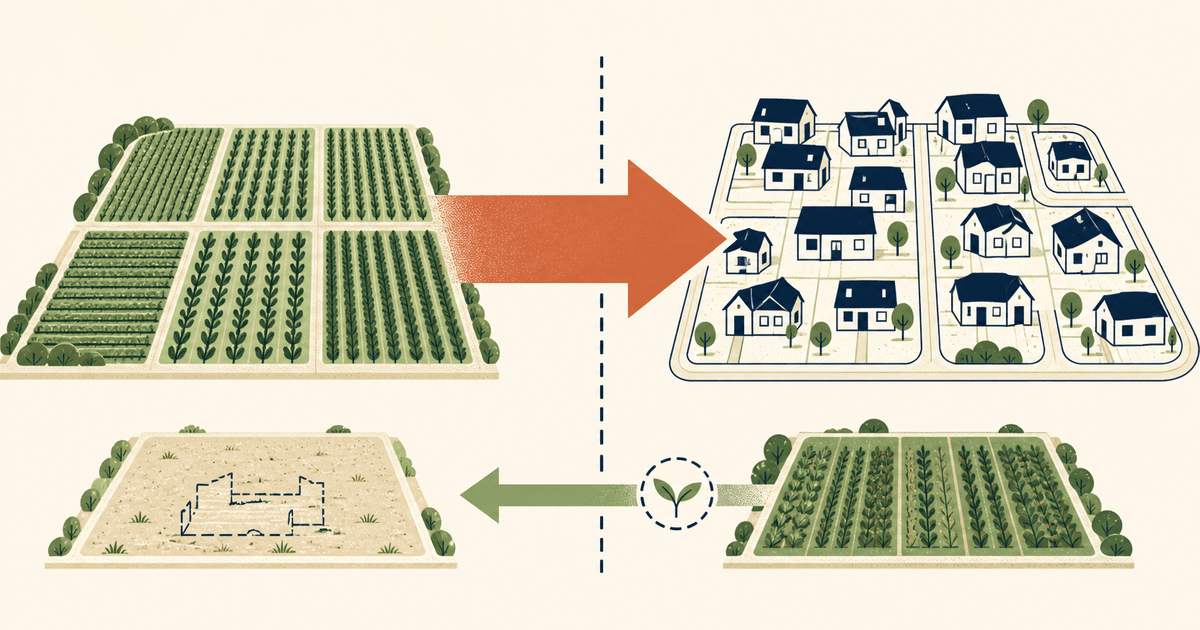
Yesterday's second instalment tracked the fight over hedonic estimates: does living next to a garden really raise the price of your house? Every one of those studies takes one thing for granted — that the garden is there at all. This article questions that premise. Urban farmland did not simply survive; it was left, or not left, by decisions someone made. In Japan, the 1968 City Planning Act drew a line across the country and redefined the farmland inside it as land that had not yet become housing. Britain codified the wrapping of green belts around its cities with a single 1955 circular. Several American counties went further and detached the right to build from the land itself so it could be bought and sold. And conversion is not a ratchet. In Detroit, vacant lots turned into tree farms at under $350 a lot; in Leipzig, land turned green because owners agreed to leave their building rights unused for a fixed term. But the reverse flow comes with a condition attached: the land that comes back is almost always land that has lost its price. That asymmetry is what this article is about.
This article in 3 minutes
- On 11 December 2012 Detroit's city council approved, 5–4, the sale of roughly 1,500 lots — about 140 acres — for $520,000. Reporting at the time put it at about $300 a lot; dividing $520,000 by 1,500 gives roughly $347. The buyer was obliged to plant at least 15,000 hardwood trees.
- Japan's 1968 City Planning Act split land into urbanisation promotion areas and urbanisation control areas. The former is defined as land to be urbanised, on a priority and planned basis, within roughly ten years — so the farmland inside it was, by definition, housing-in-waiting.
- In the designated cities of Japan's three metropolitan regions, land registered as productive green land slipped only from 15,113 ha (1993) to 13,088 ha (2016), while unregistered 'to-be-housing' farmland collapsed from 30,628 ha to 11,956 ha — a fall of more than 60%.
- England's Green Belt covered 1,633,220 ha on 31 March 2025 — about 12.5% of the country. Yet it shrank by 660 ha (0.04%) in a single year, 650 of those hectares because six local authorities adopted revised plans. The line can be moved.
- Montgomery County, Maryland created a 93,000-acre Agricultural Reserve in 1980 and bolted on a market in transferable development rights. More than 52,000 acres have since been preserved, drawing $117 million of private money into TDR purchases.
- In Berlin, a referendum on 25 May 2014 banned construction on the former Tempelhof airfield, with 739,124 votes in favour. In a city where the land was worth a great deal, keeping it open took not an ordinance but a ballot.
Opening
$347 a lot — what land costs when it comes back as farmland
On 11 December 2012, Detroit's city council approved a land deal by five votes to four: roughly 1,500 vacant lots on the city's lower east side, about 140 acres in all, sold to a single buyer for $520,000. Divide it out and each lot cost around $347. The buyer took on obligations — demolish at least fifty derelict structures, mow every three weeks through the growing season, plant at least 15,000 hardwood trees. The deal was finalised on 17 October 2013 with the signatures of the state-appointed emergency manager and the governor. You could call this farmland returning to the city, and people did. But the deal was possible only because the land had stopped being priceable as housing.
This article is about the far larger half of the story: the other direction. Twentieth-century cities grew, almost without exception, by eating farmland. In Japan's boom years, built-up areas sprawled outward with housing stuck onto fields that had neither roads nor parks; the reaction to that produced a new City Planning Act in 1968 and a line drawn across the map. Britain, in 1955, wrapped its capital in a belt with a single circular. Some American counties and states arrived at a stranger idea: detach the right to build from the farmland it sits on, move it somewhere else, and let it be traded. Different instruments, one shared assumption — left alone, a field becomes housing.
The argument
Conversion is reversible — but you do not get to choose which land reverses
The claim that urbanisation is irreversible is only half true. In Detroit, in Leipzig, and in parts of Japan's shrinking regional cities, land that once carried houses or factories has been cleared and has come back as fields, woodland or meadow. Physically, land-use change runs both ways. But running both ways is not the same as being symmetrical. Conversion to housing happens where prices are rising, driven by the owner's gain. Conversion back to farmland happens where prices have already collapsed, and is usually the disposal of a loss. Miss that asymmetry and you land on the cheerful, dangerous conclusion that vacancy is an opportunity for urban agriculture.
What follows first checks three attempts to stop conversion — Japan's zoning line, Britain's green belt, America's market in development rights — with their dates and their acreages. Then it looks at how the allotments that exploded in wartime quietly died in peacetime, which is the prehistory of the reverse flow. Then the instruments shrinking cities invented: Leipzig's permitted-use agreement and Detroit's transfer of maintenance duty. Finally, what the asymmetry means for practitioners in Japan. One section is reserved for the objection: is the land that comes back really farmland at all?
Sources & further reading
- 国土交通省「都市計画制度の概要」(区域区分・市街化区域と市街化調整区域)
- 農林水産省「都市農業を巡る経緯と施策の現状」(生産緑地法の制定経緯)
- 国土交通省「都市農地 データ集」(市街化区域内農地・生産緑地の面積推移)
- MHCLG, Local authority green belt: England 2024-25 — statistical release
- House of Commons Library, Allotments (Standard Note SN/SC/887)
- MHCLG, Local authority green belt: England 2024-25 — technical notes
- Crain's Detroit Business, Hantz Farms inks purchase deal with Orr, state to clear 1,500 Detroit lots for tree farms
- Montgomery Planning, Agricultural Reserve — Preserving Rural Legacy
- Oregon DLCD, Farmland Protection (Goal 3 / Exclusive Farm Use zoning)
- Stadt Leipzig, Sanierungstipps 5: Baulücken (Gestattungsvereinbarung)
- Landesabstimmungsleiterin Berlin, Volksentscheid Tempelhofer Feld 2014 — Ergebnis
Japan
In 1968, Japanese farmland was redefined as land that was not yet housing
The Japanese ministry's own account of why the line was drawn runs like this: through the high-growth years of the late 1950s and 1960s, people and industry piled into the cities, the fringe urbanised without order, and built-up areas took shape before roads or parks arrived. The prescription was the area division introduced by the 1968 City Planning Act. Every planning area was split in two. The urbanisation promotion area covers land already built up plus land to be urbanised, on a priority and planned basis, within roughly ten years. The urbanisation control area is land where urbanisation is to be held back, and development is in principle not permitted.
What is easy to miss is what that line did to farmland. Inside the control area, fields kept their status as fields, in exchange for a ban on building. Inside the promotion area, farmland became — in the wording of the law itself — land within a zone to be urbanised within ten years that had not yet been urbanised. Being a field described its present condition, not its planned destination. The system did not fail to protect that farmland. The system decided not to protect it.
The weight of that decision surfaced six years later, in the Productive Green Land Act of 1974. The agriculture ministry's own history explains its purpose: to preserve, in a planned way, farmland inside urbanisation promotion areas that contributes substantially to a good living environment and is suitable as a future site for public facilities. Note the justification. Not agricultural production, but environmental amenity and suitability as land for parks, schools and hospitals later on. The case for keeping fields inside the line was built in the language of city planning, not farm policy. What followed — the taxation battles, and above all the expiry of those designations — belongs to day five of this series.
The acreage shows how differently the two sides of the line fared. In the designated cities of the three metropolitan regions, farmland registered as productive green land fell only from 15,113 ha in 1993 to 13,088 ha in 2016. Farmland left unregistered — officially, farmland to be turned into housing — fell from 30,628 ha to 11,956 ha, more than sixty per cent. Nationally, unregistered farmland inside promotion areas shrank from 128,094 ha to 58,535 ha over the same years, to about 46% of where it started. Around sixty per cent of what disappeared became residential land. A line drawn half a century ago is still deciding which fields live.
Britain
The belt stopped the city — and the belt itself is being shaved every year
Britain drew a band rather than a line. According to the government's own technical notes, the first official proposal came in 1935, when the Greater London Regional Planning Committee called for a reserve supply of public open space and recreation land — a girdle of open space, a green belt. The 1947 Town and Country Planning Act then let local authorities write green belt proposals into their first development plans. In 1955 the policy was codified by circular and extended beyond London. The aim was to check the unrestricted sprawl of large built-up areas and to stop neighbouring towns from merging into one another. What had been conceived as recreational green for city dwellers had changed character: it was now a barrier against the city's growth.
Seventy years on, the belt is still enormous. On 31 March 2025 England's Green Belt covered 1,633,220 hectares, around 12.5% of the country's land area, with the Metropolitan Green Belt around London alone accounting for 31.1% of the total. Few countries have kept that much land out of development for that long. Where Japan's line announced that the inside would be urbanised, Britain's belt announced that beyond this point it would not be. The same planning tool, pointed in opposite directions.
The belt is not made of stone. The same statistics record a net decrease of 660 hectares — 0.04% — between 31 March 2024 and 31 March 2025. Of that, 650 hectares came from local plans being adopted and ten from boundary updates — which is to say almost the entire reduction was produced by six authorities each revising a plan. Nought point nought four per cent a year sounds trivial. Read the other way: under enough housing pressure, seventy years of protection can be lifted by one adopted local plan. It is not the designation that protects the land. It is the politics of continuing to renew the designation.
United States
Buying the right to build without buying the land
American cities have no national body drawing lines. Land-use regulation is largely local, and the idea of private property rights is strong. Ban building to save a farm and the owner loses the development value. The answer some jurisdictions built was to sever the right to build from the land and let it be traded. Montgomery County, Maryland is the standard example. In 1980 the county council and planning board designated 93,000 acres — roughly a third of the county — as an Agricultural Reserve, and cut permitted residential density there to one dwelling per 25 acres.
Down-zoning alone would have been close to expropriation by regulation. The trick lies in what came next. The previous density had been one dwelling per five acres, so owners could take the development rights they had just lost and sell them into areas the county wanted to grow. Buyers used those rights to build at higher density where the infrastructure already was. Rural landowners recovered part of the equity the 1980 rezoning took away; growth concentrated where it could be served. County figures put the result at more than 52,000 acres preserved and $117 million of private money drawn in through TDR purchases. Unlike buying easements with public funds, this pulls the money for preservation out of the market itself.
In the same decade Oregon made a very different bet. Senate Bill 100, signed in 1973, created a state commission, required it to adopt statewide planning goals, and made cities and counties draw urban growth boundaries: urban uses inside, farm and forest outside. Goal 3 obliged counties to inventory their farmland and zone it Exclusive Farm Use. By 1985 all thirty-six counties had finished their inventories, and roughly 16.1 million acres carried EFU zoning. State material reports that 99% of that land is still zoned EFU today. As an act of holding a statewide agricultural land pattern in place for half a century, it has few equals.
Both have their limits built into their achievements. Montgomery's TDR market works only while there are receiving areas hungry for density; saturate them and the price of rights falls and the engine stalls. Oregon's boundaries push up land prices inside the line, and have drawn recurring political backlash over housing costs. Every system that protects farmland makes housing harder to build somewhere. That is the other face of the same coin Japan flipped when it sacrificed the fields inside its urbanisation line.
Prehistory of the reverse flow
War makes gardens; peace unmakes them
There is exactly one twentieth-century episode in which urban land turned back into cultivation en masse: war. Britain's Ministry of Food launched Dig for Victory in October 1939, and allotments — about 930,000 plots when the war began — rose, on ministry figures, to some 1.4 million by 1943. Parks, playing fields, railway margins and bombed-out plots were all put under the spade. What happened during those years is covered elsewhere on this site; what matters here is what happened afterwards.
After the war those gardens went, almost without exception. Allotment numbers in Britain have fallen steadily ever since; a House of Commons Library briefing records 50,630 plots lost in the single decade from 1996 to 2006. The causes are various, but they share a root. Nearly all wartime gardens sat on land the gardener did not own — a park, a railway margin, a plot waiting for houses. It had been lent for an emergency. When peace returned and the land had a price again, the lender stopped lending. The gardens vanished less because people lost interest than because the land could no longer afford them.
That episode is the yardstick for reading the reverse flow. Land returns to cultivation not when someone wants to cultivate it, but when the expected return from every other use has dropped far enough to tolerate cultivation. In wartime, shortages of materials and labour, plus compulsory freezes on land use, produced exactly that: policy manufactured a state in which you could not build even if you wanted to and could not sell even if you tried. In peacetime there is only one situation where the equivalent condition arises on its own — when the city itself contracts. People leave, housing runs to surplus, lots stop finding buyers, and only then does land become cheap enough to bear a field. The two cities considered next have lived with that condition for the better part of half a century.
Shrinking cities
Leipzig and Detroit — contracts to leave the right to build unused
Leipzig lost a great deal of its population after the collapse of East Germany, and was left with empty flats, buildings queued for demolition and blocks full of gaps. In 2002 it joined Stadtumbau Ost, the eastern German programme for shrinking the housing stock to fit real demand. The problem was what remained once the buildings came down: owners carrying the costs of unsellable land, and neglected plots dragging down the blocks around them. The city's answer was the Gestattungsvereinbarung — a permitted-use agreement.
The mechanism is simple and the thinking is sharp. Owner and city sign an agreement: the plot is greened and opened to the public. In return, for the term of the agreement, the owner undertakes not to exercise the building rights they already hold under §34 of the federal building code. Ownership is untouched; so is the underlying right to build later. City material describes the effect as suppressing the hazards and blight of derelict plots while creating new public and semi-public green space, play areas and parking inside dense nineteenth-century blocks. Not purchase, not expropriation — a time-boxed suspension of the right to build. It is a bargain an owner accepts only while the city is contracting.
Detroit shows the same logic stripped of its politeness. That $347 a lot is the price at which the market judged the land to have no residential future. No wonder the council split 5–4; the objection was that a great deal of land was going cheaply to one operator. What the buyer took on was demolition, mowing and planting — the maintenance costs that would otherwise fall on owners or the city. In substance the deal transferred responsibility more than it transferred land. Someone had to hold ground that had lost its price, and a forestry venture volunteered. That is what the reverse flow actually is.
The objection
Is the land that came back really farmland?
At least three objections can be raised against the story so far. First, the content of the land that came back. What went into the ground in Detroit was hardwood trees, not crops. Turning vacant lots into woodland solves problems of appearance and maintenance cost; it does not by itself produce food or create a working local agriculture. When we say land returned to farming, we often mean only that it turned green. The category in the register and the activity on the ground are two different things.
Second, there is the ethics of welcoming cheap land at all. When large numbers of lots move to a single operator at a low price, critics at the time called it an enclosure of community assets on the cheap. Falling land prices also mean that the people still living there have lost wealth, that the tax base is thinning, and that services are degrading. The slack that urban agriculture moves into is the wreckage of somebody's loss. It raises the mirror image of the problem this site examined in its piece on green gentrification, where greening pushed residents out.
Third, the same doubt runs the other way, at land the systems protected. Farmland preserved inside Japan's urbanisation areas was kept for its contribution to the living environment and its suitability as future public land, not for what it grows. Britain's green belt is an instrument for restraining urban expansion, not an agricultural policy. Some of the protected land is not land being farmed; it is merely land not being built on. Blur that distinction when arguing from the acreage statistics and the numbers will flatter the reality.
With that said, the conditions for reversal deserve one more turn of the screw. On the former Tempelhof airfield in Berlin, a citizens' bill banning construction outright passed by referendum on 25 May 2014, with 739,124 votes in favour. In a city where the land was worth a great deal, holding that much ground unbuilt required not an ordinance and not a plan but the heaviest political instrument available: a public vote. Land that has lost its price comes back almost for free. Land that still has one comes back only at a political cost equal to that price.
For practitioners
Do not wait for land to empty; catch the years when its price sinks
For practitioners in Japan the asymmetry is not a reason for pessimism but an aiming device. Land opens to farming inside a city not permanently but for the few years while its price is down: the interval after an inheritance while the next use is undecided; the remnants left over from road schemes and land readjustment; sites where a rebuild has stalled for want of finance; the gap-toothed centres of regional cities that keep losing people. None of these is simply empty land. Each is land that cannot currently earn. That is the category to look for. The owner's problem is not a lack of land but the running costs, the property tax and the neighbours' eyes.
That changes what you should be offering. Set aside, for a moment, the assumption that you rent land for money. It is worth constructing the deal the way Leipzig did: for a fixed term, you take on the burden of maintaining the plot, and in exchange you get to use it. State on the first sheet of paper that neither ownership nor the future right to build is affected; define what restoration on hand-back means and who pays for it; design so that no trees or structures are left behind; fix the notice period for ending the agreement. This is not merely reassurance for the owner. Knowing when it ends is what keeps the grower's investment and crop choices realistic.
At the same time, build the assumption that the land goes back into the design of the activity itself. Minimise the value fixed in the soil — improved beds, fruit trees, structures — and maximise the value that accumulates in people: skills, relationships, records. Do not depend on a single plot; keep one next candidate site in the same neighbourhood at all times. Post-war allotments disappeared because the gardeners did not own the ground. That fact cannot be changed, but a structure that survives losing a site can be built in advance.
So far this has been a story about fields returning only where prices fell. Yet there are actors who deliberately draw a farm onto land where prices are rising — the more expensive the parcel, the keener they are to put a garden on the plan, and they have no intention of doing the growing themselves. Developers. If the farm is not there for the harvest but for what it does to sales, rents or permissions, what exactly is that something? Tomorrow's fourth instalment takes the motive apart.
Key takeaways
- Farmland conversion is more often a design feature than a policy failure. Japan's 1968 zoning line redefined farmland inside urbanisation areas as land yet to be urbanised within ten years.
- Protective systems come in three shapes: divide with a line (Japan), enclose with a belt (Britain), or detach and trade the right to build (Montgomery County's TDR). Only the third compensates the owner through the market.
- Designations do not hold themselves. England's Green Belt lost 660 hectares net in a single year to 2025, 650 of them through six adopted local plans. What protects the land is the politics of renewing the designation, not the designation.
- Reversal is triggered not by the will to cultivate but by the disappearance of returns from other uses. Detroit's $347 a lot and Leipzig's temporary suspension of building rights are both deals that only close on land whose price has sunk.
- So design for a fixed term from the outset: state that ownership and future building rights are untouched, minimise value fixed in the soil, maximise value accumulated in people, and always hold one next site in reserve.
This column is free to read
As new columns publish, older ones move into the members' archive. Join the free newsletter to get every new column and the week's urban-farming news by email.
Reader feedback
Was this article useful?
No sign-in required. One vote per article on this device; you can change your choice.
Related columns
Does a farm next door make a house worth more? The fight over the evidence
A thousand feet, 9.4 percentage points, and the caveats nobody ever quotes
23 min readDisaster and urban farming ① — Reading a farm as emergency open space
From food production to evacuation, firebreaks and neighbourhood hubs
15 min readWhat is a rooftop farm good for? — between 633 hectares and 1,284
Twenty-four years have put about 633 hectares of greenery onto Japan's roofs. On the ground, allotment gardens hold twice that, in 188,000 plots. If there is still a reason to climb, it is not the harvest
26 min readWho pays for the roof — mandates, subsidies, and repeal
From two hundred Canadian dollars a square metre in lieu to forty-six euro cents a year off a sewage bill — what put greenery on roofs was always somebody's purse
25 min read