How dormant deposits are reshaping community gardens — Japan's impact-evaluation landscape today
Money from bank accounts untouched for ten years now reaches children's cafeterias and local grants — with evaluation attached as the price of admission
2026-08-30 · 21 min read
Series · How do you measure 'good for society'? — urban farming and social impact5 / 7
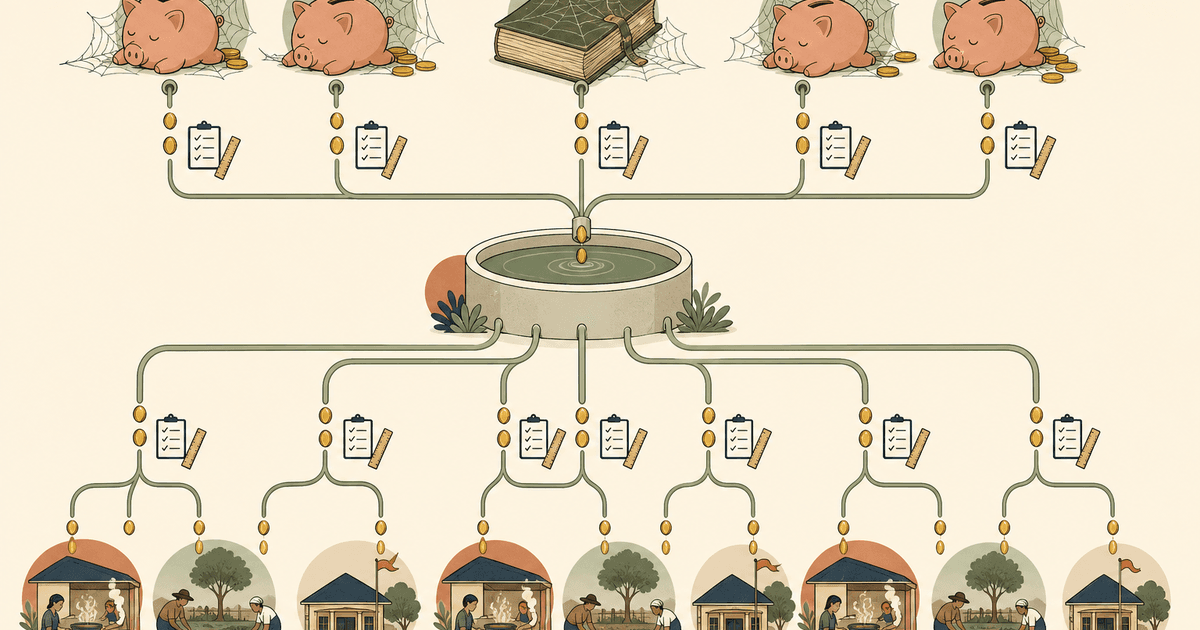
So far this series has looked at UK Social Impact Bonds and US programme-related investment. Today narrows to Japan, which already has its own funding channel built on the same premise — that measuring results is a condition of the money. The Dormant Deposit Utilization scheme draws on deposits left untouched in bank accounts for ten years or more, and channels them through a three-tier structure headed by the designated entity JANPIA to community organisations and NPOs. Since its fiscal-2019 launch, cumulative grants had reached roughly ¥40.1 billion by the end of April 2026, including funding for a children's-cafeteria network and food-bank operations in Nagano Prefecture. But getting that money means carrying out social-impact evaluation — there is no way around it. Today looks at how far this system actually reaches, what form the evaluation requirement takes, and how regional-revitalisation grant KPIs constrain project design on the ground.
This article in 3 minutes
- The Dormant Deposit Utilization Act was enacted in December 2016 and took effect in January 2018. JANPIA, the designated entity, was appointed in January 2019 and began grants to fund-distribution organisations from fiscal 2019 — cumulative grants had reached roughly ¥40.1 billion by the end of April 2026.
- The money has reached, for instance, a Nagano children's-cafeteria network covering roughly 180 sites and around 60,000 people a year, and a regional food bank — but this research did not find a JANPIA-funded project explicitly labelled a community garden or urban farm.
- Getting the money means accepting evaluation as a condition. JANPIA set an evaluation guideline in July 2019 and revised it in May 2024, imposing a four-stage cycle — pre-, interim, post- and follow-up evaluation — across every tier of the funding chain, down to the implementing organisations themselves.
- Japan's evaluation practice has not caught up with Europe: a 2016 Cabinet Office report found only 32.8 per cent of Japanese organisations were evaluating outcomes as of 2014, well behind the UK's 75.5 per cent as of 2012.
- The regional-revitalisation promotion grant makes setting and verifying KPIs a legal filing requirement. The Cabinet Office's own guideline states plainly that KPI performance 'is reflected in the following year's grant allocation' and that insufficient results 'may mean the project is not approved as planned.'
- This article's position is not to criticise Japan's evaluation system as such. Its conclusion is that the Cabinet Office's own 2016 report already names a shortage of evaluation personnel and the burden of evaluation cost as system-level problems, and that Japan's current position should be read with that self-acknowledgment in view.
Opening
Separately from the Anglo-American contracts, Japan already has its own version of 'no results, no reward'
The UK Social Impact Bond and US programme-related investment examined on day four both centred on private investors. Japan's Dormant Deposit Utilization scheme draws on money of a wholly different character. Its source is not investor capital but deposits left untouched in bank accounts for ten years or more — 'dormant deposits' that a 2016 law designated as a resource for public-interest activity. After banks complete a notification and confirmation process and the money still goes unclaimed, it passes through the Deposit Insurance Corporation into national coffers, and from there through a designated entity to public-interest work. There is no concept of investor return here; instead, the fact that the money's origin is, in principle, money that should have belonged to depositors is precisely why accountability for how it is used is demanded all the more strongly.
What makes this scheme important for this series is that it realises the same underlying logic seen in the Anglo-American cases — that measuring results is a condition of the money — inside an entirely different institutional design. Today looks at the actual scale this scheme has reached, which organisations it funds, and what shape its evaluation requirement takes on the ground.
The structure
Money flows in three tiers, from JANPIA through distribution organisations to implementing organisations
The Dormant Deposit Utilization Act (Law No. 101 of 2016) was promulgated on 9 December 2016 and took full effect in January 2018. JANPIA, formally the Japan NPO Center for Public Interest Activities Promotion, was established in July 2018 and appointed by the prime minister as the law's designated entity on 11 January 2019. Rather than running programmes itself, JANPIA funds 'fund-distribution organisations,' which in turn fund 'implementing organisations' on the ground — a two-step structure. As of the end of April 2026, a cumulative 373 fund-distribution organisations had run 254 grant projects, averaging about ¥154 million each, and 1,550 implementing organisations had received grants averaging about ¥16.24 million each. A June 2023 amendment to the law, effective from December that year, added two further channels: 'capacity-support organisations' offering non-financial hands-on support, and a higher-risk equity-investment scheme.
Sources & further reading
- 内閣府 — 休眠預金等活用制度の概要(説明資料PDF、2026年7月版)
- 内閣府 — JANPIA(指定活用団体)ページ
- 日本経済新聞 — 休眠預金原資の助成倍増、5年で300億円 子ども支援など(2023年10月)
- JANPIA情報公開サイト — 信州こども食堂ネットワーク&生活困窮世帯への継続食料支援
- JANPIA情報公開サイト — 長野県中信地域におけるフードバンク・フードパントリー事業
- JANPIA — 資金分配団体・活動支援団体・実行団体に向けての評価指針(2024年5月改訂)
- 内閣府 — 社会的インパクト評価の推進に向けて(社会的インパクト評価検討ワーキング・グループ報告書、2016年3月)
- 内閣府地方創生推進事務局 — 地方創生推進交付金の概要(平成30年11月)
- 内閣府地方創生推進事務局 — 地方創生事業実施のためのガイドライン(平成30年4月)
Everything above is free to read.
The rest is for members
This column has moved into the archive, so the full deep-dive is for Urban Farm Crew members and up. Membership funds the daily collection, research and operation of this independent public database. The latest columns are free for everyone.
Or get new columns free by email first
Every Wednesday: a free email digest of new urban-farming cases, research and events from around the world.
Reader feedback
Was this article useful?
No sign-in required. One vote per article on this device; you can change your choice.
Related columns
The gardens came in 1990, the national law in 2024 — a map of six South American countries
In South America the response to crisis came first, municipalities carried it for two decades, and national law arrived last
17 min readGermany among its neighbours — what is actually different from Britain, France and Poland?
Allotments are no German monopoly. What differs is not the number of plots but the rent cap, the closed list of termination grounds and the legal standing of the association
19 min readA Munich foundation that links 1,000 gardens — anstiftung and the network of self-making
Who keeps the gardens that no law protects?
18 min read1.5 million in the East, a 1983 law in the West — the two gardens that division made
In the East an organisation kept the gardens; in the West a statute did. What unification left standing was the statute, plus a set of exemptions written for the East
18 min read