The gardens came in 1990, the national law in 2024 — a map of six South American countries
In South America the response to crisis came first, municipalities carried it for two decades, and national law arrived last
2026-09-09 · 17 min read
Series · Crisis first, law later — urban farming in six South American countries1 / 7
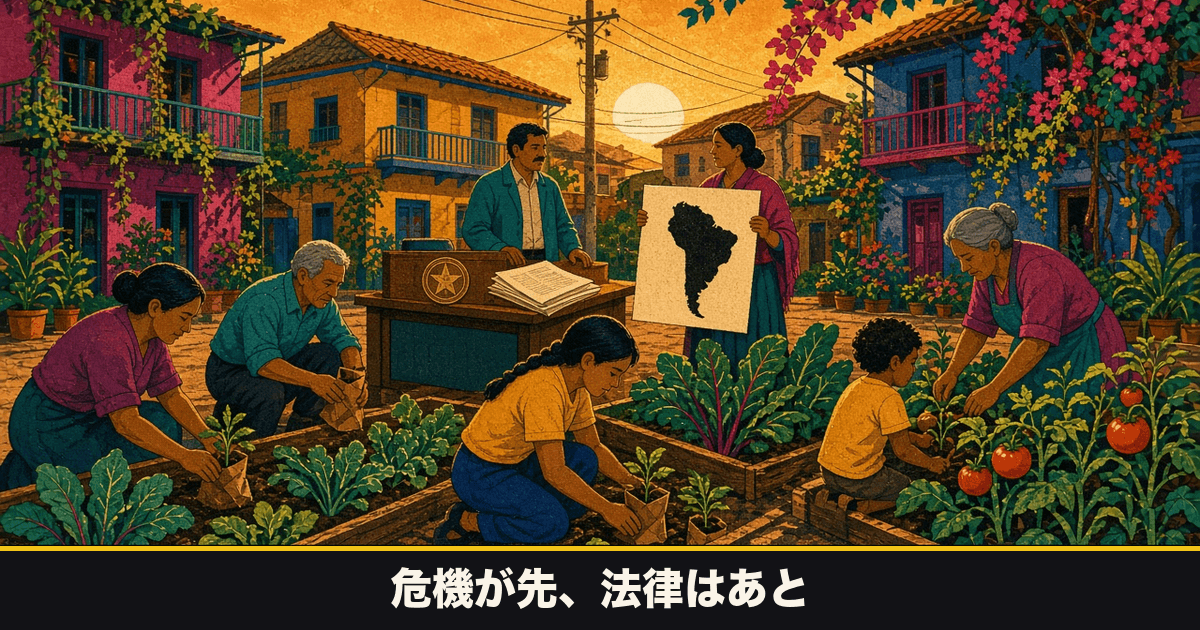
Law 14,935, which made urban farming a national policy in Brazil, appeared in the official gazette on 29 July 2024. The bill behind it was tabled in 2015 by the deputy Padre João, so it took nine years to become law. On the same continent, in Argentina, a resolution of the board of the National Institute of Agricultural Technology (INTA) launched ProHuerta on 3 August 1990 — an emergency measure to get seed and seedlings to people the 1989 economic crisis had cut off from food. Belo Horizonte in Brazil made food security municipal policy with by-law 6,352 of 15 July 1993, and Quito in Ecuador started AGRUPAR in 2002. Municipal ordinances run ten to thirty years ahead of national law. That order is the reverse of Europe's. This series works through six South American countries over seven days, and today sets out the sequence by its dates.
This article in 3 minutes
- In South America the gardens came first and the law came after. Brazil's national policy, the PNAU (Law 14,935), reached the official gazette on 29 July 2024; the bill behind it was tabled in 2015, so it took nine years.
- What moved first was a practical response to crisis. Argentina's ProHuerta began on 3 August 1990 after the crisis of 1989, and the government's own thirty-year account puts it at 637,847 gardens reaching more than four million people.
- For two decades it was municipalities that carried the gardens: Belo Horizonte with by-law 6,352 in 1993, Lima with framework ordinance 1629 in 2012, and Bogotá with Acuerdo 605 of 11 September 2015.
- The vocabulary of the statutes differs. Where Germany's Federal Allotment Gardens Act writes down a 400-square-metre plot and a rent ceiling, the South American texts write down 'agroecology' and 'food sovereignty'.
- A law does not necessarily secure the land. Buenos Aires city law 6377, passed on 3 December 2020, drew criticism from gardeners themselves over article 8, which they read as opening public land to private profit.
- This article's position is not to hold South America up as a model. Only the order is reversed: neither a rent ceiling nor long-term tenure exists there yet, and this series looks at that missing part too.
Opening
In South America the gardens came first and the national law arrived thirty years later
Set two dates side by side. On 3 August 1990 a resolution of the board of Argentina's National Institute of Agricultural Technology (INTA) launched ProHuerta. It answered the year before, 1989, when prices ran away and food stopped reaching the most vulnerable. The programme distributes seed, seedlings and tools and gives technical support to family, school and community gardens, and it is run jointly by INTA and the ministry responsible for social development. The second date is 29 July 2024, when Law 14,935, establishing Brazil's National Policy for Urban and Periurban Agriculture (PNAU), appeared in the official gazette. Thirty-four years separate one of the continent's earliest large public programmes from the only national statute among the six countries.
That order is the reverse of Europe's. In Germany, the subject of last week's series, the Allotment and Small Lease Ordinance of 31 July 1919 first set a rent ceiling and a ban on termination, and the associations and plots were built up on top of it: the law made a frame and practice grew inside it. South America ran the other way. Faced with economic collapse and hunger, residents and municipalities made gardens first, and legislation caught up decades later — and even then without touching the price of land or the length of a lease. So summarising this as 'South America was slow to institutionalise urban farming' drops half the fact. It was not slow; it went in a different order. And the lag has not finished running: as of 2026 Chile still has no statute on urban gardens, thirty-six years after ProHuerta began.
This series checks that order across six countries, and what today hands over is a chronology rather than a conclusion. ProHuerta in 1990; Belo Horizonte's by-law 6,352 in 1993; Rosario's urban agriculture programme and Quito's AGRUPAR in 2002; Lima's framework ordinance 1629 in 2012; Bogotá's Acuerdo 605 in 2015; Buenos Aires city law 6377 in 2020; Brazil's PNAU in 2024; and the Chilean bill tabled in 2025 that has still not become law. We run through that sequence once, and from tomorrow each country gets its own instalment. One thing is worth saying in advance: of the six countries, only Brazil has a current national statute that deals with urban farming head-on. What holds up the other five is not national law but municipal ordinances and national programmes.
What this covers
This series covers six countries on the South American continent, and Cuba is not one of them
The six countries are Argentina, Brazil, Colombia, Peru, Ecuador and Chile. Cuba is the name that usually comes up first when Latin American urban agriculture is mentioned, and this series leaves it out for two reasons. The first is that an earlier column, Urban Farming in Cuba: Farming Born of Necessity, already covers it. The second is that the conditions are too different. Cuba's organopónicos spread under a system in which the state held both the land and the distribution network, and under the very particular condition of the import collapse of the 1990s. Measuring that on the same scale as six countries with private land and market economies distorts the understanding of both. In these six, the ground a garden sits on is usually municipal property or privately owned, and what residents can obtain is a permit or a temporary right of use. The starting point — who holds the land — is simply different.
One more line is worth drawing: national law and municipal ordinance are not mixed here. In South America the municipal ordinances came earlier, were more numerous, and for a long stretch mattered more on the ground. Belo Horizonte and Rio de Janeiro in Brazil, Rosario in Argentina, Bogotá and Medellín in Colombia all ran their own machinery for roughly two decades with no reference to national law. So when reading the chronology, do not read 'no national law' as 'no institution'. The institutions existed. They sat inside city hall, in a place where the budget could vanish when the mayor changed. Nor were they small. Medellín's garden programme in Colombia set itself a target of 1,707 plots in three years, and Bogotá's municipal platform keeps track of more than 4,000 gardens and more than 20,000 urban growers.
Sources & further reading
- Câmara dos Deputados (Brasil) — Lei cria Política Nacional de Agricultura Urbana e Periurbana (Lei 14.935/2024, PL 906/15)
- Argentina.gob.ar — ProHuerta: una política pública con más de 30 años de historia
- Observatorio Ambiental de Bogotá — Se establecen lineamientos para el programa de Agricultura Urbana y Periurbana Agroecológica (Acuerdo 605 de 2015)
- Quito Informa (Municipio del Distrito Metropolitano de Quito) — En Quito se aprobó una ordenanza que fomenta la creación de huertos urbanos
- World Future Council / futurepolicy.org — Belo Horizonte's Food Security Policy (Municipal Law 6,352 of 1993)
- World Future Council / futurepolicy.org — Quito's Participatory Urban Agriculture Programme (AGRUPAR)
- WRI Ross Center Prize for Cities — Sustainable Food Production for a Resilient Rosario
- El Barrio Pueyrredón — Ley de agricultura urbana: huerteros alertan por «la posibilidad de uso de tierras públicas con fines de lucro privado» (Ley 6377, CABA)
- Actualidad Jurídica, Diario Oficial de Chile — Proyecto de ley fija normas para el fomento, desarrollo y registro de huertos urbanos (Boletín 17.433-06)
- CEPES — Biohuertos en ollas comunes: claves para seguridad alimentaria y medio ambiente (Ordenanza 1629, Lima)
Starting point 1989–2002
What made the first gardens was not an idea but the year the food stopped arriving
Start with Argentina. In 1989 runaway prices broke the food supply to the most vulnerable, and on 3 August 1990 a resolution of INTA's board launched ProHuerta. What it hands out is not cash but seed, fruit plants and tools, together with technical support for growing and education about food and the environment. It is run not by INTA alone but jointly with the ministry responsible for social development, and that choice shows where it began: on the social-policy side, not the agricultural one. A government article looking back over thirty years reports 637,847 gardens across more than 3,700 localities, roughly 97 per cent of them family gardens, supported by 9,192 promoters of whom 67 per cent are women, alongside 744 agroecological markets, more than 3,000 partner organisations and over four million people reached.
In Rosario, in the same country, the trigger was the economic collapse of 2001. The city joined forces with the NGO CEPAR and with ProHuerta and opened idle land to residents: strips beside railway lines, low ground that floods, green space left unfinished. What marks this period is that usability was judged by whether the ground could be cultivated rather than by the status of the site. A municipal ordinance of 2004 created a mechanism granting the urban poor temporary tenure of vacant public land, and gave the arrangement a category of its own, the parque huerta or garden park. This site's record puts the idle land opened up at roughly 36 per cent of the city's surface, and reports some 800 gardens producing vegetables for around 40,000 people within two years of the start. That word 'temporary' enters here, and it matters later.
Quito in Ecuador takes the same shape. In 1999, 48 per cent of the city's population was below the poverty line. A citizens' consultation on urban agriculture was held in 2000, and in 2002 AGRUPAR was launched as a formal municipal programme. Since 2005 it has been delivered by CONQUITO, the city's economic development agency — not a welfare department and not an agriculture department, which is worth remembering. The World Future Council's record puts the programme at 3,679 gardens covering 32 hectares, producing more than 960,000 kilograms of food a year and directly benefiting 73,936 people. In 2018 it took the silver Future Policy Award, run with FAO and IFOAM.
Who carried it 1993–2015
For two decades it was city halls, not national governments, that carried the gardens
Belo Horizonte in Brazil is the earliest case. Municipal by-law 6,352 of 15 July 1993 set a food-security policy framework and created a municipal secretariat for supply, SMAB, later SUSAN. It was pushed through by Patrus Ananias, newly elected as mayor. The policy linked producers directly to consumers, used public procurement to diversify local production, and folded support for urban agriculture and agroecology into that supply policy. The World Future Council's record puts the cost of running it at roughly 2 per cent of the city's annual budget, on the order of 25 million US dollars a year. A city of some two million people did this on its own, thirty-one years before the national law existed.
Rosario firmed up its skeleton in this period. The 2004 ordinance granted temporary tenure, and a 2015 ordinance permanently designated 800 hectares of peri-urban land for agroecological production — the area known as the Cinturón Verde, the green belt. WRI's record puts the gardens and growing land inside the city at 75 hectares, with more than 2,400 households keeping their own plot and producing roughly 2,500 tonnes of fruit and vegetables a year; in 2020–21 the city took the grand prize of the WRI Ross Center Prize for Cities. What deserves attention is the difference in how the two designations were made. The 800 peri-urban hectares are permanent; the plots inside the city are temporary. Within one policy of one city, the strength of tenure comes in two grades.
The two Andean capitals acquired their ordinances in the 2010s. Metropolitan Lima in Peru enacted framework ordinance 1629 in September 2012, positioning urban agriculture against four stated aims at once: environmental management, food security, social inclusion and local economic development. What stands out is the enumeration of forms — roofs, terraces and back yards, community gardens, gardens at schools and public institutions, productive gardens, agro-parks, and the use of vacant land under agreements with its owners. Bogotá in Colombia set guidelines institutionalising a district programme of urban and peri-urban agroecological agriculture through Acuerdo 605 of 11 September 2015. The district environment secretariat leads it, while the José Celestino Mutis Botanical Garden provides technical advice, training and monitoring and keeps the register of growers.
National law 2020–2026
National law arrived only recently, and in Chile the bill is still stuck
Take Brazil's PNAU. Law 14,935 reached the official gazette on 29 July 2024. Behind it was bill 906/15, tabled in 2015 by the deputy Padre João of the Workers' Party, representing Minas Gerais — nine years to passage. The law sets out seven aims: to widen food and nutritional security for vulnerable urban populations, to make use of unused urban space, to create paths to income, to connect urban food production with public procurement for schools and hospitals, to support family and cooperative producers, to advance environmental education and agroecological and organic production in cities, and to promote the recycling of organic waste and the use of rainwater. It also provides dedicated credit lines, and it is to be delivered in a decentralised way through cooperation among federal, state and municipal government, civil society and educational institutions.
Argentina still has no national statute; what stands in its place is city law 6377, passed by the capital's legislature on 3 December 2020 and tabled by the socialist legislator Roy Cortina. It defines urban agriculture as an agricultural practice located in a metropolis and oriented to producing and processing food in line with the principle of sustainability, and defines urban agroecology separately. Article 8 lets any natural or legal person, public or private, apply for permission to use suitable public land as a community garden — and that article became the point of attack. The gardeners' collective El Reciclador and the network Red Inter-Huertas argued it leaves room for public land to be used for private profit. That this is a city law rather than a national one, and that the people on the ground did not welcome it, are both worth holding on to.
Chile is still at the bill stage. A private member's bill setting rules for the promotion, development and registration of urban gardens was tabled in the Chamber of Deputies in March 2025 as boletín 17.433-06 by the deputies Mulet, Félix González, Melo, Oyarzo and Saffirio together with deputy Veloso. It defines an urban garden as a growing space of up to 500 square metres within urban territory, meant for growing vegetables, fruit, medicinal herbs and flowers for the growers' own consumption, and it creates a register of such gardens. It permits temporary use of abandoned sites that pose a safety risk while forbidding anyone to sleep on them. What can be confirmed is that it was referred to the Chamber's committee on housing, urban development and national assets. On 29 April of that same year, 2025, Quito's metropolitan council approved an ordinance opening unused municipal land to gardens and requiring new residential developments to include space for them. Municipalities moving ahead without waiting for the national government is a pattern that still holds in 2026.
The words and the department
What marks South America out is that 'agroecology' and 'food sovereignty' are written into the statutes
What Germany's Federal Allotment Gardens Act writes down is a measurement and a price: a plot of no more than 400 square metres, a shed of no more than 24, and rent capped at four times the local going rate for commercial fruit and vegetable growing. It says nothing about how to grow. The South American texts do the opposite and write down method and purpose. Bogotá's Acuerdo 605 carries 'agroecological agriculture' in the name of the programme itself and enumerates eight production methods — vertical growing, biointensive beds, floating-root systems, raised beds, growing from recycled materials, family farming, biological fertilisers and biological control agents. Brazil's PNAU sets out agroecological and organic food production in cities and goes as far as recycling organic waste and using rainwater. Chile's bill caps a growing space at 500 square metres, but even there the only number is an area; the rent is untouched.
The department it sits in differs too. ProHuerta is jointly run by the ministry responsible for social development and by INTA; it is not a standalone agricultural project. Belo Horizonte put it under the secretariat for food supply. Quito's AGRUPAR is delivered by CONQUITO, the economic development agency, which hands out seed and training and even runs the bioferias where the produce is sold. Lima's ordinance 1629 leads with environmental management but sets food security, social inclusion and local economic development on the same line. Set against Germany, where allotments belong to the parks and planning side of government, the shelf these programmes sit on is plainly a different one. In South America urban farming began as food and welfare policy rather than as green policy.
There is an exception. What mainly drives Bogotá's Acuerdo 605 is the district environment secretariat, with the botanical garden carrying the technical side — sitting on the green and environmental side of government, closer to Europe. The continent is not of one piece. So saying that food-security bodies run these programmes in South America describes a tendency rather than a rule. What is more interesting is that a different department produces a different programme. Belo Horizonte, run from the supply secretariat, built its work around public procurement and direct sales; Quito, run from the economic development agency, built it around market-oriented production and routes to sell; Bogotá, run from the environment secretariat and the botanical garden, built it around growing technique and a register. Which shelf a programme is put on decides what it makes.
The limits
A law being passed is not a guarantee that the ground stays a garden
Put Rosario first. What the 2004 ordinance granted was temporary tenure of vacant public land, not a permanent right. This site's own record notes that even in Rosario, internationally praised as it is, the number of participating households has fallen in recent years as public support thinned. A garden does not only disappear when an ordinance is repealed. If the budget stops, if the seed and materials and training stop, if the city stops walking alongside, the ordinance stays on the books and only the garden goes. Where Germany's Federal Allotment Gardens Act cut the plot loose from the price of land through a rent ceiling, the South American ordinances and statutes have so far not touched ground rent at all. What happens when land values rise has not yet been tested.
Buenos Aires makes the point one degree more sharply. Article 8 of city law 6377 allows applications for permission to use public land as a community garden, and the applicants need not be public bodies: private legal persons may apply too. The gardeners' organisations took issue precisely there. Agustín Reus, who handles agrarian economics for El Reciclador, said the bill was presented in a watered-down form and forced through by the governing majority. It is an example of a law being passed without that being a victory for the people on the ground. When a chronology of institutionalisation is drawn up, what those people said in the year of each entry has to be read alongside it. Article 8 does admit another reading, though. Drawing the class of applicants widely also opens a route for incorporated citizens' organisations to obtain permits on public land. What drew fire was the breadth of the clause, not the merit of the law as a whole.
The laws still matter. Brazil's PNAU creates a reference point that does not vanish when a municipal budget changes, and it writes in concrete routes to money through public procurement and credit lines. Quito's 2025 ordinance goes as far as requiring new residential developments to set aside space for gardens — a way of moving the plot from 'greenery that would be nice to have' to 'land to be secured when building'. Both of these are clauses that could only be written because twenty years of practice came first. The reversed order is a weakness and, at the same time, the condition that made the texts so specific. Quito's ordinance also carries a numerical target: from roughly 2,000 urban gardens in the city to 4,000 by 2030. ConQuito, the economic development agency, supplies the seed and the training, and the produce is sold at bioferias run by the zonal administrations together with ConQuito. The text also states explicitly that existing traditional markets are not to be undercut.
Recap
What today hands over is one sequence running through six countries
Lay the route out once more. It starts with Argentina's economic crisis of 1989, and on 3 August 1990 a resolution of INTA's board launched ProHuerta. On 15 July 1993 Belo Horizonte made food security municipal policy through by-law 6,352. After the collapse of 2001, Rosario set up its urban agriculture programme in 2002 and, by ordinance in 2004, institutionalised temporary tenure and the parque huerta. Quito began AGRUPAR in the same year, 2002, delivered by CONQUITO from 2005. Lima passed framework ordinance 1629 in September 2012 and Bogotá passed Acuerdo 605 on 11 September 2015. Buenos Aires city law 6377 came on 3 December 2020, Brazil's PNAU, Law 14,935, reached the gazette on 29 July 2024, Chile's bill 17.433-06 was tabled in March 2025, and Quito approved its new ordinance on 29 April that year.
Three points restated. First, the order is reversed. Germany had the Allotment and Small Lease Ordinance of 31 July 1919 first, and associations and plots were built on top of it. South America had the practical response to crisis first, and national law came thirty-four years behind. Second, what carried the intervening two decades was municipal government: Belo Horizonte in 1993, Rosario in 2004, Lima in 2012, Bogotá in 2015, all of them moving with no reference to national law. Third, the words in the texts differ. Where the Federal Allotment Gardens Act writes 400 square metres and a rent ceiling, Bogotá's Acuerdo 605 carries 'agroecological agriculture' in the programme's own name and lists eight growing methods — and the responsible bodies sit with food security, social development and economic promotion rather than with parks or planning.
The gaps and reservations belong on the record. First, where the Chilean bill now stands. The tabling in March 2025 and the committee referral can be confirmed; what has happened since, and whether it has passed, this article has not been able to verify, and no record of its passage was found. Second, the provenance of the numbers. ProHuerta's 637,847 gardens and four million people come from a government article summing up thirty years, so they date from around 2020; other published accounts of the same programme give around 80 per cent of the country's municipalities and about three million people, so the count varies with the method. AGRUPAR's 3,679 gardens and Rosario's 2,500 tonnes are likewise measured at different moments. Third, this article arranges everything around the arrival of law and does not count the gardens the law failed to keep; how many plots disappeared after an ordinance was passed is not something today's instalment can show. The obvious objection sits here too — that drawing a chronology of institutions is itself a way of making the practice that never entered an institution invisible.
Today's place in the series is the chronology. Each of the six days that follow enlarges one point on it, country by country. Day two is Argentina, reading the institution the collapse of 2001 produced through Rosario as the prototype; today gave the 2004 ordinance and the 800 hectares of 2015 a line each. Day three is Brazil, and how a municipality kept going for thirty-one years before the national government caught up. Day four is Colombia, the soil after the conflict, in Medellín and Bogotá. Day five is Peru, water and the communal cooking pot in a city where it does not rain. Day six is Ecuador and what twenty years of participation actually looks like inside Quito's AGRUPAR. Day seven is Chile, the country where the law has not arrived. As you read, it helps to keep asking which of the three stages — crisis, municipality, national law — a given point belongs to. Do that and the seven days join into one line.
Key takeaways
- In South America the gardens came first and the law came after: thirty-four years separate the launch of ProHuerta on 3 August 1990 from the appearance of Brazil's national policy, Law 14,935, in the gazette on 29 July 2024.
- Crisis made the first gardens: ProHuerta answered the crisis of 1989, Rosario the collapse of 2001, and Quito's AGRUPAR a situation in which 48 per cent of the city was below the poverty line in 1999.
- Municipalities carried the intervening two decades. Belo Horizonte's by-law 6,352 of 1993 is reported to have taken roughly 2 per cent of the city's annual budget, on the order of 25 million US dollars a year.
- The national law took nine years to arrive. Bill 906/15, behind Brazil's PNAU, was tabled by the deputy Padre João in 2015 and became Law 14,935 in 2024.
- The vocabulary of the statutes differs. Germany's Federal Allotment Gardens Act writes 400 square metres and a rent ceiling; Bogotá's Acuerdo 605 carries 'agroecological agriculture' in its name and lists eight growing methods.
- These programmes sit with food and welfare rather than with parks: ProHuerta is run jointly by the social-development ministry and INTA, Belo Horizonte by its supply secretariat, and Quito's AGRUPAR by the economic development agency CONQUITO.
- A law does not secure the land. Rosario's 2004 ordinance granted only temporary tenure, and article 8 of Buenos Aires city law 6377 was criticised by gardeners as opening public land to private use.
This column is free to read
As new columns publish, older ones move into the members' archive. Join the free newsletter to get every new column and the week's urban-farming news by email.
Reader feedback
Was this article useful?
No sign-in required. One vote per article on this device; you can change your choice.
Related columns
Disaster and urban farming ⑦ — Keep growing a farm that is useful to its community
The seven-day conclusion: preparedness cultivates everyday relationships
15 min readDisaster and urban farming ④ — Do not rush to ‘green’ damaged land
Christchurch and the time needed for temporary use and recovery
15 min readUrban Farming and Community: The Social Capital that Soil Grows
How strangers become neighbours — read through social science and the world's gardens
21 min readThe national law came for the pot, not the plot — Peru, Lima's gardens and communal kitchens
In a city with under 15 millimetres of rain a year, what keeps the gardens going is a municipal ordinance and women's neighbourhood organisations
17 min read