The law came in 1930 and patent number one went to a climbing rose — rights over plant varieties were built in under a century
Plant patents, the UPOV Convention, the 1991 revision and Farmers' Rights: four decisions drew the line we live with
2026-09-18 · 15 min read
Series · Who owns a seed — ownership drawn by registration, patents and landraces3 / 7
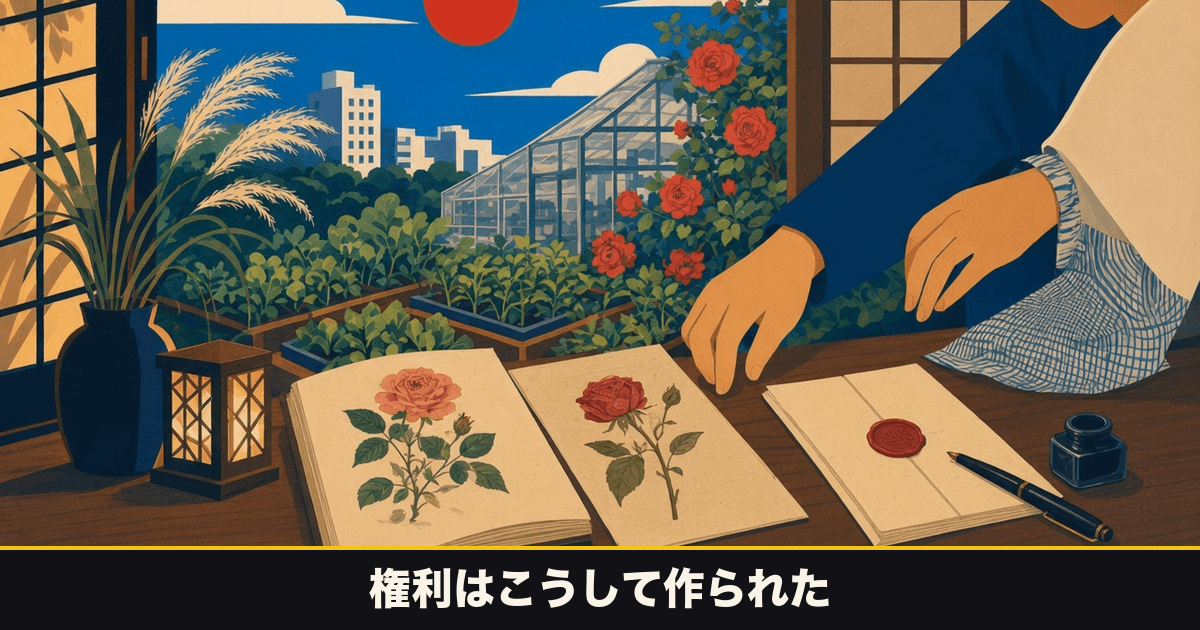
The first thing America's plant patent law protected was not a seed but a flower. The United States Plant Patent Act became law on 23 May 1930, and plant patent number one, issued the following year, went to a climbing rose with ever-blooming properties called The New Dawn. The Act itself left out seeds, potatoes, corn and other cereals and grains. In America, in other words, rights over plant varieties began with a law that did not cover seed. Thirty-one years later, on 2 December 1961, an international convention protecting plant varieties themselves was concluded in Paris. The revision of 19 March 1991 took the practice of a farmer resowing seed harvested on their own land out of the convention's general rule and placed it inside an exception each country may choose to grant. What the farmers' side had been arguing became treaty text in 2001, in force on 29 June 2004. Rights attached to seed are not an old and settled fact of life. They were assembled in under a century, one decision at a time, each made to solve somebody's problem.
This article in 3 minutes
- Rights over seed are not an old and settled fact. The United States Plant Patent Act became law on 23 May 1930, and the first plant patent, issued the following year, went to a climbing rose called The New Dawn.
- The 1930 Act protected only plants grafted or otherwise propagated by hand. Seeds, potatoes, corn and other cereals and grains were left out, and crops raised from seed had to wait for a separate statute in 1970.
- The international convention protecting varieties themselves was concluded in Paris on 2 December 1961 and revised in 1972, 1978 and 1991. On 24 April 1998, the day the 1991 Act entered into force, the 1978 Act closed to new accessions.
- What the 1991 revision moved was the standing of farm-saved seed. The United States Senate report on the treaty says the farmers' privilege was 'explicitly recognized but also partially eliminated'. Selling that seed to other farmers is not permitted.
- Farmers' Rights became treaty text in the International Treaty on Plant Genetic Resources for Food and Agriculture of 2001. But the treaty places the responsibility for realising them with national governments. It does not create the right itself.
- This is not a story with a villain. Breeding takes long years and capital, and sowing the seed you saved is as old as farming itself. Where to draw the line has been the argument of the past century.
Opening
Rights over seed are recent, and the first plant ever patented was a garden rose
The list of milestones in United States patenting kept by the Patent and Trademark Office includes plant patent number one: a climbing rose called The New Dawn. Not wheat, not rice, not a tomato. A flower for the garden. The office reports that plant patents remain popular, with more than a thousand still issued every year. We tend to treat the fact that somebody holds rights over seed and nursery stock as though it had been the system's setting from the start. Yet number one dates from 1931, not yet a hundred years ago. The system did not grow on its own. It exists because people lobbied a legislature, a bill passed, and an office began examining applications.
Institutions are built in an order. Breeders had something to protect and so did farmers, and states kept rewriting treaty text with both in view. Every rewrite moved the line. What follows sets out only the direction it moved and the reasons given at the time, decision by decision. It does not rule on who was right. The dates matter for a reason. Accept an institution as the way things have always been, and it stops looking like something anyone could change. 1930, 1961, 1991, 2001: each has a day on which people in a room decided something, and each of those people had a name and an employer. What was decided can be decided again.
The stage is mostly the United States and an international convention that began in Europe. The rules where you live are that international frame translated into a national statute, and every country translates differently. Two members of the same convention need not allow farmers the same latitude. So when a convention's text is quoted below, it does not automatically become the rule for your own plot. Where Japan stands now is day five, the seed business as an industry is day six, and the argument itself is day seven. Today looks at the trunk beneath them all. Every national rule branched off from here. In plain terms, it is the ground those laws have in common.
The route
Today's line was built by four decisions stacked in order
The first is the United States Plant Patent Act of 1930, which allowed patents on plants propagated by hand and put the breeder in the same category as the inventor. The second is the International Convention for the Protection of New Varieties of Plants, concluded in Paris in 1961. It protected the variety itself through a mechanism separate from patents and set out to make that protection work across borders. The third is the revision made at Geneva in 1991, which widened the acts the breeder's right reaches and rewrote, in plain terms, how farm-saved seed is treated. The fourth is the International Treaty on Plant Genetic Resources for Food and Agriculture of 2001, which put the phrase Farmers' Rights into treaty text.
None of the four came out of an abstract principle. Each began with a concrete complaint. Representative Purnell, who pushed the 1930 bill, told a House committee that its purpose was 'to afford agriculture, so far as is practicable, the same opportunity to participate in the benefits of the patent system as have been given industry.' The 1961 convention was made by countries that wanted to stop varieties they had bred being freely multiplied abroad. The 1991 revision grew out of a grievance that the breeder's right was being hollowed out. And the 2001 treaty is text pushed in by the side that believed it had lost ground over that same century.
Two further events sit on top of those four. One is the World Trade Organization agreement, in force from 1 January 1995. The TRIPS Agreement, part of that package, requires members to 'provide for the protection for plant varieties either by patents or by an effective sui generis system or by any combination thereof.' The other is what happened as countries carried that obligation out: the standard set by the international convention became, in practice, the yardstick for what a sui generis system should contain. In June 1998 the convention had 35 members. With Nigeria's accession in March 2025 it has 80, covering 99 states.
Sources & further reading
- U.S. House of Representatives, History, Art & Archives — Plant Patent Act of 1930
- USPTO — Plant patent (35 U.S.C. 161): asexually reproduced varieties, exclusions and term
- USPTO — Milestones in U.S. patenting (plant patent no. 1, 1931)
- U.S. Senate, Committee on Foreign Relations — Exec. Rpt. 105-15, Convention for the Protection of Plants (UPOV 1991)
- UPOV/EXN/EXC/1 — Explanatory Notes on Exceptions to the Breeder's Right under the 1991 Act of the UPOV Convention
- UPOV Press Release 143 — Nigeria becomes the 80th member of UPOV (80 members covering 99 States)
- FAO — International IPR agreements regulating plant varieties (UPOV Acts, TRIPS Article 27.3(b))
- FAO — Farmers' Rights and the International Undertaking: Conference Resolutions 8/83, 5/89 and 3/91
- FAOLEX — International Treaty on Plant Genetic Resources for Food and Agriculture (full text, Article 9 and Annex I)
- FAO — International Treaty on Plant Genetic Resources for Food and Agriculture, Overview
1930, the United States
Plants became patentable in 1930 so that breeders could be treated as inventors
A man who invents a mousetrap or writes a jazz song has the protection of the patent and copyright systems, while a man like Luther Burbank, who spent his life developing new plants, gets nothing. That was the argument of Fred Purnell of Indiana, and it survives in the committee record. In the Senate the bill was introduced by John Townsend of Delaware, who ran large strawberry orchards. There was opposition. Fiorello La Guardia of New York asked on the floor in early May whether the measure was needed at all. The House passed the bill anyway on 13 May 1930, and President Hoover signed it on the 23rd of the same month.
The boundary shows what kind of statute this was. It protected plants grafted or otherwise propagated by hand. Seeds, potatoes, corn and other cereals and grains were left out. The patent code still defines the subject matter as a distinct and new variety of plant that the applicant has invented or discovered and asexually reproduced, and it expressly excludes 'a tuber propagated plant or a plant found in an uncultivated state.' A potato multiplies by tuber, not by seed. On biology alone it would sit comfortably inside the definition. It was excluded anyway. The line was drawn not by biology but by the Congress of 1930.
Crops grown from seed got a frame of rights forty years later. The Plant Variety Protection Act of 1970 set up protection certificates at the Department of Agriculture for sexually reproduced varieties. Then, in 1980, came the Supreme Court's decision in Diamond v. Chakrabarty. Plants had until then been refused ordinary utility patents as products of nature; the decision opened those patents to them. A United States Senate report sets out the result: utility patents under the Patent Act of 1952, plant patents under the 1930 Act and certificates under the 1970 Act, three doors standing open at once. The system was not finished in a single stroke. The gaps were filled one at a time, after the fact.
1961, Paris
An international convention came in 1961 because varieties had begun crossing borders
On 2 December 1961 the International Convention for the Protection of New Varieties of Plants was concluded in Paris. It is administered by the International Union for the Protection of New Varieties of Plants, known by its initials as UPOV. The Food and Agriculture Organization of the United Nations is frank about its origins: the first Act was drafted principally by industrialized governments seeking to provide protections for plant breeders in their own and overseas markets. So how does it differ from a patent? A patent protects an invention, and both its subject matter and its examining logic lean industrial. UPOV built a separate system. Is the variety distinct from others? Is it uniform? Does it stay the same as it is propagated? A variety is examined for distinctness, uniformity and stability, and protected on that basis.
The convention has since been rewritten three times: on 10 November 1972, on 23 October 1978 and on 19 March 1991. Its formal name still carries the original date and all three revision dates. The 1978 Act entered into force on 8 November 1981. Under the system as it then stood, what the breeder held was the right to require authorization, in respect of propagating material, for three acts in the words of the text: production for purposes of commercial marketing, the offering for sale, and the marketing. Just three. That short list would turn out to matter.
That short list mattered in practice. A farmer sows, on their own land the following year, seed harvested on that same land. The act is neither production for purposes of commercial marketing, nor an offering for sale, nor marketing. It was simply never on the list of what the text prohibited, and the practice survived as something the rule did not reach. The 1978 Act had a second feature: a ban on double protection. A country with both patents and breeders' rights on its books could grant only one of them for one and the same botanical genus or species. The coverage required of members was modest too. The standard of the day was to reach at least twenty-four genera or species within eight years of becoming bound.
1991, Geneva
The 1991 revision moved farm-saved seed from outside the ban into an exception states may grant
The 1991 revision pushed the breeder's right outwards in three directions. First, more acts needed authorization. Alongside the earlier three came exporting, importing, conditioning for the purpose of propagation, and stocking for any of those purposes. Second, the right reached harvested material: where it is obtained through unauthorized use of propagating material, and the breeder had no reasonable opportunity to exercise the right at the propagating-material stage, the harvested material needs authorization too. Third, the concept of an essentially derived variety arrived. Registering a separate variety on the strength of superficial cosmetic changes had been undermining and diluting the breeder's right. The United States Senate report says this ends the practice.
And farm-saved seed? Under the 1991 Act each Contracting Party may, 'within reasonable limits and subject to the safeguarding of the legitimate interests of the breeder', restrict the breeder's right so that farmers can use for propagating purposes, on their own holdings, the product of the harvest obtained by planting the protected variety on those same holdings. As the wording shows, this is not an obligation. It is an option a country may take. The United States Senate report sums the change up in a sentence: the farmers' privilege was 'explicitly recognized but also partially eliminated'. And Contracting Parties may not go so far as to let farmers sell that seed on to other farmers.
How far should the exception reach? The 1991 Diplomatic Conference left a recommendation: the provision should not be read as intended to open the possibility of extending the practice commonly called farmer's privilege to sectors of agricultural or horticultural production in which such a privilege is not a common practice in the territory of the Contracting Party concerned. UPOV's explanatory notes build on this. The provision contemplates crops such as small-grained cereals, where the harvested grain can equally serve as seed, and it may be considered inappropriate to introduce the exception for sectors such as fruit, ornamentals and vegetables, where using harvested material as propagating material has not been common practice. The same act of saving seed was treated differently for a grower of small-grained cereals and for a grower of vegetables. The line ended up in a different place for different crops.
1983–2004, Rome
Farmers' Rights entered a treaty in 2001, and delivering them was left to national governments
The other side was moving somewhere else. In November 1983 the twenty-second session of the FAO Conference, meeting in Rome, unanimously adopted the International Undertaking on Plant Genetic Resources. It had no binding force. In November 1989 the twenty-fifth session defined Farmers' Rights: rights arising from the past, present and future contribution of farmers in conserving, improving and making available plant genetic resources, particularly those in the centres of origin and diversity. In November 1991, the same year Geneva moved farm-saved seed into an exception, the twenty-sixth session affirmed that states hold sovereign rights over their own plant genetic resources.
The binding treaty came in 2001. The International Treaty on Plant Genetic Resources for Food and Agriculture was open for signature from 3 November 2001 and entered into force on 29 June 2004. At its centre is the Multilateral System, which, in FAO's description, puts 64 of our most important crops — crops that together account for 80 per cent of the food we derive from plants — into an easily accessible global pool. Count the crops annexed to the treaty and you get 35 food crops and 29 genera of forages. Rice, wheat, potato and maize are all there. Potatoes and corn, both left out by the 1930 Act, now sit on the shared side. Here seed is handled not as somebody's property but as a shared resource.
Farmers' Rights sit in a single article of three paragraphs. In the first, the Contracting Parties recognise the contribution made by local and indigenous communities and by farmers all over the world. The second is the crux: the Contracting Parties agree that the responsibility for realising Farmers' Rights rests with national governments. It lists measures — protecting traditional knowledge, sharing in benefits, participating in national decisions — but every one of them sits inside the qualifier 'as appropriate, and subject to its national legislation.' The third says nothing in the article shall be read to limit any rights farmers have to save, use, exchange and sell farm-saved seed. It does not create a right. It refrains from taking one away. The continuing argument over how much it delivers is rooted in that drafting.
Two arguments
Breeders and farmers both had something to protect, and the line was redrawn again and again
Bringing out a new variety takes years and capital in crossing, selection and trials. That is where the breeders' argument begins. The United States Senate report, writing in 1998, noted that the country exported over six billion dollars of seed a year, much of it cereals such as corn, wheat and oats and food plants such as potatoes. In non-member countries, it said, farmers freely sell harvested grain as seed to others, competing with plant breeders. Without a prospect of recouping the outlay, the argument runs, research and development thins out and varieties for that country's own market stop being made. Membership of the convention did grow, and it now stands at eighty.
The farmers' argument is just as concrete. In 1994 the United States became the first member to amend its domestic law to match the 1991 revision. Yet by the State Department's own account, part of that implementing legislation — language prohibiting farmers from selling protected seeds — was controversial at the time and delayed the treaty's submission to the Senate. The Supreme Court's 1995 decision in Asgrow Seed Co. v. Winterboer laid the uncertainty to rest, and the implementing legislation took effect in April that year. From the institution's side, the matter was settled. For a farmer whose lawful sale had just become unlawful, the line had moved onto their side of the field. Both views describe one and the same decision.
So where does someone growing vegetables in a garden or on an allotment stand? According to an explanatory document UPOV adopted on 22 October 2009, the breeder's right does not extend to acts done privately and for non-commercial purposes. The example given is the amateur gardener. Propagating a variety for exclusive use in their own garden, with no material provided to others, may fall within that exception. The same document says a farmer growing a food crop to be consumed entirely by the farmer and dependents living on that holding may likewise be acting privately and for non-commercial purposes. But this is commentary on a convention, not the statute where you live. What decides in the end is national law.
Recap
Rights over seed were assembled from four decisions in under a century
Retrace the route. In May 1930 the United States Congress allowed patents on plants propagated by hand, and the following year, 1931, plant patent number one went to the climbing rose The New Dawn. Crops grown from seed had to wait until 1970 to come inside a frame of rights. On 2 December 1961 an international convention protecting varieties themselves was concluded in Paris, and it was rewritten in 1972, 1978 and 1991. Under the 1978 Act farm-saved seed sat outside what was prohibited. Under the 1991 Act it became an exception a state may choose, and on 24 April 1998, when that Act entered into force, the 1978 Act closed to new accessions. At FAO, Conference sessions in 1983, 1989 and 1991 adopted the Undertaking, defined Farmers' Rights and affirmed sovereign rights, and the International Treaty on Plant Genetic Resources for Food and Agriculture, open for signature from 2001, entered into force on 29 June 2004.
Three points matter most. First, the boundary in the 1930 statute was not drawn by biology alone. It protected only plants propagated by hand, and the exclusion of the potato, which multiplies by tuber, alongside seeds and grains is the proof. Second, what the 1991 revision moved was the standing of farm-saved seed. An act that had sat outside production for purposes of commercial marketing, the offering for sale and the marketing under the 1978 Act was brought inside an optional exception in the 1991 Act. In the words of the United States Senate report, the privilege was 'explicitly recognized but also partially eliminated'. Third, the 2001 treaty placed the responsibility for realising Farmers' Rights with national governments. The treaty did not hand the rights out.
This timeline has holes. First, it reads only the records left by the side that built the institutions. Statutes, legislative records and treaty commentary survive. How many farmers stopped doing something on their own land in the year a provision changed is a figure this article cannot give. Second, a membership of eighty measures the spread of the system and nothing more. What each national law permits farmers to do differs from country to country, and two members of the same convention are not aligned in substance. Third, there is an obvious objection: drawing a chronology of institutions is itself a way of hiding the practice that never entered one. Seed handed from one person to another, appearing in no text, appears on no line of this timeline.
This instalment is day three of the series, and it has followed the order in which the institutions were built. Day one laid out the four mechanisms that draw lines around seed; day two showed that what stops F1 seed from reproducing true is biology, not law. Today laid the dates of statutes and treaties over both. Tomorrow, day four, comes down to the ground, to the people actually keeping seed that nobody owns — community seed banks and the work of holding on to landraces, the side that does not appear in the chronology. Day five is where Japan stands now, day six follows the money, and day seven closes with the argument and the practice. Behind each of those stories stands one of today's four decisions. In 1930 a legislature allowed patents on plants propagated by hand and left out the potato. In 1991, at Geneva, farm-saved seed became an exception. Every line has a date, and people who decided it. So take the seed you harvested this year and mean to sow next year. Who decided you may sow it? In what year was that line drawn? And when it is redrawn, will you once again be outside the room?
Key takeaways
- Rights over seed are not an old and settled fact. The United States Plant Patent Act became law on 23 May 1930, and plant patent number one issued the following year, in 1931, for a climbing rose.
- The 1930 boundary was not drawn by biology alone: it protected plants propagated by hand, and the potato, which multiplies by tuber, was excluded along with seeds and grains.
- Under the 1978 Act the breeder held authorization rights over just three acts — production for purposes of commercial marketing, offering for sale, and marketing. Farm-saved seed lay outside them.
- The 1991 revision moved farm-saved seed into an exception each country may choose to grant. The United States Senate report described it as 'explicitly recognized but also partially eliminated'.
- The spread shows up in the count: 35 members in June 1998, and 80 covering 99 states after Nigeria's accession in March 2025.
- The 2001 International Treaty put Farmers' Rights into treaty text, but it placed the responsibility for realising them with national governments. What they amount to depends on national law.
- Acts done privately and for non-commercial purposes sit outside the breeder's right. UPOV's explanatory notes give the example of an amateur gardener propagating a variety for use only in their own garden.
Don't miss the rest of the series
Columns publish one each morning, seven to a series. The free weekly email wraps up the series that just ended and introduces the one that's starting — every Wednesday.
Reader feedback
Was this article useful?
No sign-in required. One vote per article on this device; you can change your choice.
Related columns
F1 seed scatters in the second generation — what stops it is biology, not law
Hybrid vigour, segregation and male sterility: three steps that explain why saved seed does not come back the same
16 min readIt is not one law that draws the line around a seed — breeder's rights, patents, contracts and custom
The four overlap on the same plant, and each of them bites in a different place
15 min readDevelopers do not build farms for the vegetables
From Agritopia to Porte de Versailles — line them up under the same question and you can see what is actually being recovered
22 min readDisaster and urban farming ① — Reading a farm as emergency open space
From food production to evacuation, firebreaks and neighbourhood hubs
15 min read