No results, no payment — the gamble of the Social Impact Bond
Investors put up the money first, and the government pays only if results appear — one case that worked, and one that didn't
2026-08-29 · 21 min read
Series · How do you measure 'good for society'? — urban farming and social impact4 / 7
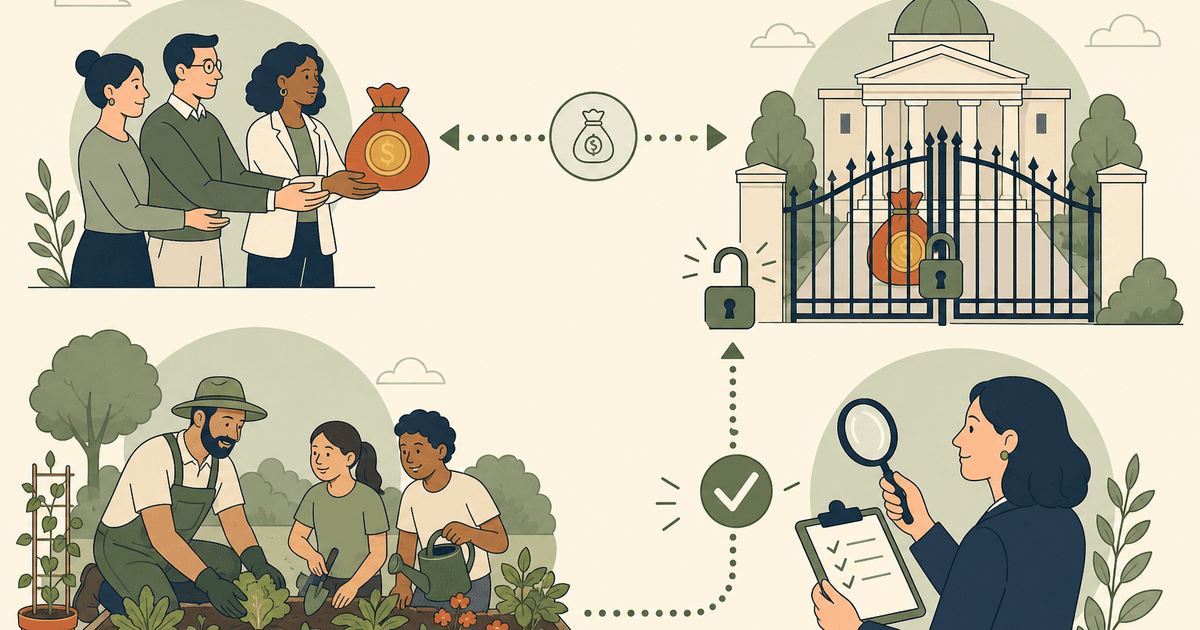
Day three established that the phrase 'impact investing' was coined only in 2007. Today looks at what that idea actually became as a contract. A Social Impact Bond — also called 'Pay for Success' — has investors put up the operating money for a welfare programme first, with government repaying their capital and interest only if an independent evaluator confirms a predetermined outcome was met. If the outcome fails to appear, investors lose money. The world's first such contract began in 2010 at a prison in Peterborough, England, and hit its target seven years later. A comparable contract in New York, using the same model, was shut down in 2015. Today draws on both the case that worked and the one that didn't to see what this contract form actually does on the ground.
This article in 3 minutes
- The world's first Social Impact Bond began in September 2010 in Peterborough, England. Social Finance raised £5 million from 17 investors to fund a programme reducing reoffending among short-sentenced male prisoners.
- The payment threshold was a cut of at least 7.5 per cent in reoffending. An interim result published in August 2014 showed an 8.4 per cent reduction, and the final result, published in August 2017, showed 9 per cent over seven years — triggering repayment of investors' capital plus a return just over 3 per cent a year.
- The model spread globally, but not every attempt succeeded. A comparable contract launched in 2012 at Rikers Island jail in New York was ended in August 2015, after the Vera Institute of Justice concluded in 2016 that it had not significantly reduced recidivism.
- As of November 2024, Oxford's INDIGO tracking database recorded 300 impact bonds worldwide. A leading critique, published in Stanford Social Innovation Review, points to 'creaming' — the perverse incentive to select only the clients easiest to help — as a documented risk of the model.
- The US has developed a parallel model, programme-related investment. The Ford Foundation pioneered it in 1968 and has since committed a cumulative total of more than $865 million. The F.B. Heron Foundation had shifted 100 per cent of its endowment into mission-aligned investment by December 2016.
- This article's position is not to pronounce this contract form good or bad. Its purpose is to show, through both a success and a failure, that the design itself — no payment without proven results — places a distinct new kind of pressure, in cash flow and in administration, on the organisation running the programme on the ground.
Opening
A four-party contract — investors, the service provider, an independent evaluator, and government
A Social Impact Bond only works when four distinct parties are in place. Investors put up the money to run a support programme first. A service provider, typically a nonprofit, delivers the actual programme — job training, life-skills support, whatever it is — using that money. Once the programme has run for a set period, an independent evaluator with no stake in the contract confirms whether a predetermined indicator, such as a drop in reoffending or a rise in employment, was actually met. Only then, and only if it was met, does government, a local authority or a foundation repay investors their capital plus interest. If the target is missed, investors lose some or all of what they put in. The point of the design is to shift the risk of spending public money upfront away from government and onto investors.
Day one of this series introduced Peterborough as one example of a Social Impact Bond. Today returns to it, examining that success in detail alongside a case that failed. An outcome-based contract looks rational on its face — public money only pays for what actually worked. What that rationality does to the organisation on the ground, though, is invisible if you only look at the successes. Today covers both the light and the shadow.
The stakes for providers
The provider has to survive on its own cash flow until the results come in
Consider what this contract does to the support organisation on the ground, by tracing the flow of money. The provider itself runs the programme using money that ultimately comes from investors, but investors are repaid only after results are confirmed — meaning the provider has to cover its own day-to-day running costs until that confirmation arrives. A 2010 report by the US Government Accountability Office found that smaller nonprofits without cash reserves or lines of credit are put at particular risk by payment delays. A Social Impact Bond, in effect, builds that same delay directly into its contract design.
Evaluation carries its own burden too. Because an independent body has to confirm the indicator was met, the provider must keep daily activity records precise enough to withstand later scrutiny. A critical analysis published in Stanford Social Innovation Review in 2018 found that this kind of contract clearly raises administrative burden on the ground and reduces the day-to-day flexibility of the organisation running it. The next section starts with the case that worked — Peterborough, in detail.
Sources & further reading
- Social Finance UK — Reducing reoffending in Peterborough
- Social Finance — World's first Social Impact Bond shows positive results (2017)
- Barrow Cadbury Trust — Peterborough Social Impact Bond reduces reoffending by 8.4%
- Government Outcomes Lab, Oxford — INDIGO milestone: 300 impact bonds and counting
- Brookings Institution — The Potential and Limitations of Impact Bonds
- Roy, McHugh & Sinclair — A Critical Reflection on Social Impact Bonds, Stanford Social Innovation Review (2018)
- MDRC — Social Impact Bond Project at Rikers Island
- Vera Institute of Justice — New study evaluates program financed by the nation's first Social Impact Bond
- Rockefeller Archive Center — Supporting Economic Justice: Ford's 1968 PRI Experiment
- Mission Investors Exchange — network and member data
Everything above is free to read.
The rest is for members
This column has moved into the archive, so the full deep-dive is for Urban Farm Crew members and up. Membership funds the daily collection, research and operation of this independent public database. The latest columns are free for everyone.
Or get new columns free by email first
Every Wednesday: a free email digest of new urban-farming cases, research and events from around the world.
Reader feedback
Was this article useful?
No sign-in required. One vote per article on this device; you can change your choice.
Related columns
The gardens came in 1990, the national law in 2024 — a map of six South American countries
In South America the response to crisis came first, municipalities carried it for two decades, and national law arrived last
17 min readGermany among its neighbours — what is actually different from Britain, France and Poland?
Allotments are no German monopoly. What differs is not the number of plots but the rent cap, the closed list of termination grounds and the legal standing of the association
19 min readA Munich foundation that links 1,000 gardens — anstiftung and the network of self-making
Who keeps the gardens that no law protects?
18 min read1.5 million in the East, a 1983 law in the West — the two gardens that division made
In the East an organisation kept the gardens; in the West a statute did. What unification left standing was the statute, plus a set of exemptions written for the East
18 min read