Leave it a field, and the tax divides — the arithmetic of not selling
A thousand yen per tenth of a hectare, or the low hundred-thousands. Inheritance tax is halted at a separate yardstick called the agricultural investment price. What sets the size of the break is not the farm's margin but the price of the building plot next door
2026-08-17 · 22 min read
Series · Urban Farming and Real Estate6 / 7
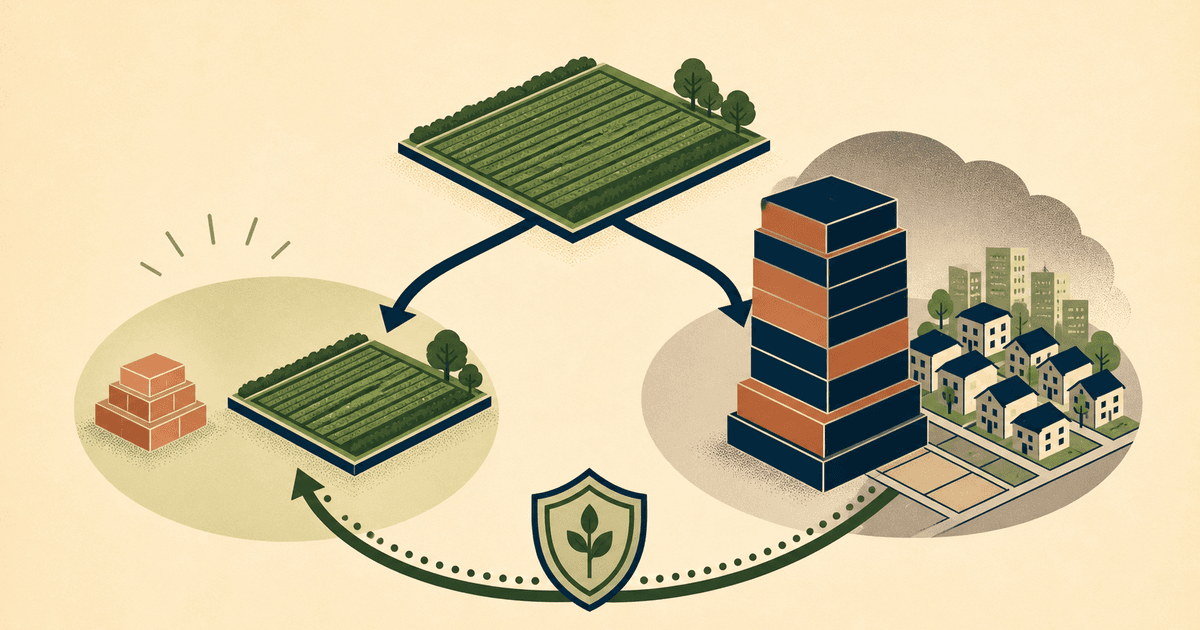
Our previous instalment followed what actually happened to Japan's productive green land after 2022, the year it was all supposed to be released at once. One of its conclusions was that most owners chose to keep the field rather than sell it. This article dissects that choice from the side of the tax bill rather than the sentiment. Japanese tax law puts two different prices on one and the same field. According to the Ministry of Agriculture, Forestry and Fisheries, property tax on ordinary farmland runs to roughly a thousand yen per tenth of a hectare a year; on farmland inside an urbanisation promotion area in a designated city of the three major metropolitan regions it leaps to the low hundred-thousands. Designate the same plot as productive green land and it returns to farmland valuation and farmland taxation, while sitting in the same zone. Inheritance tax is more extreme still: the land is re-measured at an agricultural investment price — a figure that only makes sense if farming continues — and everything above it is deferred outright. That price, set by the National Tax Agency by prefecture and land type, runs from about 200,000 to 900,000 yen per tenth of a hectare. So what is this enormous gap actually payment for? This article's position is that it is not a subsidy for keeping a field, but a price placed on the choice not to sell — and that the price is set not by what farming earns but by what the housing plots around it would fetch. The higher land values climb, the fatter the relief grows, and the fatter the incentive to sell grows with it. We follow the numbers through Japan's green land and deferral regime, America's use-value assessment and conservation easements, the ceiling Britain imposes from 6 April 2026, and the reason farmland REITs stop at the edge of the city.
This article in 3 minutes
- The same farmland is taxed on three different tiers. Ministry of Agriculture material puts annual property tax at roughly 1,000 yen per tenth of a hectare on ordinary farmland, tens of thousands on ordinary urbanisation-area farmland, and the low hundred-thousands on designated urbanisation-area farmland in the major metropolitan cities. Productive green land is pulled back to farmland valuation and farmland taxation.
- The inheritance tax deferral re-measures farmland at an agricultural investment price and halts the tax on everything above it. Set by the National Tax Agency for each prefecture and land type, that price runs from roughly 200,000 to 900,000 yen per tenth of a hectare — deliberately detached from urban market reality.
- The condition for cancellation is, in practice, farming until death. Urban farming land in the designated cities of the three major metropolitan regions always required lifelong cultivation, and the 2018 reform removed the twenty-year route for farmland inside other productive green land districts as well, leaving lifelong farming as the single path.
- Being productive green land in itself shaves little off the inheritance tax valuation. The National Tax Agency's deduction ranges from 5 to 35 percent, and is 5 percent where a buy-out request can already be made. Since the death of the principal cultivator is itself a ground for that request, 5 percent is the common case at succession. What does the work is the deferral, not the valuation discount.
- The biggest barrier — that letting the land ends the deferral — was removed by the Act on Facilitating the Lease of Urban Farmland, in force since 1 September 2018. If the prospective tenant files a cultivation plan and the mayor certifies it, the lease can be granted while the inheritance tax deferral continues.
- The size of the break tracks land prices. USDA's 2025 figures put average US cropland at 5,830 dollars an acre, but the state range runs from 1,320 dollars in Montana to 32,900 in Rhode Island — a factor of twenty-five. The closer to a city, the greater the opportunity cost of leaving a field as a field.
Opening
Tax law puts two different prices on one and the same field
Few people looking at a field left standing in the middle of a residential district stop to imagine what it costs its owner in tax each year. Yet Japanese farmland taxation assigns wildly different bills to identical plots growing identical crops. Under the classification set out by the Ministry of Agriculture, ordinary farmland — in urbanisation control areas and the like — is valued and taxed as farmland, at roughly a thousand yen per tenth of a hectare a year. Inside an urbanisation promotion area the valuation switches to a building-plot basis: ordinary farmland there pays tens of thousands per tenth of a hectare even after the special measure that cuts the tax base to a third. And on designated urbanisation-area farmland in the major metropolitan cities the burden reaches the level of the low hundred-thousands. Nothing about the crop has changed; only the bill has moved by two orders of magnitude.
Designation as a productive green land district is the device for stepping down that staircase in one move. Designated farmland is returned to farmland valuation and farmland taxation even while it sits inside an urbanisation promotion area, and drops out of building-plot taxation. As the previous instalment showed, most of the land that reached thirty years of designation in 2022 chose to move into the specified productive green land category and keep that treatment. What matters here is that the choice was never only about whether the owner still wanted to farm. Let the designation lapse and the bill climbs, in stages, towards the building-plot level. Quite apart from any intention to keep cultivating, the sheer size of the gap in the tax bill was doing the deciding.
Property tax, though, is only the starter. For a family holding farmland in a city, the decisive levy is inheritance tax. It is charged in principle at market value, so inheriting urban farmland assessed at hundreds of millions of yen on the roadside land-price schedule produces a bill equal to many decades of farm income. No income the field can generate will cover it, which leaves selling part or all of the field as the only way to pay. The mechanism by which urban farmland shrinks at every succession does not begin with boredom or a missing successor; it begins here. The device built to defuse that contradiction is the deferral regime, and at its core sits a second yardstick cut loose from the market: the agricultural investment price. This article first pins down how that yardstick is built, then asks what it is secured against — and whose freedom it is secured with.
The frame
The relief is a price paid for not selling, and the price is set by the plot next door
Read farmland tax relief as support for farming and the shape of the system stops making sense. If it were support for farming, the size of the break would track yields or farm income. What it actually tracks is the value the land would command as a building plot. The gap between building-plot valuation and farmland valuation; the gap between market value and the agricultural investment price — in both cases the relief that appears is the residue left when the value-if-farmed is subtracted from the value-if-sold. What the system prices, then, is not farming. It is the decision not to sell.
Read it that way and some awkward consequences follow. First, the relief is largest where land is dearest: the closer to the centre, the thicker the tax benefit, and the thinner it grows out in the countryside. Distribution is governed by the property market, not by agricultural need. Second, a large relief necessarily means a large payoff for giving it up. The exemption and the incentive to sell are two faces of a single number, and you cannot inflate one without inflating the other. Third, that number moves every year with land prices. Even if not one line of the law changes, the reward for not selling swells on its own as the ground beneath it appreciates.
Sources & further reading
- 国税庁 No.4147 農業相続人が農地等を相続した場合の納税猶予の特例
- 国税庁 No.4626 生産緑地の評価
- 農林水産省「農地の保有に対する税金(固定資産税)」
- 農林水産省「都市農地の貸借がしやすくなります」(都市農地の貸借の円滑化に関する法律)
- GOV.UK — Agricultural Relief for Inheritance Tax
- House of Commons Library — Changes to agricultural and business property reliefs for inheritance tax (CBP-10181)
- GOV.UK — Inheritance tax reliefs threshold to rise to £2.5m for farmers and businesses (23 December 2025)
- USDA NASS — Land Values and Cash Rents 2025 Highlights
- California Legislative Information — AB-551 Local government: urban agriculture incentive zones
- SPUR — Urban Agriculture Incentive Zones: Four Years In
- Federal Register — Syndicated Conservation Easement Transactions as Listed Transactions (final regulations, 8 October 2024)
Everything above is free to read.
The rest is for members
This column has moved into the archive, so the full deep-dive is for Urban Farm Crew members and up. Membership funds the daily collection, research and operation of this independent public database. The latest columns are free for everyone.
Or get new columns free by email first
Every Wednesday: a free email digest of new urban-farming cases, research and events from around the world.
Reader feedback
Was this article useful?
No sign-in required. One vote per article on this device; you can change your choice.
Related columns
In 2022, Tokyo's fields were all supposed to go on sale — what became of productive green land
9,273 hectares hit their thirty-year deadline in the same year. The government's survey answered 89.3% — a look inside a forecast that missed
22 min readWhat is the land under that farm worth — a map of urban farming and real estate
The place we describe with community, harvest and green is moved by another vocabulary: title holder, ground lease, assessed value
19 min readDisaster and urban farming ⑤ — Make Japanese urban farmland preparedness usable every day
Do not separate disaster-cooperation farmland, wells and open days
15 min readFarming a dry city — Southern Europe has held its farmland without owning it
Water is short. Land sells. And still Milan fixed some 46,300 hectares at the city's edge in 1990, and Barcelona 3,473.26 in 1998 — without buying any of it
19 min read