The national law came for the pot, not the plot — Peru, Lima's gardens and communal kitchens
In a city with under 15 millimetres of rain a year, what keeps the gardens going is a municipal ordinance and women's neighbourhood organisations
2026-09-13 · 17 min read
Series · Crisis first, law later — urban farming in six South American countries5 / 7
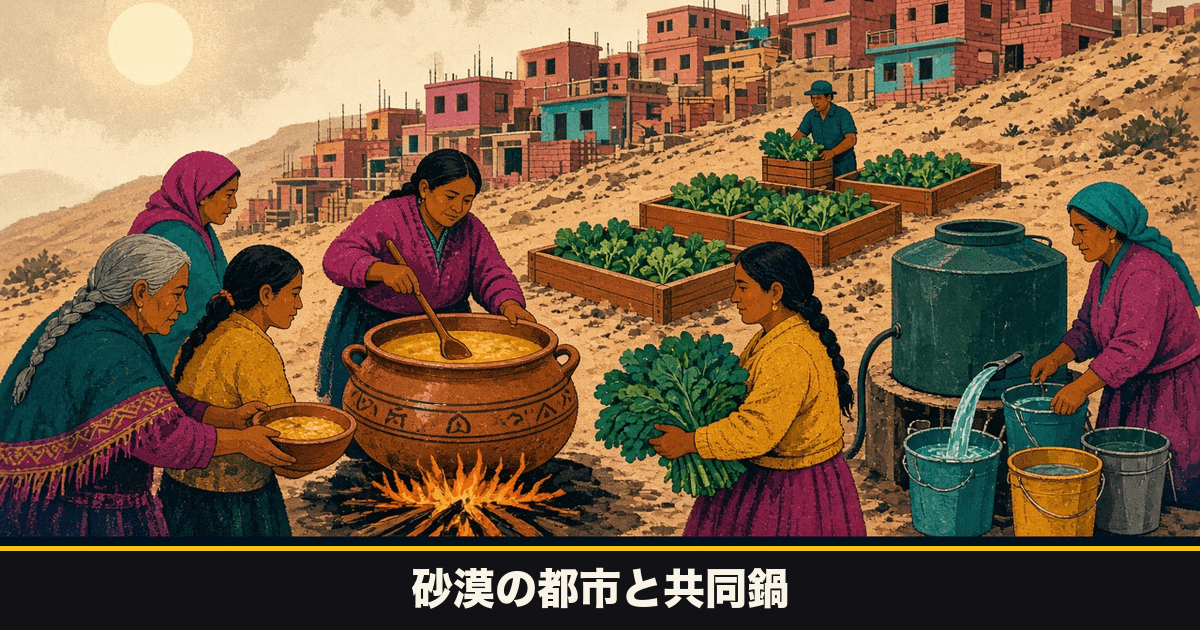
On 27 April 2022 Law 31,458 appeared in Peru's official gazette. It recognises the ollas comunes — the neighbourhood groups that cook in a shared pot and hand out meals locally — as grassroots social organisations, and sets out how they are to be registered and funded. The same country has no national law on urban agriculture. The only text that deals with the plots is framework ordinance 1629, issued by Metropolitan Lima on 24 September 2012, and that is a municipal instrument. National law arrived for the pot, not for the plot. Peru's national meteorological service, SENAMHI, describes Lima as a city with under 15 millimetres of rain a year; apart from the winter drizzle known as garúa, almost none falls. Even so there are gardens in Villa El Salvador and Villa María del Triunfo in the south of the city, and what they grow goes to household tables and to communal kitchens. Today follows how those two things, the pot and the plot, are joined.
This article in 3 minutes
- National law came for the pot. Law 31,458 of 27 April 2022 recognises the ollas comunes as grassroots social organisations, yet its text mentions neither gardens nor urban agriculture. The only instrument covering plots is Lima's framework ordinance 1629 of 2012.
- It does not rain in Lima: SENAMHI puts annual precipitation at under 15 millimetres. Villa María del Triunfo has no irrigation network at all, and its water has been brought in by tanker.
- Water costs most for those outside the network. SUNASS reports that 635,000 people in Metropolitan Lima have no mains connection and buy water at 16 to 18 soles per cubic metre, against roughly 3 soles for those on the network.
- The pots are concentrated in Lima. A MIDIS release of 6 May 2022 counted 2,506 registered ollas comunes in Metropolitan Lima, more than ten times the 242 in second-placed Callao. That is where plot and kitchen meet.
- An ordinance can survive while its programme dies. CEPES records that the garden programme built under Mayor Villarán, who passed 1629, was dismantled under Mayor Castañeda and resumed under Mayor Muñoz. What stops a garden is the budget, not the text.
- This article's position, stated up front: what holds Lima's gardens up is neither the state nor the city but women's neighbourhood organisations — while a 2025 study shows that the same arrangement leaves those women carrying the load and subordinated within it.
Opening
It does not rain in Lima, so an account of its gardens has to start with where the water comes from
SENAMHI describes Lima as a city of very little precipitation — under 15 millimetres a year — most of it the winter drizzle of June to August that Peruvians call garúa. Short summer showers do occur: rain on the night of 31 March 2020 left up to two millimetres in La Molina and Santa Anita. In a city whose annual total does not reach fifteen, it is easy to see what two millimetres in one night amounts to. The record kept by the International Potato Centre (CIP) puts the city at 505 square kilometres along an eighty-kilometre coastal strip, straddling the lower basins of three rivers: the Chillón, the Rímac and the Lurín. Water for the plots comes from those three and from the mains drawn off them.
The three do not carry the same volume. Figures compiled by CIP in 2006 give the Rímac a mean flow of 29 cubic metres per second, the Chillón 5 and the Lurín 0.41. In practice a single river, the Rímac, supplies the city. And in all three, the Rímac above all, bacterial contamination is recorded above the level permitted for irrigating vegetables. The limit is 1,000 faecal coliforms per 100 millilitres of water. Having a river nearby and being able to wash vegetables in it turned out to be two different things. The same record notes that the city's farmland shrank from 570 square kilometres in 1940 to 105. What the city expanded onto was mostly farmland.
In a city short of water, with rivers it cannot easily use, the gardens nevertheless stayed. Writing in 2006, CIP named two places where urban agriculture had actually taken hold in Lima — the districts of Lurigancho-Chosica and Villa María del Triunfo — and said that what decided the outcome was whether water fit for irrigation was available. In Chosica water was plentiful but contaminated beyond the permitted level; in Villa María there was no irrigation network at all and water arrived by tanker. The conditions were opposites, yet both districts created a department for urban agriculture inside the town hall. The first task in keeping a garden going was to turn the question of water into a job someone in local government owned.
The communal kitchen
An olla común is not a soup run: it is a kitchen the residents run themselves
Article 4 of Law 31,458 supplies the definition. An olla común is a citizens' initiative of food support, temporary or permanent, in which people who cannot obtain food or lack the means to buy it come together and cook voluntarily and in solidarity, pooling ingredients and effort. What the term carries is that the people who eat organise the cooking themselves, rather than an authority or a charity distributing meals from outside. A related institution exists in the comedor popular, the people's canteen, and article 6 allows an olla común that so chooses to register as one, provided it meets the requirements.
The link with gardens came before the legal framework. In a piece of November 2021 the Peruvian Centre for Social Studies (CEPES) writes that in Metropolitan Lima, on the legal basis of ordinance 1629, biohuertos — organic gardens — have been built in settlements and on the sites of ollas comunes. The districts it names are twelve: San Juan de Lurigancho, Villa El Salvador, Comas, Ate, San Martín de Porres, Pachacámac, Villa María del Triunfo, Carabayllo, Chorrillos, El Agustino, Puente Piedra and Lurín. Fruit and vegetable waste is composted, containers are reused as watering equipment, and water already used in the households and in the ollas comunes themselves is used again. The article is specific about the method.
There were early attempts to turn that link into policy language. Among the conclusions of the meeting CIP convened in 2006 is a proposed programme named De la Chacra a la Olla — from the plot to the pot — for moving produce from growers to the communal kitchens without intermediaries. The same conclusions call for building and strengthening biohuertos at grassroots organisations such as the ollas comunes and comedores populares. The opening instalment of this series ran a chronology across six South American countries and gave Lima's ordinance 1629 a single line. Today opens that line: what the text says, what it leaves out, and who has filled in the omissions. Brazil, the country that did get a national statute, is day three's subject. Peru is the mirror image, a country where national law has gone past the gardens for more than two decades.
Sources & further reading
- SENAMHI(ペルー国立気象水文局)— Lima registró lluvia de moderada intensidad(リマの年間降水量15ミリ未満とガルーア)
- Ley N° 31458 — Ley que reconoce las ollas comunes(2022年4月27日、El Peruano 官報 Normas Legales 掲載の条文全文)
- MIDIS(開発社会包摂省)— Lima Metropolitana, Callao y La Libertad registran mayor número de ollas comunes(マンカチャイ・ペルー登録簿、2022年5月6日)
- SUNASS(水道規制庁)— En Lima Metropolitana hay más de 635 mil personas sin cobertura de agua potable(2023年1月18日、給水網の外の人口と水価格)
- CEPES — Biohuertos en ollas comunes: claves para seguridad alimentaria y medio ambiente(条例1629号、12区、市長交代による事業の中断と再開、雑排水の再利用)
- Urban Harvest / Centro Internacional de la Papa (CIP), 2007 — Agricultura urbana y peri-urbana en Lima Metropolitana(三本の川の流量と汚染、ビジャ・マリア・デル・トリウンフォの2001年開始と1,926人、「畑から鍋へ」の提案)
- IPS Noticias — Trabajo conjunto de mujeres convierte un basurero en un huerto ecológico en Perú(ビオウエルト・アイユ21、2021年10月12日)
- Corresponsables — 20º Aniversario del Proyecto Huertos en Línea(2024年11月、四半期2万5,600キログラムと40品種以上)
- FOVIDA — Lima Sur: más de 30 experiencias de agricultura urbana son reconocidas(2026年5月、菜園に関わる人の90%が女性)
- Serrano Ayasta L. E. & Stoessel-Ritz J. (2025) — Relaciones de poder y género en proyectos de agricultura urbana en Lima Sur, Anales Científicos 85(2)
The municipal ordinance, 2012
Ordinance 1629 lists where a garden may sit, and says nothing about land, water or money
Ordinance 1629 was issued on 24 September 2012 as a framework ordinance of Metropolitan Lima. Its full title is the framework ordinance for the promotion of urban agriculture as a strategy of environmental management, food security, social inclusion and local economic development for the province of Lima. Setting those four aims on one line is itself the measure of the instrument. Here are the places it names for urban agriculture: the roofs, terraces and back yards of houses; community gardens; school gardens; gardens at public and private institutions; communal productive gardens; agro-parks, farmland combined with a park; and vacant urban land ceded for use through a formal agreement with its owner. The nearest reading is that this is a text enumerating where a plot may be put.
Listing what it leaves out brings the limits into view. There is no ceiling on rent. There is no term of occupation. Use of vacant land rests on an agreement with the owner, and an agreement is a permission rather than a right. Where Germany's Federal Allotment Gardens Act, the subject of the previous series, cut the plot loose from the price of land with numbers — 400 square metres and a rent ceiling — the numbers in 1629 touch neither area nor ground rent. As CIP noted in 2006, agricultural activity did not appear in the classification of centres and axes drawn up by the Metropolitan Planning Institute (IMP), the body responsible for Lima's planning. Seen from the planning side, the plot is still not counted as a kind of land use.
There is a record of people on the ground naming that gap first. At a meeting convened by CIP in August 2006, Washington Ipenza, mayor of Villa María del Triunfo, listed the difficulties facing urban agriculture in his district and set 'the absence of a defined legal framework' alongside 'scarcity of water for irrigation'. The framework ordinance came six years later. Practical response to crisis first, institutions catching up afterwards: the sequence this series traces did not only run between countries. It ran the same way inside a single city.
National law, 2022
The national law Peru did get was for the communal pot, not for the garden
Law 31,458 appeared in the gazette of 27 April 2022. Article 1 recognises the ollas comunes as grassroots social organisations and opens a route to temporary funding in emergencies caused by natural disaster, by a health emergency, or by grave circumstances affecting the life of the nation. Article 3 limits the law's scope to bodies entered in the single national register of ollas comunes, and article 7 allows local governments, the Ministry of Development and Social Inclusion (MIDIS) and other ministries to make budget transfers towards buying and distributing food. There is also an exceptional provision letting the finance ministry route procurement through Qali Warma, the national school feeding programme.
Gardens do not appear in the text. Neither huerto nor urban agriculture occurs anywhere in it, and the only agricultural reference is in article 10.1, which cites Law 31,071 on state purchases of food originating in family farming. The plots that supply the pot sit outside the law that supports the pot. The statute does, however, name who does the work. Article 2 of Law 30,790, amended at the same time, was rewritten so that the target population comprises beneficiaries, 'especially mothers and women who operate in the comedores populares and the ollas comunes'. What records who is doing the cooking here is not a journalistic observation but the statute itself.
The scale is heavily weighted towards Lima. MIDIS launched a registration system, Mankachay Perú, on 5 November 2021, and its release of 6 May 2022 recorded 2,506 registered ollas comunes in Metropolitan Lima. Callao came second with 242, followed by La Libertad with 101 and Arequipa with 98; Cajamarca registered one. The capital's figure is more than ten times the runner-up's. Behind it lies a national picture: according to the 2024 edition of FAO's State of Food Security and Nutrition in the World, 51.7 per cent of Peru's population — 17.6 million people — experience moderate or severe food insecurity, reported as the highest rate in South America.
On the ground: Villa El Salvador
Fourteen hundred square metres of dumping ground were turned back into a garden by older women
Villa El Salvador began in 1971 with residents occupying land and became a legally constituted district in 1983. Its population is around 424,000. In the central park of Sector 2, Group 21 stands Biohuerto Ayllu 21, a communal garden started in 2018 when neighbours — mostly older women — reclaimed a plot that had become a dumping ground. It covers 1,400 square metres with some forty six-metre beds. When IPS Noticias reported on it in October 2021, twelve families of women were working it about two days a week, and the names on record are Victoria Arce, president of the environmental network REDAVES, and Lola Flores, a retired teacher.
The harvest goes three ways. First to the tables of the participating households, then to neighbouring households in greater need, and any proceeds from sales are divided among the members. This site's record notes that the garden's produce also supports ollas comunes in the district, and that funding from the MUSA project, discussed below, paid for improvements to its infrastructure. What grows there is chard, radish, broccoli, celery, tomato, beetroot, basil, spinach, lettuce and aromatic herbs — not a single crop for market but the mix of vegetables that goes into a pot.
In Sector 1, Group 9 of the same district there is another garden, Ayllu 1-9, also self-managed by older residents who reclaimed a piece of public space. According to Lima's urban agriculture platform, in 2023 they rebuilt the meeting hall for older people under the MUSA project. Ernestino Torres, one of the growers, recalled that the original building was of corrugated sheet, rusted and leaking; another, Gloria Segura, calls the place a house held in common. A garden brings with it a place to meet and socialise, and that part no production figure measures.
On the ground: Villa María del Triunfo
Nothing can be built under a high-voltage line, and that is why the strip has been a garden for twenty years
Villa María del Triunfo is a district of 70 square kilometres, of which 21 are built up; the rest is protected lomas — the hill grassland fed by fog — and wetland, which can become neither housing nor farmland. CIP's record has the district's urban agriculture programme starting in 2001, placed inside a Zero Hunger plan against poverty. In 2004 a deputy directorate for urban agriculture was created under the local economic development department, and by 2006 the district had identified 1,926 people engaged in urban agricultural production. The district had its own dedicated office eight years before the metropolitan framework ordinance existed.
It was here, in 2004, that Huertos en Línea — gardens under the line — began. Building is restricted directly beneath a high-voltage transmission line, which leaves long, narrow strips with little other use. The transmission company Red de Energía del Perú (ISA REP) opened them to residents and has provided technical support as a social programme ever since. An article marking the twentieth anniversary in November 2024 reports more than forty varieties of fully agroecological vegetables, a harvest of roughly 25,600 kilograms per quarter, and households earning up to 350 soles a month from selling the surplus. This site's record has the produce of these gardens reaching about 150 families, some 800 people, through a communal pot.
The land, though, is not even leased. It is used provisionally, on the transmission company's permission. The reason the gardens have lasted and the reason they could end at any moment are the same one: nothing can be built under the line, so twenty years of use were possible — and should the company change its policy, neither the ordinance nor any statute contains a clause protecting the residents. A 2019 study in the social science journal Investigaciones Sociales took this network across two districts, San Juan de Miraflores and Villa María del Triunfo, and analysed the part women play in promoting and developing urban agriculture through the lens of the sex-gender system.
Water
Water for a Lima garden comes from drums, from tankers, and from water already used once
Figures published by SUNASS, the water regulator, on 18 January 2023 set out the situation. More than 635,000 people in Metropolitan Lima — 6 per cent of the population — are not connected to the mains network of SEDAPAL, the water utility. Among them are 180,000 children under eleven. Households outside the network buy from tanker trucks at 16 to 18 soles per cubic metre, against an average of about 3 soles for a connected user: up to six times as much. The people with least water pay most for it, and that inversion is the basic shape of water supply in this city.
The quantities available differ sharply too. The same release reports that in 2022 the highest daily consumption per person was San Isidro's 280 litres, followed by Miraflores at 238. The lowest were Lurigancho at 32, then Ancón at 33, and Santa Rosa and Pachacámac at 39. The WHO puts basic needs at 50 to 100 litres per person per day, so the districts at the bottom do not reach even the lower bound. Hours of supply vary as well: the average is 21 hours a day, but Pachacámac has 5.5 and Pucusana 1.7. The peripheral settlements of that same Pachacámac are where Wawa Illari, the infant nutrition and garden project recorded on this site, was carried out.
So the gardens do not assume a tap. At Ayllu 21 water is stored in large drums, filled with support from the district, and moved to the beds through hoses fitted with small taps. The method CEPES describes runs the same way: water already used in households and in the ollas comunes is put to irrigation, and fruit and vegetable waste is composted. A 2026 paper in Ecological Modelling took Ciudad de Gosen, an informal settlement in Lima of about 6,300 residents, and simulated a combination of rooftop and vacant-land cultivation, biodigesters and greywater reuse, finding that reused greywater could sustain roughly 77 per cent of the irrigation. That is a model result rather than a measurement, and the same paper names secure land tenure and governance reform as its preconditions.
Who carries it
Nine in ten of the people in these gardens are women, and that is a description of the load as much as a credit
In May 2026 FOVIDA, an NGO that supports organisations in southern Lima, gave recognition to more than thirty urban agriculture practices in Villa María del Triunfo, Villa El Salvador and San Juan de Miraflores. The organisers listed alongside it were the Network of Women Leaders for Climate Action (REDLAC), the Collective of Women Facing Climate Change (COMUTRAFRECC), the Association of Environmental Networks of Villa El Salvador (REDAVES) and the Inter-district Network of Women of South Lima. All four are women's organisations. Victoria Arce of REDAVES states that 90 per cent of those involved in the gardens are women. That the same names IPS met at Ayllu 21 in 2021 — Victoria Arce, Lola Flores — appear on the list of recipients five years later is itself evidence that these plots lasted.
Outside funding follows the same shape. MUSA stands for Women United for Food and Environmental Security, a project the Canadian NGO Cuso International has run since 2020 as part of the Canadian government's SHARE programme. Its own record has it supporting some 350 growers across nine districts of Metropolitan Lima and building 204 community gardens, with the National Agrarian University La Molina and the Institute for the Promotion of Sustainable Development (IPES) among its partners. Both the improvements at Ayllu 21 mentioned above and the rebuilding of the hall at Ayllu 1-9 were done within this framework.
The opposing view belongs here. Take the 2025 paper by Luis Enrique Serrano Ayasta and Josiane Stoessel-Ritz in volume 85, issue 2 of the agricultural journal Anales Científicos. It draws on doctoral research in three low-income neighbourhoods of southern Lima and examines the power relations inside urban agriculture projects through critical discourse analysis and deep hermeneutics. Its conclusion is severe. Projects framed around food security, social inclusion and empowerment in practice mask asymmetric power relations, reinforce existing inequalities for the gardeners who are mostly women, and perpetuate gender hierarchies, with paternalism on the part of the promoting organisations and community leaders. Ninety per cent women is a figure about who has gained power and, at the same time, a figure about who supplies the unpaid labour.
Recap
The plots survived the law passing them by because a pot stood at the other end
Lay the sequence out again. It began with water. In a city SENAMHI puts at under 15 millimetres of rain a year, CIP's record shows that of three rivers only the Rímac effectively carries the supply, and that all three are recorded with contamination above the irrigation standard for vegetables of 1,000 faecal coliforms per 100 millilitres. Then the institutions were opened. Framework ordinance 1629 of 24 September 2012 enumerates where a plot may sit but touches neither ground rent nor term of occupation, and Law 31,458 of 27 April 2022 recognises the communal pot as a grassroots social organisation while writing neither garden nor urban agriculture into its text. Three sites followed: Ayllu 21 in Villa El Salvador, started in 2018 across 1,400 square metres; Huertos en Línea in Villa María del Triunfo, started in 2004 and harvesting 25,600 kilograms a quarter; and the picture of southern Lima in which nine of every ten growers are women.
Three points restated. First, in Peru national law arrived for the pot and not for the plot. Law 31,458 created a register and a route to money, but the gardens that hand vegetables to that pot lie outside it, and its only agricultural reference is a citation of Law 31,071 on state purchases from family farming. Second, the land rests on permission rather than right: use of vacant land under ordinance 1629 depends on an agreement with the owner, and Huertos en Línea occupies the strip under the power lines provisionally, on the transmission company's consent. Third, an ordinance can stay while the programme goes. CEPES records that the municipal programme that created dozens of gardens under Mayor Villarán was dismantled under Mayor Castañeda and resumed under Mayor Muñoz. Ordinance 1629 was never repealed. What stopped was the budget.
The gaps and reservations belong on the record. First, saying there is no national law on urban agriculture is a statement about what this article could verify. Clauses touching city gardens may sit in other statutes, as Law 31,071 on state purchases from family farming shows. Second, the figures are not measured at the same moment. The 2,506 ollas comunes come from the MIDIS register as of 6 May 2022, and since registration is a voluntary system fed by local governments, the count varies with timing and method. The 1,926 growers in Villa María del Triunfo were counted in 2006. The figure of some 800 people reached through a communal pot by Huertos en Línea comes from this site's record and could not be confirmed in the twentieth-anniversary article. Third, this article covers Lima alone and shows nothing of Peru's Andean or Amazonian cities. The obvious objection sits here too — that setting the communal pot beside the garden turns into an uplifting story what is in fact unpaid work by residents doing what public food provision ought to do. The 2025 study cited above runs along exactly that line.
Today's place in the series is the mirror image of day three's Brazil. Brazil had thirty-one years of municipal work before a national law arrived in 2024. Peru has had a municipal ordinance since 2012 while national law has reached only the neighbouring institution, the communal pot. Tomorrow's day six moves to Quito in Ecuador and looks inside AGRUPAR, the participatory programme the city's economic development agency CONQUITO has run for more than twenty years since 2002. Unlike Lima, Quito has machinery through which the city hands out seed and training and even runs the markets where the produce is sold. Both are cases of a municipality carrying the work; what differs is how. That is what comes next.
Key takeaways
- In Peru national law arrived for the pot, not the plot: Law 31,458 of 27 April 2022 recognises the ollas comunes as grassroots social organisations, yet neither gardens nor urban agriculture appear in its text.
- A Lima garden cannot count on rain. SENAMHI puts annual precipitation at under 15 millimetres, and of the city's three rivers only the Rímac effectively carries the supply.
- The households with least water pay most for it. SUNASS reports that the 635,000 people off the network buy at 16 to 18 soles per cubic metre, up to six times the roughly 3 soles paid on it.
- Ordinance 1629 only enumerates places. It lists forms from roofs to community gardens to agro-parks, but sets no rent ceiling and no term of occupation, and use of vacant land depends on an agreement with the owner.
- What stops a garden is the budget, not the text. CEPES records that ordinance 1629 was never repealed, yet the municipal garden programme was dismantled when the mayor changed and resumed under the next one.
- The strip under the power lines has lasted twenty years because nothing can be built on it. Huertos en Línea began in 2004 and now harvests roughly 25,600 kilograms a quarter.
- That nine in ten growers are women is not an unqualified achievement. A 2025 study finds that projects in southern Lima mask asymmetric power relations and sustain the subordination of the women who work them.
This column is free to read
As new columns publish, older ones move into the members' archive. Join the free newsletter to get every new column and the week's urban-farming news by email.
Reader feedback
Was this article useful?
No sign-in required. One vote per article on this device; you can change your choice.
Related columns
The rap collectives made the gardens first — Colombia, Medellín and Bogotá
In Medellín the gardens began from the memory of the disappeared, and in Bogotá residents mapped them before the city did
18 min readThirty-one years in city hall, nine in congress — how urban farming became law in Brazil
What the national statute took over was a circuit with a buyer at the end, already built by municipalities and the school meal programme
18 min readThe gardens existed from 1987 — what the 2001 collapse made Rosario build was the machinery for handing over land
A 300-square-metre plot, no rent, and a market three or four times a week: Argentine urban farming in units of land and money
19 min readUrban farming in France — how the City of Paris turned land it does not farm into farmland
From a 1952 law to the 2016 Parisculteurs. Reading the urban farming that public institutions built, through the lens of policy
29 min read