The gardens existed from 1987 — what the 2001 collapse made Rosario build was the machinery for handing over land
A 300-square-metre plot, no rent, and a market three or four times a week: Argentine urban farming in units of land and money
2026-09-10 · 19 min read
Series · Crisis first, law later — urban farming in six South American countries2 / 7
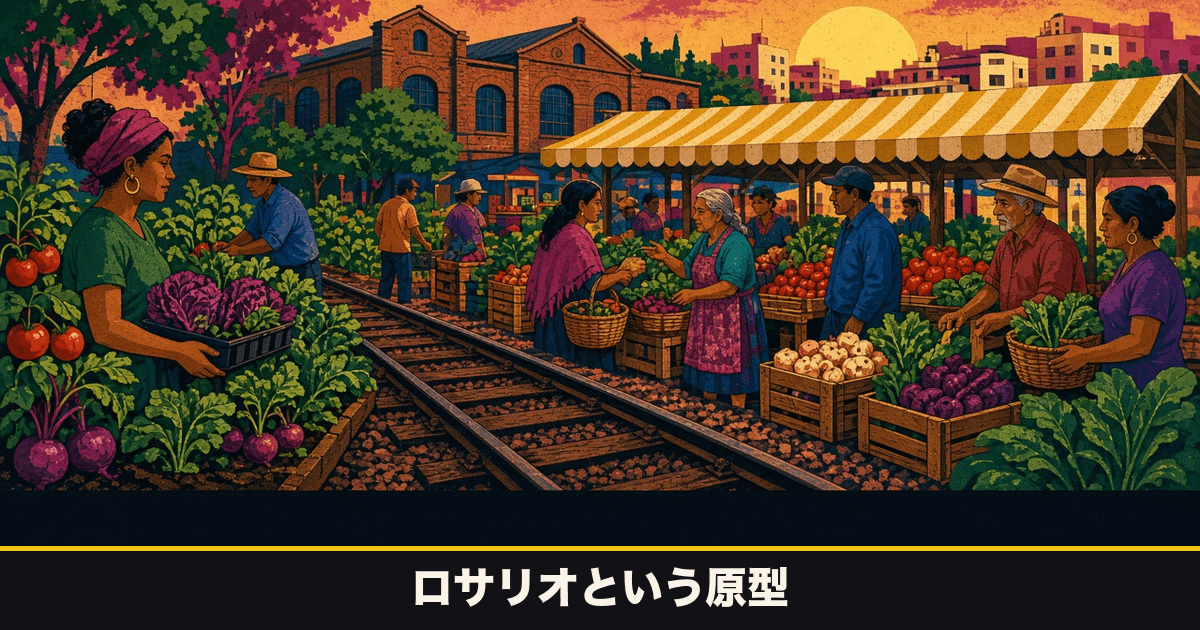
The first community garden in Rosario was made in 1987, in the district of Saladillo Sur in the south of the city. Those who made it were Antonio Lattuca, a 36-year-old agronomist newly out of the National University of Rosario, and Custodio Lemos, a man from Corrientes province who knew how to farm, along with others around them. By 1990 a municipal ordinance had created a community gardens programme, and the national ProHuerta began in the same year. So when the economy collapsed in December 2001, Rosario already had fourteen years of practice and method behind it. The urban agriculture programme, the PAU, which the city launched in February 2002, did not invent the gardens; it moved gardens that already existed onto an institutional footing. Today we open that footing up. Who hands the land to whom, at what price and on what conditions. Where the income comes from. And what happened on the ground in March 2024, when the national government stopped buying the seed.
This article in 3 minutes
- Rosario's gardens are fourteen years older than the collapse of 2001: the first community garden was made in Saladillo Sur in 1987, and by 1990 a municipal ordinance had created a community gardens programme.
- What the collapse produced was not gardens but an institution. In February 2002 the city's social promotion secretariat, the NGO CEPAR and the national ProHuerta set up the PAU, and ordinances 7358/02 and 7143/02 governed the use of land and selling at market.
- The land is lent for nothing. Each grower receives about 300 square metres under a comodato, a loan for use, with no rent; the only conditions are to grow agroecologically and to turn out for shared maintenance.
- The earnings come from the market: growers sell at ferias three or four times a week at the same prices as conventionally grown vegetables. By 2022 there were reported to be 39 selling points and 360 people working in the programme.
- The national layer stopped in March 2024. Funding to buy ProHuerta's seed ended, the last national distribution being autumn-winter kits purchased in 2023; municipalities and provinces have carried it since.
- This article's position is not to hold Rosario up as a finished model. One plot was cultivated from 2008 for fourteen years with no comodato at all, and the growers themselves say their network has in practice stopped working.
Opening
Rosario's gardens are fourteen years older than the collapse of 2001
In 1987 the first community garden appeared in the district of Saladillo Sur, in the south of Rosario. At its centre were Antonio Lattuca, an agronomist newly out of the National University of Rosario; Patricia Virga, a colleague from the same university; and Custodio Lemos, who had come from Corrientes province and knew how to work land. The NGO Taller Ecologista lent its help, and the journalist Carlos Del Frade called residents out over the radio. As the work spread beyond that single garden they founded CEPAR, the Centre for the Study of Agroecological Production. By 1990 a municipal ordinance had created a community gardens programme, and the national ProHuerta began in that same year of 1990. From about 1991 the two reinforced each other in Rosario.
The order matters. Yesterday's chronology set Rosario's starting point at 2002, but the gardens and the method were fifteen years older than that. What the collapse of 2001 brought was not technique but scale and political will. The method itself had taken CEPAR fourteen years to build: ecological growing, going into a neighbourhood and deciding things together with the people who live there, staying continuously present on the ground, and the form they called the huerta grupal, the group garden. A shared garden is cut into individual parcels, one family takes charge of one parcel and grows what it likes at its own pace, while maintenance, training and new ventures are done by everyone together. That this form already existed is one reason thousands of families could be absorbed so quickly after 2002.
Seed had been accumulating since 1987 as well. In 1997 a scheme of seed godparents grew up around the Ñanderoga seed bank: a variety is entrusted to one huertero, who grows it, saves its seed and exchanges that seed with other growers and farmers. It is a way of keeping a variety alive in the ground rather than in a refrigerator. It later widened into a plan for producing, conserving and managing local and criollo seed, and a manual of seed production was written in 2010, with leaflets and posters for an awareness campaign under the slogan that Rosario grows diversity. By 2014 the godparent network had 240 members. What Rosario could reach for when the collapse came was not an inventory of vacant land but this web of people and seed. What the institution later caught up with was that accumulation quite as much as the ground itself.
The design
What the city handed over was land, tools and a place to sell
The PAU started moving in February 2002. Those who put it together were the city's Secretaría de Promoción Social, the NGO CEPAR, and ProHuerta, run by the National Institute of Agricultural Technology (INTA) and the national development ministry. The stated aim was endogenous development at neighbourhood level, and the method was agroecology. In practice that meant setting up group gardens in the city to grow healthy vegetables and herbs and turning them into income by selling at ferias, open-air markets. By the coordinators' own account, ferias of that kind did not exist in Rosario at the time. Making the place to grow and the place to sell at once is what the design of this programme amounts to. The first two years are classed as the stage of social emergency, in which a garden was a source of income and also somewhere an unemployed person went every day. Most of the actual early work was clearing ground.
A legal frame went in within the first two years: ordinances 7358/02 and 7143/02, which governed the use of productive space and its sale, and mayoral decree 0.838 of 2003, which formally established the PAU. The paper the programme's coordinators published in 2014 names these three as the pillars of its institutionalisation. What deserves notice is that an ordinance about the land was not enough on its own; one about selling at market was needed too. Selling vegetables on a public street or square requires permission. Give someone a plot and leave the stall illegal, and the plot does not become income. The same paper describes the object of institutionalisation as making urban agriculture a municipal public policy rather than a food-emergency programme, and lists three things that required: a legal frame for ceding space and for selling the produce, the incorporation of urban agriculture into the city's planning, and the entry of poor families into a solidarity-economy circuit recognised by society at large.
It is worth noting which shelf it was put on. The PAU went neither to a welfare department nor to an agriculture department but to the social economy side of the city government. As of 2026 it still sits under a coordination office for productive spaces within the sub-secretariat for social economy. The capital of the same country makes the contrast: Buenos Aires city's urban agriculture programme belongs to the Agencia de Protección Ambiental, its environmental protection agency, and is built mainly around hydroponics classes and teaching people to compost kitchen waste. The city's urban agriculture centre reports 800 linear metres of hydroponic beds producing 7,000 kilograms a year, and a greenhouse producing 50,000. That a different shelf produces a different programme came up yesterday; within a single country the gap is this wide.
Sources & further reading
- Lattuca, Terrile y Sadagorsky — El Programa de Agricultura Urbana de la Municipalidad de Rosario en Argentina, Hábitat y Sociedad n.º 7 (2014)
- Fundación Rosa Luxemburgo — La prehistoria de la Agricultura Urbana en Rosario, un proyecto modelo(1987年のサラディージョ・スール、CEPAR、1990年の市条例)
- La tinta — Rosario: el programa de Agricultura Urbana que salió campeón del mundo(コモダート、1人300平方メートル、パルケ・ウエルタ7か所、WRI都市賞)
- Infobae — El Programa de Agricultura Urbana de Rosario produce alimentos agroecológicos y da trabajo a 360 personas (2022)
- enREDando — Agricultura urbana en Rosario: una fisura vital en la ciudad(ウエルテロへの聞き取り、2022年11月4日)
- Municipalidad de Rosario — Realizar visitas formativas en huertas y parques huerta(現在の所管:社会経済次官室 生産スペース調整課)
- Argentina.gob.ar — ProHuerta: una política pública con más de 30 años de historia
- LCR Diario Digital — Cierre del ProHuerta: municipios están a cargo de la compra y distribución de semillas(2024年10月25日)
- Ministerio de Desarrollo Agrario, Provincia de Buenos Aires — Programa Huerta Urbana Bonaerense(下限40平方メートル、MI MDA)
- El Barrio Pueyrredón — Ley de agricultura urbana: huerteros alertan por «la posibilidad de uso de tierras públicas con fines de lucro privado»(Ley 6377 第8条への批判と対案)
The land
The land is neither sold nor rented: about 300 square metres is lent to each grower, free of charge
What a grower receives is neither ownership nor a lease but a comodato, a loan for use. There is no canon, no rent. Each parcel runs to about 300 square metres. Two conditions attach: grow by agroecological methods, and turn out for the upkeep of the shared space. According to reporting from 2021, the city had roughly 40 hectares in agricultural use — seven parques huerta of two and a half to three hectares each, three green corridors along railway lines, ten municipal gardens and a number of intermittent community plots. Setting the rent at zero carries real weight on the income side, because nothing has to be taken out of sales to pay for ground. Where Germany's Federal Allotment Gardens Act placed a ceiling on rent, what is used here is not a ceiling but a waiver — and the price of that is that the decision whether to hand over the land at all stays within the city's discretion.
Which land was chosen is the heart of the arrangement. In 2003 the city carried out a full survey of vacant land usable for urban agriculture, and what it then prioritised was land that cannot be built on: the flanks of motorways, the banks of streams, the edges of railway lines, planting beds in squares, hospitals and schools. The selection criterion was that the site should not compete with demand for housing. By the coordinators' account these are degraded leftover grounds mixed with rubble and household rubbish, which become usable only after clearing, the restoration of fertility, and the connection of water and power. In exchange for that labour, the programme bought a kind of stability: nobody else wants the ground. The same paper records that alongside this selection the programme progressively moved gardens off land held on precarious terms and onto land held securely. The policy was not to keep cultivating insecure sites but to reduce their number.
Nor does the land come from a single owner. The parques huerta rest on an agreement with Vialidad Nacional, the national roads body, and the green corridors along the tracks on an agreement with the railway operator NCA. Municipal property alone did not supply enough surface, so the city borrows from a national agency and a private railway company. The results of the restoration were measured. From 2011 the programme worked under an agreement with the soil science and microbiology chairs of the National University of Rosario's agricultural faculty, testing organic amendments and green manuring with hairy vetch at the Parque Huerta El Bosque. The university's analyses confirmed improvements in organic matter, biological activity, nitrate nitrogen and available phosphorus. It is a case of a claim that the soil got better being backed by a third party. In 2017 a three-hectare Centro Agroecológico Rosario was set up to handle seed production, medicinal plants, composting and the development of biological preparations — a design meant to shift soil, seed and inputs onto the side the programme makes itself, and so to cut what it has to buy in.
The money
The income comes from the ferias, and the price is set level with conventionally grown vegetables
The ferias were created alongside the PAU itself. They open three or four times a week. The way prices are set is distinctive: produce is placed in the same band as conventionally grown vegetables. The claim that agroecological vegetables need not cost more is made on the price tag. The outlets multiplied afterwards, and by 2022 there were reported to be 39 of them, counting greengrocers and box deliveries alongside the markets. That the city supplied the distribution side and not only the production side is what marks Rosario out against garden schemes in other countries. The coordinators explain the ferias from another angle as well: they are the joint that holds the network of gardens together, and the place where growers from the periphery and buyers from the centre meet face to face. A garden closes in on its own neighbourhood; a market opens out to the city.
Seasonal swings and surpluses were answered with processing, in small workshops called agroindustrias sociales, social agro-industries. What they make is trays of vegetables, pickles and jams, and shampoos, gels and soaps from aromatic plants. Selling only vegetables means the price collapses on a day of glut and the income disappears in the season of scarcity; processed goods flatten both. There is a reason soap and shampoo turn up here: aromatic herbs fetch more per kilo than vegetables, they keep, and a small parcel can produce a worthwhile quantity of them. Nor is the harvest the only thing sold. A high-yield method of raised beds filled with a soil-and-compost mix — the eco-gardens, or healthy garden-plots — has been installed in schools, hospitals, care homes, squares and companies, and the growers' network takes on that installation as a paid service for households and institutions. In the sense of creating something sellable in the season when no vegetables come in, it follows the same logic as the preserves.
Some sense of scale is on the record. Reporting from 2022 puts 360 people at work in the programme, with more than 300 huerteros growing across the seven parques huerta, 60 per cent of them women; the same report says the seed bank at the Centro Agroecológico Rosario holds 400 seeds and varieties. Where the German system cut the plot loose from the price of land through a rent ceiling, Rosario set ground rent at zero and then built the outlets — that is, it built the flow of cash. The difference is less in how they protect than in what they protect. One protects a plot; the other protects a livelihood. The same report introduces one grower, Javier Tolaba, who expanded from half a hectare to three. Not everyone who is handed a parcel stops there; the route to farming it as a full occupation is open.
Who does it
'Huertero' became an occupation entered in a national register
The growers acquired an organisation of their own: the Red de huerteras y huerteros de Rosario, the network of Rosario's women and men gardeners. It was registered as a non-profit civil association with legal personality, and its board was made up of members drawn from each garden, by design, so that every growing space would have a representative. In 2014 it had roughly 160 active members. Getting from being beneficiaries of a municipal programme to being a party the city has to negotiate with took about ten years. Outside support went into that process: an international cooperation project aimed at strengthening the PAU, and a training plan run in 2010 by the NGO Nacimiento that took the building of the organisation itself as its subject. That training in how to build an association, rather than how to build a garden, was needed at all is the part most easily missed by anyone hoping to transplant a scheme like this.
What institutionalisation actually handed the growers shows up at one point. The national sub-secretariat for family agriculture recognised huerteros as family farmers and entered them in RENAF, the national register of family agriculture. Registration gradually opens social-security rights, including access to an obra social, the health cover scheme. Neither the size of the plot nor the size of the harvest was the benefit; having one's name in a national ledger as a trade was. In 2013 unemployed young people aged 18 to 24 came in under the labour ministry's More and Better Work for Young People scheme, with the network acting as the counterpart and providing the trainers alongside technicians from the PAU and from ProHuerta. National employment money passed through a municipal garden and came out as an allowance for a young person. It is one of the few places where the layers actually join up.
The record also says who was doing the growing. The coordinators write of a mixture: the rural skills of people who had come from Corrientes, Santiago del Estero, Chaco, Paraguay and Bolivia; ways of growing handed down from Italian and Spanish grandparents; and the ecological techniques the technicians brought. The knowledge of people who had left the provinces and settled on the edges of the city took the shape, inside the city, of a new trade — un nuevo oficio, in their words. The people at the centre of this are precisely the ones that an account of urban farming as a new hobby for city dwellers never reaches. How the roles move is worth noting too. Tomasa Ramos, interviewed in 2021, began as a grower and now gives technical advice to newcomers, describing how she stays with them from preparing the soil through to their first sowing. Over twenty years the training stopped being bought in from outside and became something the people who stayed hand on to the people who arrive.
Where the numbers come from
The same programme's output differs twenty-five-fold between sources
The figures the coordinators themselves published in 2014 run as follows. Sixty-seven hectares of land recovered and preserved for urban agriculture, of which 19 are in social and productive use and the remaining 48 given over to recreation and sport. Two hundred and fifty huerteros taking part, 140 of them young, and 400 regular customers. Annual production of 95,000 kilograms of vegetables and 5,000 kilograms of aromatic plants — roughly 100 tonnes together. Educational work with 40 schools, and 240 people in the seed godparent network. These are figures the people running the programme published as their own achievement, so an understated estimate is the less likely reading of them.
The figure most often quoted from 2021 onwards, by contrast, is around 2,500 tonnes a year — a gap of twenty-five times. The size of the peri-urban green belt varies by source too: one record has 800 hectares permanently designated by an ordinance in 2015, an article from 2021 says 700 hectares were secured, and reporting from 2022 puts the green belt at 120 hectares. The area in agricultural use inside the city wavers between 40, 30 and 67 hectares. None of these is invented; each appears in a real published source. The count of participants swings in a similar way: 250 people in 2014, more than 300 in 2022, and more than 2,400 households in another record. Whether households are being counted, or individuals, or only those regularly present, is something most of the sources do not say.
Any explanation that closes that gap is guesswork for now. The plausible reading is that the 100 tonnes are the harvest of the gardens inside the built-up city while the 2,500 tonnes cover food production as a whole, the peri-urban green belt included. The difference between land formally designated and land actually cultivated must be part of it too. Since none of the sources states its boundary, this article does not treat any of these as settled figures. One practical lesson can be drawn from it: state the scope and the date alongside any number for urban farming's output, or the next person will quote that number with a twenty-five-fold spread. After Rosario won its international prize the figure was cited in policy documents around the world — and a number that carries no stated boundary is precisely the kind that travels furthest.
City, province, nation
City, province and nation run on separate tracks and do not connect
The national layer is ProHuerta. Its seed kits are assembled for a garden of about 100 square metres and have been handed out twice a year, for the autumn-winter and spring-summer seasons. From March 2024, however, the national government stopped paying for the seed, on a decision of the ministry of human capital. Reporting from October 2024 says the last national distribution was of autumn-winter seed bought in 2023, and that municipalities were urged to buy their own and hand it out through their social development offices — while noting that whether they do so is a political decision in each municipality. The bottom of a layer that had held for thirty-four years since 1990 fell out. INTA is said to be continuing the technical advice. The same report gives one example of what replaced it: the administrative commission of Valle Azul, in Río Negro province, announced that it would buy and hand out 100 seed kits for the spring-summer season. A settlement of a few thousand people buying a hundred households' worth in the national government's place. The drop in scale reads straight off the figure.
The provincial layer moved in the same year. In the second half of 2024 the Province of Buenos Aires ministry of agrarian development launched the Programa Huerta Urbana Bonaerense. It is aimed at the institutions, clubs, associations and organisations that set up community gardens of at least 40 square metres, and at municipalities building local plant nurseries. What it supplies is seedlings and training, with inputs and accompaniment for the municipalities; applications go through the province's online portal, MI MDA. The low threshold of 40 square metres is designed to catch the small gardens at schools, hospitals and neighbourhood organisations, and in practice the first edition worked mainly with school gardens, social organisations and hospitals, with little participation by family gardens. The parallel strand supporting municipal nurseries exists so that the province can intervene directly in the bottleneck of seedling supply: what the nation had handed out as seed, the province re-issues as seedlings and nurseries. The timing coincides with the national withdrawal, but no record establishing a causal link could be verified.
The city layer is Buenos Aires itself. Article 8 of city law 6377, passed on 3 December 2020, provides that any natural or legal person, public or private, may apply for permission to use public land as a community garden. That is where the criticism concentrated. The gardeners' collective El Reciclador, around Carlos Briganti, and the network Red Inter-Huertas argued the clause leaves room for public land to be used for private profit, and the agronomist Agustín Reus said so in as many words. Their counter-proposal, a system of public agroecological gardens, would have confined management to state bodies and non-profit organisations and built the scheme around pedagogy, environmental education, food sovereignty and community integration. The legislator Cecilia Segura sided with them.
On the ground
One plot was cultivated for fourteen years, from 2008, with no comodato at all
The design of an institution and the state of things on the ground are not the same. In interviews published by a local outlet in November 2022, Roberta Valencia Muñoz said: we have been here fourteen years, since 2008, and we never had a comodato; yesterday people from the municipality turned up wanting to make one. She also criticised the lack of transparency in the process. The mechanism of a free loan for use had not reached every plot. Reading the description of the institution alone will never bring you to someone who cultivated for fourteen years without the paperwork. Those fourteen years, moreover, map exactly onto the period in which the programme was being recognised internationally and collecting its prizes. A scheme being given awards and a plot that never received its papers existed side by side, in the same city, in the same years.
Other voices appear in the same interviews. Ida Pintos said of the network that what had once linked the growers' families across every district has now come to almost nothing. Dolores Pintos said she gets no help, nothing at all, and described disputes with neighbours — one keeping chickens over the garden, another starting a pig pen — in which no municipal coordination intervenes. Roberta said that because no reinvestment has been made in maintenance, growers cannot buy tools or produce enough to both sell and eat. That is how people lose heart and leave. The weakening of the network rebounds on the design itself, because putting a representative from every garden on the board assumes there are still people in every garden. A plot that has emptied out cannot send anyone.
Lilli Marinello put it most compactly: some spaces were created, but it never became a policy of the state. In the same period, though, the programme was chosen out of 262 entries from 54 countries to take the grand prize of the WRI Ross Center Prize for Cities for 2020–21, worth 250,000 US dollars. That it has run for more than twenty years and survived several changes of mayor is itself unusual for a municipal programme. Both things are true. The design lasts; the day-to-day upkeep is not guaranteed. Pablo Nasi, then the city's sub-secretary for social economy, named the twenty-year duration and the programme's capacity for inclusion as the reasons it won. That it lasted twenty years is a fact, and how many people dropped out over those years has not been counted. The two statements do not contradict each other.
Recap
What the crisis produced was not gardens but the paperwork that hands a garden its land and its market
Lay the route out again. It starts in Saladillo Sur in 1987, where the agronomist Antonio Lattuca and others made the first community garden. In 1990 a municipal ordinance created a community gardens programme, and the national ProHuerta began the same year. After the collapse of December 2001, the city's social promotion secretariat, CEPAR and ProHuerta together launched the PAU in February 2002. Ordinances 7358/02 and 7143/02 governed the use of productive space and its sale, and mayoral decree 0.838 of 2003 formally established the programme. On that base we looked in turn at how the land is handed over, how the money is made and where the growers stand, and finally went down into the disagreement between the figures and the voices on the ground.
Three points restated. First, the crisis did not invent the method. Because the huerta grupal — a shared garden cut into individual parcels — had been built by CEPAR over the fourteen years from 1987, thousands of families could be absorbed quickly in 2002. Second, what this institution protects is not a plot but a livelihood: it set ground rent at zero, used the 2003 survey to pick land that cannot be built on and so does not compete with housing, and built outlets that open three or four times a week. By 2022 there were 39 selling points and 360 people working in the programme, with 60 per cent of the growers women. Third, the layers do not connect. The national government stopped buying seed in March 2024; the Province of Buenos Aires opened a 40-square-metre-minimum scheme the same year; and Buenos Aires city passed law 6377 in 2020, whose article 8 the gardeners themselves attacked.
The gaps belong on the record too. First, the output. This article could not close the gap between the roughly 100 tonnes a year the coordinators reported in 2014 — 95,000 kilograms of vegetables plus 5,000 of aromatics — and the roughly 2,500 tonnes quoted from 2021 onwards. The green belt likewise comes in at 800, 700 and 120 hectares depending on the source. Second, the numbers of the 2004 and 2015 ordinances could not be verified against primary text; ordinance 7341 of 2002, which appears in the background material, could not be confirmed either, so the figures used here are 7358/02 and 7143/02 as named in the coordinators' own paper. The wording of article 8 of city law 6377 rests on press quotation, because the official statute repository could not be reached. Third, there is an obvious objection: this article is written from the side of the municipal institution, and if a plot was cultivated for fourteen years with no paperwork, then the description of the institution may capture only part of what is on the ground. Nor could any record be verified linking the national withdrawal of 2024 to the province's new scheme in the same year.
This instalment's job in the series was to open up the 2004 ordinance and the 1990 launch of ProHuerta, which yesterday's chronology gave a line each, and take them down to units of money, land and people. Tomorrow's third instalment is Brazil: how Belo Horizonte ran a food policy for thirty-one years from 1993 with no national law behind it, and how the national PNAU, Law 14,935, finally arrived on 29 July 2024. One guide-line is worth laying down for the comparison. Rosario supported livelihoods by building a market. Belo Horizonte built a different kind of demand, through public procurement. Both are cases of an institution supplying a buyer from outside the plot in order to keep the plot. What happens when that buyer thins out is something today's Rosario has already shown.
Key takeaways
- Rosario's gardens are fourteen years older than the 2001 collapse: the first community garden was made in Saladillo Sur in 1987, and a municipal ordinance created a community gardens programme by 1990.
- What the collapse produced was an institution. The PAU began in February 2002; ordinances 7358/02 and 7143/02 governed the use and sale of productive space, and mayoral decree 0.838 of 2003 established the programme.
- The land is lent for nothing: each grower takes about 300 square metres under a comodato, and the only conditions are to grow agroecologically and to turn out for shared maintenance.
- The land was chosen from places that cannot be built on. After a full survey in 2003 the city prioritised motorway flanks, stream banks, railway edges and beds in squares and hospitals, so that gardens would not compete with housing.
- The earnings come from the market: growers sell at ferias three or four times a week at conventional prices, with a reported 39 outlets by 2022, and processed goods flatten the seasonal swings.
- The biggest thing institutionalisation handed the growers was registration: being entered in RENAF, the national family-agriculture register, brings social-security rights including health cover within reach.
- The national layer stopped in March 2024, when funding to buy ProHuerta's seed ended and municipalities were urged to purchase their own. The city, provincial and national layers do not connect.
This column is free to read
As new columns publish, older ones move into the members' archive. Join the free newsletter to get every new column and the week's urban-farming news by email.
Reader feedback
Was this article useful?
No sign-in required. One vote per article on this device; you can change your choice.
Related columns
The national law came for the pot, not the plot — Peru, Lima's gardens and communal kitchens
In a city with under 15 millimetres of rain a year, what keeps the gardens going is a municipal ordinance and women's neighbourhood organisations
17 min readThe rap collectives made the gardens first — Colombia, Medellín and Bogotá
In Medellín the gardens began from the memory of the disappeared, and in Bogotá residents mapped them before the city did
18 min readThirty-one years in city hall, nine in congress — how urban farming became law in Brazil
What the national statute took over was a circuit with a buyer at the end, already built by municipalities and the school meal programme
18 min readUrban farming in France — how the City of Paris turned land it does not farm into farmland
From a 1952 law to the 2016 Parisculteurs. Reading the urban farming that public institutions built, through the lens of policy
29 min read