Thirty-one years in city hall, nine in congress — how urban farming became law in Brazil
What the national statute took over was a circuit with a buyer at the end, already built by municipalities and the school meal programme
2026-09-11 · 18 min read
Series · Crisis first, law later — urban farming in six South American countries3 / 7
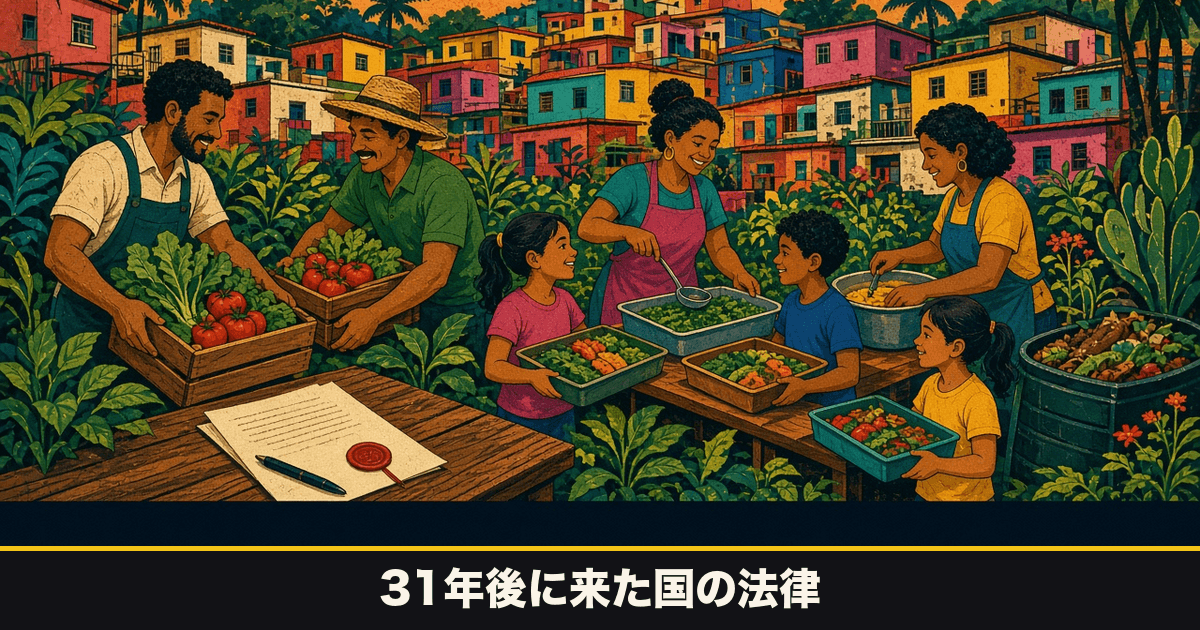
School meals in Brazil are bound by federal law. Article 14 of Law 11,947 of 2009 requires at least 30 per cent of the school meal money transferred by the National Fund for the Development of Education (FNDE) to be spent buying directly from family farming. Law 15,226 of 30 September 2025 raised that floor to 45 per cent, in force since 1 January 2026. When Law 14,935, which established the National Policy for Urban and Periurban Agriculture (PNAU), was sanctioned on 26 July 2024 and printed in the gazette on 29 July, item IV of its article 2 named precisely this purchasing circuit: schools, nurseries, hospitals, care homes, public food-security facilities and prisons. Send what the city grows into those kitchens, the text says. The circuit existed before the national law did. Belo Horizonte created a municipal supply secretariat through by-law 6,352 in 1993 and has had a support policy aimed at urban agriculture alone since municipal law 10,255 of 2011. Today we look at those thirty-one years from both sides: the text and the ground.
This article in 3 minutes
- The strongest device behind urban farming in Brazil is not a statute but the way school meals are bought. Law 11,947 of 2009 required at least 30 per cent of the budget to be spent directly with family farming, and Law 15,226 of 2025 raised it to 45.
- National law arrived behind the practice. Belo Horizonte had by-law 6,352 in 1993 and municipal law 10,255 in 2011, and the decree that finally set out how to run the latter, 18,385, came in 2023 — one year before the federal PNAU.
- Rio turned the garden into a job. Hortas Cariocas, running since 2006, pays growers 500 reais a month and the 56 garden coordinators 630, and half of each harvest is donated while the growers sell the other half.
- In São Paulo the residents dug first and the permission followed. Horta das Corujas, opened on 29 September 2012, began with nothing but a district-office authorisation and runs on a rule that anyone may harvest so long as they neither uproot nor damage.
- Two different kinds of farming sit in the same city. São Paulo also has Pink Farms, a vertical farm inside a warehouse, and the capital-intensive and the food-security models coexist without touching each other.
- This article's position is that Brazil's strength lies in the buyer and the cash rather than in the statute. Even so, a 2025 São Paulo study counted 152 gardens and concluded that their output is too small to change access to fresh food.
Opening
Urban farming in Brazil ran inside city halls for thirty-one years before it became national law
Take Belo Horizonte's chronology first. Municipal by-law 6,352 of 15 July 1993 set a food-security framework and created SMAB, the secretariat responsible for food supply; the work now sits with Susan, the food and nutritional security sub-secretariat inside SMASAC, the municipal secretariat for social assistance, food security and citizenship. That much has already been touched on in this series. What follows is new. Municipal law 10,255 of 13 September 2011 established a municipal policy for the support of urban agriculture in its own right — a statute aimed at urban farming itself rather than at food supply with farming folded into it. And decree 18,385, which set out how to run that law, appeared only in 2023: twelve years after the law, one year before the federal statute.
Now the federal side. Article 1 of Law 14,935, which established the PNAU, defines urban and periurban agriculture as agricultural and livestock activity carried out in urban and periurban areas and integrated into the ecological and economic system of the city, directed at producing and gathering food and other goods for the growers' own consumption or for sale. Article 2 then sets out seven objectives. The bill behind it was PL 906/15, tabled in 2015 by the deputy Padre João of the Workers' Party for Minas Gerais; the Senate passed it on 2 July 2024 with Senator Beto Faro, Workers' Party for Pará, as rapporteur. Delivery is decentralised, through cooperation between federal, state and municipal government, civil society and educational and research institutions.
What today covers is what was actually running between those two chronologies. The list of clauses was dealt with on day one. From here the questions are different: how the purchasing circuit the statute names came to exist, what each of four cities — Belo Horizonte, Rio de Janeiro, São Paulo and Curitiba — actually built, who paid and who received cash, and which parts remain untouched now that the national law has arrived. One thing is also taken out of the usual order. A country report normally starts with the law and descends to the ground, but in Brazil the clauses cannot be read for what they point at until the purchasing machinery has been looked at. So the school meal budget comes first.
Procurement
The national law bites because the way school meals are bought was settled first
The Brazilian school meal system is known as the PNAE. Article 14 of Law 11,947 of 2009 requires at least 30 per cent of the meal budget passed from the FNDE to municipalities and states to be spent buying directly from family farmers and family rural entrepreneurs or their organisations. The buying itself differs from an ordinary tender: it runs through a chamada pública, a public call without price competition, and the tender procedure may be dispensed with provided prices match the local going rate. Priority goes to agrarian reform settlements, traditional indigenous communities, quilombola communities and formal or informal groups of women. There is also a ceiling of 40,000 reais per farmer per calendar year. That floor is not an old provision. The meal programme itself long predates it; what the 2009 law did was write the obligation to buy directly from family farming into the statute as a number.
That floor moved in 2025. Law 15,226 of 30 September raised the 30 per cent to 45; it was printed in the gazette on 1 October and applies from 1 January 2026. The Senate's record shows the list of priority groups carried over unchanged. The same law also set a rule on shelf life at delivery: food must arrive with at least half the period between manufacture and expiry still to run — except for food coming from family farming, which is exempt. The carve-out exists so that fresh produce is not penalised. Close to half of a single purse, the school meal budget, is now reserved by law for family farming. For someone growing vegetables in a city, that is not a statement about subsidy. It is a statement that the law has already decided who will buy.
Article 2 of the PNAU sets out seven objectives by number. The first is to widen food and nutritional security for vulnerable urban populations; the second, to occupy urban space that is free, idle or under-used; the third, to create paths to income and to work. The fourth plugs urban production into the purchasing circuit, listing schools, nurseries, hospitals, care homes, public food-security facilities, prisons and others. The fifth places family labour, cooperatives, associations and organisations of the popular and solidarity economy at the centre; the sixth covers environmental education and agroecological and organic production in cities; and the seventh provides for recycling organic waste, wastewater and rainwater into the growing. The text also carries dedicated credit lines and support for direct sales. This is not a law that protects the plot; it is a law that arranges where the produce goes. Where Germany's Federal Allotment Gardens Act protects the garden from the land side through a rent ceiling, the Brazilian text supports it from the exit side.
Sources & further reading
- Senado Federal (Brasil) — Lei cria a Política Nacional de Agricultura Urbana e Periurbana (Lei 14.935/2024)
- Senado Federal (Brasil) — Lei prevê aumento de produtos da agricultura familiar na merenda escolar (Lei 15.226/2025)
- Ferreira et al. (2024) — Cultivating Urban Agriculture Policies: Local Government Entrepreneurs' Strategies in Three Brazilian Cities, Urban Planning vol. 9
- Instituto Escolhas / 100 Políticas — Unidades Produtivas da Agricultura Urbana (Belo Horizonte, Lei Municipal 10.255/2011)
- Articulação Nacional de Agroecologia — Belo Horizonte (MG): três décadas inovando na agricultura urbana e na agroecologia
- Instituto Escolhas / 100 Políticas — Programa Hortas Cariocas (Rio de Janeiro)
- AIPH Green City Case Study — Curitiba, Brazil: Curitiba's Urban Agriculture
- Organização Cidades Sem Fome — site oficial (hortas urbanas e escolares em São Paulo)
- Horta das Corujas — horta comunitária na Praça das Corujas, Vila Beatriz, São Paulo (blog oficial)
- Toledo & Toledo (2025) — Mapeamento de hortas urbanas comunitárias no município de São Paulo, Cidades Verdes v.13 n.49
Institutions 1993–2023
Belo Horizonte put gardens inside its food policy and, eighteen years later, gave them a law of their own
Look at what the work begun in 1993 actually consisted of. SMAB built an entire supply apparatus, with urban agriculture folded in as one part of it: planting in alternative spaces, community gardens, school gardens, agroecological living centres known as CEVAEs, a supply programme, and caravans for workers. Technical support and exchange between growers were carried by REDE, the alternative technologies exchange network, and in 2004 AMAU, the metropolitan urban agriculture network, was formed and identified more than twenty separate initiatives. In 2018 a participatory guarantee system began, certifying organic and agroecological production for 96 growers through the Horizontes Agroecológicos association. According to the records of ANA, the national agroecology articulation, municipal investment rose from 60.06 million reais in 2016 to 82.6 million in 2020.
What municipal law 10,255 of 2011 did was give that work a legal basis of its own. It carries four instruments: permission to use land, training and technical assistance, donation of inputs, and support for selling. The nature of the first matters. What is granted is neither ownership nor a lease but a permissão de uso, a permission, and the administration can take it back. Decree 18,385 of 2023 set out for the first time in detail how the law is to be run, and included among its aims the management of organic waste through domestic, community and institutional composting. The decentralised facilities the decree names include the Biofábrica Joaninha, a municipal centre for agroecology and environmental education focused on organic waste, and a seed bank for native and agroecological seed.
Put a number on the scale. According to the policy compendium published by the Escolhas institute, the city runs 182 productive units: 61 institutional units at schools, 73 at other public facilities, and 48 collective or community units. Setting up a community unit requires a group of three or more families. Installing a garden of 10,000 square metres costs roughly 85,000 reais, and the programme's annual budget is around 2 million reais, of which 1.5 million goes to the community units. What is harvested may be eaten by the growers, donated or sold. This site's own record notes a municipal count of 42 productive units cultivating more than 88,000 square metres with over 300 registered farmers. The two figures count the same layer of the programme in different ways and at different moments.
On the ground: Rio, from 2006
Rio turned the garden into a job: it pays the growers 500 reais a month
Hortas Cariocas is a programme begun in 2006 by SMAC, Rio's municipal environment secretariat, on unused land in favelas and on the grounds of municipal schools. What sets it decisively apart from gardens in other cities is that participants are paid. Resolution 005 of 2018, issued by the city's conservation and environment secretariat, laid down the framework for the mutirão remunerado, the paid collective work session: 500 reais a month for a hortelão, one of the growers; 630 for each of the 56 people who run an individual garden; and 1,000 for the five community integrators who handle the link to the neighbourhood. It is assembled as work rather than as goodwill. New gardens keep being added: this site's record notes that the garden at Sepetiba opened with a capacity of six tonnes a year. Every plot added means more people to pay.
What happens to the harvest is fixed by rule as well. In the community gardens half of production is donated to care homes, shelters, orphanages and households in food insecurity, and the growers sell the other half for income. The Escolhas compendium gives the scale as of 2022: 56 gardens over 25.3 hectares, made up of 27 school gardens employing 191 people and 29 community gardens employing 85. Production in the first half of 2022 came to 35 tonnes, with 7.2 tonnes in June alone — 3.1 sold and 4.1 donated — plus 107,000 seedlings. This site's record shows further growth since: 53 community gardens and 30 inside schools, roughly 82 tonnes a year, reaching more than 20,000 pupils, with 3,600 households benefiting in 2025 alone.
Trace where that cash comes from and the strength and the weakness appear together. The annual budget runs to 1.8 million reais for the stipends — 150,000 a month — plus 50,000 for inputs and 44,000 for technical services and vehicles, the last of these funded through environmental compensation agreements. Environmental compensation is an obligation developers carry to offset the impact of their projects; it is not a food policy budget. Building a mechanism that puts cash into gardeners' hands is among the rarer things done on this continent, but the source of that cash sits outside the food budget. If building slows, the compensation thins. There is a second weak point. The basis of the arrangement is a secretariat resolution rather than a municipal by-law: it did not pass through the legislature, so it can be altered by administrative decision alone. This is exactly the sort of place where the PNAU's dedicated credit lines are meant to matter, since a route to money written into national law is harder to lose when a city redraws its budget.
On the ground: São Paulo, from 2004
In São Paulo the residents dug first and the permission followed
It started as a group on Facebook. In 2011 the journalists Claudia Visoni and Tatiana Achcar set up Hortelões Urbanos, urban horticulturists. The talk was about home gardens until someone proposed planting in a public square instead. On 29 September 2012 the Horta das Corujas opened in Praça Dolores Ibarruri — known locally as Praça das Corujas — in the Vila Beatriz neighbourhood. The Pinheiros district office authorised the first fencing, but at the time no ordinance squarely permitted this kind of initiative. The garden runs on weekend mutirões, with people turning up in work clothes, carrying tools and something to share for lunch. The rule on harvesting is a single line: anyone may pick, so long as they neither uproot nor damage.
The same city also holds something much closer to a business. Cidades Sem Fome, the NGO founded in 2004 by Hans Dieter Temp, leases the unused strips of land beneath the electricity company's transmission lines and turns them into gardens — choosing, in effect, the one kind of urban gap on which nothing can be built. The organisation reports 34 urban gardens established since 2004 and 77 school gardens since 2012, with 512 direct beneficiaries in the urban gardens and 61,477 pupils reached daily through the school ones. What is grown goes both to the growers' own tables and to sale, giving participants a continuing income. A volunteer garden in a square and a production site organised around earning a living run on different logics inside the same city.
How many gardens São Paulo has depends heavily on how they are counted. This site's record notes a 2020 survey that identified 735 agricultural production units in the city, along with 104 urban gardens and 170 gardens at public institutions. A 2025 paper by Lúcio Lorandi de Toledo and Renata Ferraz de Toledo in the journal Cidades Verdes identified 152 urban gardens in public spaces and classified 114 of them as community gardens. What that study showed was the distribution: the gardens cluster in the southern, eastern and northern peripheries, overlapping with favelas and with the ZEIS, the special zones of social interest. They are, in other words, where they are needed.
Who keeps it going
What keeps Curitiba's gardens going is not the mayor but the officials who run them
Urban farming in Curitiba began in the mid-1990s and now sits with the municipal secretariat for food and nutritional security. It rests on three legs: urban vegetable gardens, an urban farm, and 'honey gardens' holding hives of stingless bees. According to the case study published by the International Association of Horticultural Producers (AIPH), there are 47 community gardens, 36 institutional gardens and 43 school gardens, with 150 growing spaces in all supported by the city and 325 families maintaining them. The total area comes to 177,000 square metres, monthly production in the community gardens is estimated at around 160 tonnes, and some 37,000 people are said to benefit. The urban farm, laid out in 2020, covers 4,435 square metres and produces about a tonne a year.
There is research into why it lasts. A 2024 paper by Marcela Alonso Ferreira and colleagues in the journal Urban Planning compared three cities — Recife, Rio de Janeiro and Curitiba — and concluded that at the centre of creating, maintaining and adapting urban agriculture policy stand particular municipal officials. The paper calls them policy entrepreneurs and lists four strategies they use: working with civil society organisations, building partnerships both inside and outside government, aligning their proposals with international policy frameworks, and making use of the media and of outside recognition. Curitiba becoming a mentor city in 2021 for LUPPA, the urban laboratory for integrated municipal food policies with its network of 48 Brazilian cities, is one instance of the fourth.
That finding changes how the PNAU should be read. Its text says the policy is to be delivered in a decentralised way — and decentralisation means, in practice, that the work returns to municipal officials. Even with a national statute in place, the clauses reach no garden unless the people who have carried these policies in Recife or Curitiba go on making allies inside the building, bringing outside recognition home, and working with civil society. Put the other way round: prizes and membership of international networks are not decoration. They are a practical device for making sure a programme survives a change of mayor. One prediction follows. The PNAU will not take hold evenly across the country; it will take hold first in the cities that already have such officials and such a record — Belo Horizonte's thirty years, Curitiba's build-up since the 1990s, Rio's two decades. Where that accumulation is absent, the clauses arrive but nobody is there to work them.
Coexistence
The same São Paulo holds a vertical farm in a warehouse and a garden in a square
Pink Farms started in São Paulo in 2016, founded by the engineers Geraldo Maia and Rafael Delalibera among others, and is described as one of the earliest commercial urban vertical farms in Latin America. This site's record puts it at eight tiers of growing racks inside a 750-square-metre warehouse, shipping about 6,000 pounds — some 2.7 tonnes — of leafy greens a month and using roughly 95 per cent less water than field growing. It uses neither soil nor sunlight. What it grows is lettuce, herbs and other leafy crops, and it sells to consumers in the same city. Its founders describe output as up to a hundred times that of the same area in open field, and speak of extending to strawberries and tomatoes. The order of magnitude is large, but the terms of the comparison are not given, so it cannot simply be taken at face value.
This farm does not fall inside the categories the PNAU names. What the text lists is vulnerable urban populations, family labour, cooperatives and associations, the solidarity economy, and agroecological and organic production. Hydroponics in a warehouse is none of those, and it does not need public support in the first place. The two answer different questions: one asks how to shorten the distance goods travel, the other asks who gets to eat. Explaining Brazilian urban farming through either one alone misreads it. Both stand in the same city, and the policy is written for only one of them. That is the position as it stands in 2026. The PNAU's credit lines are aimed at family and cooperative producers too, so the warehouse farm raises its own money. A business that needs no public support and a plot that exists only because of it: gathering the two under the single phrase 'urban agriculture' clouds the assessment of both.
The limits
The PNAU says nothing about the price of land or the length of a lease
Set out what the PNAU contains and it comes to this: a definition, seven objectives, decentralised delivery, credit lines and support for direct sales. Listing what it lacks may be quicker. There is no ceiling on ground rent. There is no minimum term of use. There is no rule on the size of a plot. What Belo Horizonte grants is a permission to use, and if the administration withdraws it the garden ends. The questions about land remain very nearly where they were before the national law existed. Where Germany's Federal Allotment Gardens Act cut the plot loose from movements in land value through a rent ceiling and limits on termination, the Brazilian text does not go there. Whether the permission carries any minimum term was not found in the material examined for this article either. On the strength of tenure, there is nothing for it but to check each city's practice one at a time rather than reading the statute.
The purchasing circuit has an entry condition of its own. To sell into the PNAE a grower must be registered as family farming, and the proof of that is the CAF, the national family farming register, formerly the DAP. Transactions run through a public call without price competition, with a ceiling of 40,000 reais per person per year. What follows is easy enough to see. A garden like the one on Praça das Corujas, where the harvest is shared on the spot, sits outside this circuit. The circuit reaches producers rather than everyone who grows. Item IV of article 2 of the PNAU therefore takes effect for those urban farmers who already have the scale and the legal form to register as producers. That item V names cooperatives and associations alongside family labour is itself an answer to that entry condition: a cooperative can bundle growers who would never reach the 40,000-real allowance or the paperwork on their own and put them into a public call together. As policy design it holds together, though forming a cooperative is itself a high step for a small garden.
A sober estimate of scale is needed too. The 2025 São Paulo study, having accepted that the gardens are appropriately distributed across vulnerable peripheries, concludes that their productive volume is insufficient to have a significant impact on access to fresh food. This site's record also holds a study of 159 urban and periurban producers across 29 municipalities in the state of Rio de Janeiro. Most are men over 50 with few years of formal education, working small plots by organic methods and receiving almost no technical assistance; the study states that the potential of urban agriculture there is held back by the absence of effective public policy. Between a law being passed and its reaching the ground, a distance remains.
Recap
What Brazil built over thirty-one years was not a text but a circuit with a buyer at the end
Lay the route out once more. It began with how school meals are bought: article 14 of Law 11,947 of 2009 requires at least 30 per cent of the budget to be spent directly with family farming, and Law 15,226 of 30 September 2025 raised that to 45 per cent, in force from 1 January 2026. Next came Belo Horizonte in three stages — by-law 6,352 of 1993, municipal law 10,255 of 2011, decree 18,385 of 2023. From there the article went down to the ground: Rio's paid mutirão, São Paulo's garden in a square and its NGO beneath the power lines, and Curitiba's three legs and the officials who hold them up. Last came the coexistence with the vertical farm, and a count of what the statute does not reach.
Three points restated. First, the device that works hardest in Brazil is school meal procurement. Item IV of article 2 of the PNAU could name schools, nurseries, hospitals, care homes and prisons because that circuit had been running since 2009. Second, municipalities went as far as building mechanisms that hand out cash: Rio's Hortas Cariocas pays 500 reais a month to a grower, 630 to each of 56 garden coordinators and 1,000 to five community integrators, and donates half of every harvest. Third, what sustains the work is people rather than clauses. The 2024 study by Ferreira and colleagues concluded across Recife, Rio and Curitiba that the policies are created and maintained by municipal officials acting as policy entrepreneurs. Belo Horizonte holds 182 productive units today because thirty years of that continuity came first.
The gaps and reservations belong on the record. First, this article cannot show what has happened since the PNAU came into force. No national tally could be confirmed for how many credit lines have been drawn or how much urban production has entered PNAE purchasing. Second, there is the problem of counting. São Paulo's gardens are given as 735 production units in the 2020 survey and as 152 in public spaces, 114 of them community gardens, in the 2025 paper; Belo Horizonte likewise carries two figures, 182 units and 42. The definitions and the dates differ, so neither pair can be read as a simple rise or fall. Third, the obvious objection. Reading the country through school meal procurement writes off the small gardens that cannot register for a CAF. The 2025 São Paulo study's finding that output is insufficient to change access to fresh food is a direct objection to this reading as well. A strong device existing and that device being enough are two different things.
Now the place of this instalment in the series. Day one ran the chronology of six countries as a single line, and yesterday's day two read Argentina through Rosario as the prototype of the institution the collapse of 2001 produced. Today's Brazil is the only one of the six with a national statute on urban agriculture — and today's conclusion is that even there, what the law holds up is not the land but the exit. Tomorrow's day four turns to Colombia, to Medellín and Bogotá: how soil came to be used in cities that people moved into after the conflict, which is a different order of events again. Where Brazil supported its gardens from the procurement end, it is worth watching which end Colombia supported them from. One handle for the reading ahead: in each country, look for who buys and who pays, and the shape of the institution becomes easier to see. Brazil's answers were the school meal budget and a municipal stipend.
Key takeaways
- The device that works hardest in Brazil is school meal procurement: article 14 of Law 11,947 requires at least 30 per cent of the budget to be bought directly from family farming, and Law 15,226 of 2025 raised it to 45.
- National law followed practice. Belo Horizonte had by-law 6,352 in 1993 and municipal law 10,255 in 2011, and decree 18,385, which set out how to run the latter, came in 2023 — a year before the federal PNAU.
- Rio built a mechanism that puts cash into gardens. Hortas Cariocas pays growers 500 reais a month and 630 to each of its 56 garden coordinators, donating half of each harvest while the growers sell the rest.
- That cash comes from outside the food budget. The 44,000 reais Rio spends on technical services and vehicles is funded through environmental compensation agreements, and thins if building slows.
- In São Paulo practice came before permission. Horta das Corujas, opened on 29 September 2012, began with only a district-office authorisation, at a time when no ordinance covered gardens of that kind.
- What sustains the work is people rather than clauses. Ferreira and colleagues concluded in 2024 that in Recife, Rio and Curitiba the policies are created and maintained by municipal officials acting as policy entrepreneurs.
- The PNAU does not touch the land. There is no rent ceiling and no minimum term of use, and what Belo Horizonte grants is a permission the administration can withdraw.
This column is free to read
As new columns publish, older ones move into the members' archive. Join the free newsletter to get every new column and the week's urban-farming news by email.
Reader feedback
Was this article useful?
No sign-in required. One vote per article on this device; you can change your choice.
Related columns
The national law came for the pot, not the plot — Peru, Lima's gardens and communal kitchens
In a city with under 15 millimetres of rain a year, what keeps the gardens going is a municipal ordinance and women's neighbourhood organisations
17 min readThe rap collectives made the gardens first — Colombia, Medellín and Bogotá
In Medellín the gardens began from the memory of the disappeared, and in Bogotá residents mapped them before the city did
18 min readThe gardens existed from 1987 — what the 2001 collapse made Rosario build was the machinery for handing over land
A 300-square-metre plot, no rent, and a market three or four times a week: Argentine urban farming in units of land and money
19 min readUrban farming in France — how the City of Paris turned land it does not farm into farmland
From a 1952 law to the 2016 Parisculteurs. Reading the urban farming that public institutions built, through the lens of policy
29 min read