The rap collectives made the gardens first — Colombia, Medellín and Bogotá
In Medellín the gardens began from the memory of the disappeared, and in Bogotá residents mapped them before the city did
2026-09-12 · 18 min read
Series · Crisis first, law later — urban farming in six South American countries4 / 7
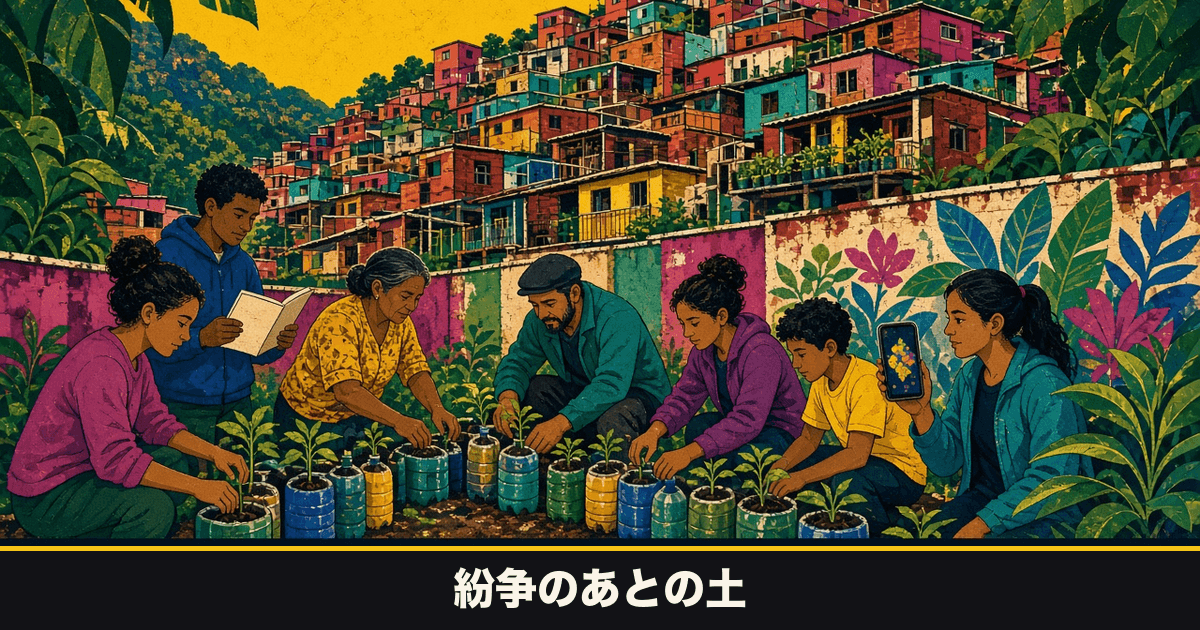
At midnight on 16 October 2002 some thousand police and soldiers entered Comuna 13 in Medellín. That mobilisation, known as Operación Orión, is described as the largest military action carried out in an urban area of Colombia during the armed conflict. People disappeared around it. The UBPD, the body charged with searching for the missing, estimates that 502 of the 5,912 people who vanished in Medellín may lie buried in La Escombrera, a rubble dump on the west side of the city. A third round of digging there began at the end of July 2024, and between 18 December 2024 and 25 September 2025 seven bodies were recovered. In the same district residents had begun something else. AgroArte, a collective that treats rapping and planting as one piece of work, lines the walls of the cemetery with planters made from plastic bottles and writes on each of them the name of someone killed or still missing. Colombia's urban gardens started in that soil. The municipal programmes came afterwards.
This article in 3 minutes
- Medellín's gardens came out of a hip hop collective. AgroArte lines the walls of the San Javier cemetery in Comuna 13 with planters and puts on each one the name of a person killed or still missing.
- The municipal programme arrived later. Medellín's Huertas con Vos is presented as a shift from handing out food to creating opportunity, and it set a target of 1,707 gardens over three years.
- The conflict enters the institutions as an eligibility rule. Medellín's self-consumption garden scheme states that it gives priority to women heads of household, victims of forced displacement and indigenous people.
- Bogotá's Acuerdo 605 of 11 September 2015 created a register rather than gardens: it instructs the Mutis Botanical Garden to build and run a directory of the city's crops and producers.
- Residents mapped the gardens first. The student-run AgroEcoBogotá built its map between 2014 and 2016 with no institutional backing, and the city's own AUPA app arrived in April 2022.
- This article's position is that memory and food security sit in the same programme as a result of sequence, not of design: the grassroots handled both first, and the city took the arrangement over as it stood.
Opening
In Medellín the gardens were not started by city hall but by the people searching for the disappeared
Start with the dates on the ground. At midnight on 16 October 2002 some thousand police and soldiers entered Comuna 13 in what was called Operación Orión, described as the largest military action carried out in an urban area of Colombia during the armed conflict. Many people went missing around it. The UBPD, the body responsible for searching for the disappeared, estimates that 502 of the 5,912 people who vanished in Medellín may lie in La Escombrera, a rubble dump on the western edge of the city. On 11 August 2020 the Special Jurisdiction for Peace, the JEP, placed protective measures on the site, and a third excavation began at the end of July 2024. Two sets of bones were found on 18 December 2024, two more on 10 January 2025, and a seventh person was recovered on 25 September of that year. On 30 January 2025 two of them were confirmed as victims of forced disappearance dating from 2002.
In the same district residents were keeping a different record in the soil. AgroArte has a greenhouse inside the San Javier cemetery and lines its walls with planters built from plastic bottles and packaging. Each planter carries the name of someone from the district who was killed or is still missing. The work is called Plantas de memoria, cuadros verdes vivos en los territorios — memory plants, living green pictures in the territories. According to the magazine Semana the collective was started by seven women, and after the death of one of them Luis Fernando Álvarez, a rapper trained in art and known as El Aka, has led it since 2011. Young people in the district have written more than three hundred songs. The cemetery wall has served as a list of names for a long stretch of time, and the fact that the 2024 dig at La Escombrera was the third of its kind indicates how long.
The sequence is worth fixing before anything else, because the municipal programmes move only after this. Medellín's garden work runs from Ecohuertas Urbanas, begun in 2005, and now consists of Huertas con Vos alongside a self-consumption garden scheme. In Bogotá the council agreement that made urban farming an institution, Acuerdo 605, is dated 11 September 2015, while the botanical garden that carries out the work started training growers in 2004. The grassroots made the shape first and the administration took it over afterwards. That order matches Rosario, seen on day two, but what came first in Colombia was violence rather than an economic crisis. It is why the descriptions of these municipal programmes set food security and social healing side by side in one sentence. The two were not adopted as a pair of ideals; the practice that was taken over had been both from the start.
Two cities
Medellín entered urban farming through memory, Bogotá through a register
Take Bogotá first. Acuerdo 605, dated 11 September 2015, set guidelines to institutionalise a district programme of urban and peri-urban agroecological agriculture. The district environment secretariat holds the coordinating role, while the José Celestino Mutis Botanical Garden provides technical support and monitoring, with the secretariats for social integration, economic development, government and health in support. The places the programme covers are sorted into three kinds: terraces, house patios and apartment balconies; institutional and community space inside the city; and the plots of peri-urban farmers. The botanical garden had already been running training and technical assistance across the city since 2004, eleven years before the agreement. What the text created, then, was not new plots but a way for the city to keep track of people who were already growing.
Medellín came in by another door. Its self-consumption garden scheme is run by the food and nutritional security team inside the secretariat for social inclusion and the family; registration is free, and priority goes to women heads of household, victims of forced displacement and indigenous people. The conflict entered the institution not through the name of the programme but as a line in the eligibility rules. Rural plots must have at least 100 square metres that can be cultivated, while in the built-up city the scheme works on terraces, yards and courtyards. What is handed over is organic fertiliser, agricultural lime and seed, together with a spade, a hoe and a planting trowel, and the contents vary with the type of garden. The scheme is called Huertas para el Autoconsumo, gardens for self-consumption, and the premise in the name is eating your own produce rather than selling it. What changes hands is tools and materials, never the ground itself.
What the two cities have in common is that neither hands over land. Bogotá hands over training, materials and a place on a list; Medellín hands over a kit and technical assistance. Neither text says anything to guarantee that a given plot will still be there next year. Where Germany's Federal Allotment Gardens Act used a rent ceiling to cut the plot loose from the price of land, ground rent does not appear in the Colombian texts at all. Nor is there anything in either city resembling a long, renewable leasehold. This article therefore gives the collectives on the ground the same weight as the wording of the statutes. What follows works through two collectives in Comuna 13, then the two municipal programmes, then the question of who counts the gardens.
Sources & further reading
- Observatorio Ambiental de Bogotá — Se establecen lineamientos para el programa de Agricultura Urbana y Periurbana Agroecológica (Acuerdo 605 de 2015)
- Observatorio Ambiental de Bogotá — «Bogotá es mi huerta», primera plataforma de co-creación de agricultores urbanos
- Hacemos Memoria (Universidad de Antioquia) — La Escombrera: cronología de una búsqueda (Operación Orión, UBPD, JEP)
- Metropolis / urban sustainability exchange — Greening Bogotá (AUPA app, programme targets)
- Kharen Viviana Pinilla Guerrero, «Iniciativa de Mapeo Libre de Experiencias de Agricultura Urbana en Bogotá y sus Alrededores, Agroecobogotá (2014-2016)», Revista de Geografia (UFPE), 2017
- Daniel Andrés Vega Castro & Lili Tatiana Vega Clavijo, «Niveles de metales pesados. Huertas urbanas en Bogotá Colombia», Luna Azul 54 (2022)
- Alcaldía de Medellín — Proyecto Huertas para el Autoconsumo
- El Tiempo — Programa «Huertas con vos» de Medellín mejora la alimentación y fortalece relaciones sociales
- Semana — La historia de Agroarte, un proyecto de la comuna 13 de Medellín
- El Colombiano — En 37 terrazas de la comuna 13 de Medellín cultivan lechuga, albahaca y cogollo europeo de calidad
On the ground: Medellín I
What AgroArte plants is not vegetables but names
List what AgroArte grows and the collective's purpose becomes legible: sweet pepper, maize, sunflower, cauliflower, lemongrass, heliconia, plantain and guayacán. They are sorted as ornamental, medicinal and aromatic plants, and they are not a planting plan for feeding a household. The work is described along three lines: repairing the social fabric, exchange between generations, and taking the territory back. Somewhere between two and three hundred people take part, from children to mothers and grandmothers, with a core of around eighty, and the collective is reported to work across twenty-two sites in the city. The ground it works is the San Javier cemetery and the area around the parish cemetery of La América. When the project is presented as a case of urban agriculture, this breakdown of what is actually planted usually drops out.
The link to the music sits in a line of El Aka's: hip hop belongs to the street, but under the street there is soil, and that soil holds our history and our memory. They therefore call the work agrarian hip hop. Writing a song and sowing a seed are set down as the same act, and the row of planters along the cemetery wall can be read straight off as a list of names. Cuerpos Gramaticales, a performance in which participants stand buried to the waist in the ground, has been staged sixteen times in Colombia and twice in Spain. They have also gone out to learn the craft of record-keeping: with support from the Kreanta foundation, El Aka and Katerin spent two months in Barcelona looking at Catalan memory movements and taking archival training from bodies including the district historical archive of the Baix Llobregat and Archiveros sin Fronteras. Planting, singing and keeping records have become a single gesture.
Something follows from this. Urban agriculture in Colombia did not begin as a conversation about food. It began with the search for buried people and with refusing to let their names be erased. So when the municipal programmes that came later put food security and social healing in the same sentence, that is not because officials thought of both. It is because the practice already running had never separated them. Read the order backwards and it looks as though the administration designed a comprehensive policy. What actually happened is that the administration accepted a shape that already existed. The distinction matters when the work is assessed. Something designed as policy can be measured against the designer's intention, but a practice that was taken over has to be measured against its original purpose or its substance will be misread.
On the ground: Medellín II
The collective growing hydroponically on the roofs came out of the same district's music
Comuna 13 holds a second project, and this one uses the roofs. It is called Terrazas Verdes, green terraces, and it is led by Carlos Alberto Sánchez Mosquera, known as Nene, a co-founder of the Afro-Colombian hip hop group Son Batá. Racks for hydroponic growing are built on the flat roofs of houses and the vegetables are raised without soil. It began with a single trial rooftop. One report puts it at twenty-seven roofs and a little over 600 square metres, with two new plots of 90 square metres just added in the Nuevos Conquistadores neighbourhood. By the time of the report in El Colombiano it covered thirty-seven roofs in Comuna 13, twelve of them supported by the Fundación Éxito. What grows there is smooth, curly, purple and romaine lettuce, green and purple basil, chard, kale and European hearting lettuce.
The economics are built differently from AgroArte's. What Terrazas Verdes harvests is not shared around the neighbourhood but sold, to restaurants and to the Éxito supermarket in Laureles. More than twenty-five single mothers in Comuna 13 take part, shifts are arranged so that no one works more than four hours a day, and the result is monthly household income. Companies including the drinks group Postobón are involved in supplies and routes to market, and the same model has been transferred to Ciudad Bolívar in Bogotá and Siloé in Cali. The reason for choosing roofs is plain enough. In a district of houses packed onto a hillside the only flat surface a resident controls is her own roof, and a mother heading a household or a person with limited mobility can both grow and sell without leaving the building. Nene puts the work as sowing dreams in order to harvest opportunities.
Two collectives out of the same district, and out of the same music, have chosen opposite economies. AgroArte does not sell and plants names; Terrazas Verdes sells into a premium supermarket. Both are called urban agriculture and both take the memory of Comuna 13's violence as their starting point. Score them on a single scale and one looks too unproductive while the other looks as though it has turned memory into a product. What has actually happened is that the possible uses of a garden have split in two. One side counts the people who were lost; the other counts household income. Which of the two scales a municipal programme reports on is a choice made on top of that split — and work that does not fit the scale being reported quietly falls outside the support.
Policy: Medellín
The city turned to gardens in order to stop handing out food
What repeats in the presentation of Medellín's garden programme, Huertas con Vos, is a turn away from aid. Luis Bernardo Vélez, who served as secretary for social inclusion and the family, explained that families produce what they eat and can sell the surplus for income: the phrasing is about creating opportunity rather than continuing to hand out food. Its predecessor, Ecohuertas Urbanas, began in 2005 and is reported to have reached more than three thousand people. Huertas con Vos set a target of 1,707 gardens over three years, and for 2018 a plan was announced for 700 new ones — 250 rural, of which fifty were to be at schools or public institutions, and 450 in the built-up city. That one programme covers both the rural and the urban parts of the municipality follows from how this city's terrain and administrative boundaries are drawn.
What the scheme actually measures shows up clearly in one figure from the press coverage. María Lucelly Ríos, fifty-eight, in the Doce de Octubre neighbourhood in the north-west of the city, shares a 270-square-metre garden with four other households and says it saves her fifty thousand pesos a month at the market; she had previously worked as a sales representative for a fig wholesaler from Sonsón in Antioquia. The programme hands over seed, tools and agronomic assistance, and the growing is designed as clean agriculture: fungicides and insecticides are bio-preparations made from garlic, vinegar, bicarbonate of soda, rue and nettle, and no synthetic inputs are used. The result put into words for this scheme is money saved on the household budget, not memory.
The self-consumption scheme, meanwhile, writes the conflict into the door of registration: priority goes to women heads of household, victims of forced displacement and indigenous people. One point deserves attention here. What the city supplies is eligibility, not land. The ground a garden sits on has to be owned or rented by the applicant. Where the city does not reach, residents connect things themselves. The Red de Huerteros Medellín, which began in the La América neighbourhood in 2013, is not a municipal project but a citizens' network that rotates seed exchanges and collective cooking among member gardens. It describes itself as a socio-environmental strategy for making the territory one's own, and says the form can be reproduced autonomously by citizens and social movements. Its activities carry names such as seeds with stories and memories that germinate: the word memory has not dropped out here either.
Policy: Bogotá
What Acuerdo 605 created is not gardens but a register of growers and crops
Read Bogotá's Acuerdo 605 of 11 September 2015 through the duties it assigns. Overall coordination sits with the district environment secretariat and technical support and monitoring with the Mutis Botanical Garden, backed by the secretariats for social integration, economic development, government and health. And the text contains this line: the Botanical Garden of Bogotá shall create and administer a directory holding data on the city's crops and producers. The stated aim of the agreement was to institutionalise the programme sustainably and at low cost. Nowhere does it say that the city will make new gardens. The design of delivery took concrete form only later still: on 13 October 2021 a third participatory drafting stage opened, covering the five localities of Tunjuelito, Usme, Ciudad Bolívar, Bosa and Rafael Uribe.
The agreement names eight ways of growing: vertical cultivation, biointensive beds, floating-root systems, raised beds, growing from recycled materials, family farming, biological fertilisers and biological control agents. Set them out and the common thread appears. Every one is a technique for growing on a surface you do not own — a wall, a roof, a courtyard, a borrowed yard. Only methods that can be started without acquiring land are listed, and in exchange nothing is said about the length of a lease or the rent. As day one noted, the German statute wrote down an area and a rent; what the Bogotá text wrote down is a way of growing. The difference comes from the premise rather than from any philosophy: in a city that cannot allocate plots, all that can be distributed is technique that works without an allocation.
The figures for scale differ with the source. The Bogotá environmental observatory, the OAB, records more than twenty thousand urban growers and more than four thousand gardens in the city, with 3,873 gardens strengthened since 2020, 12,192 people given technical assistance and 7,561 trained. The surplus coming out of urban and peri-urban gardens is put at roughly 1,778 kilograms a month. That last number shows what these gardens are not: divide it straight across twenty thousand people and it does not reach a hundred grams each per month. The two counts may cover different things, but reading this as production for the market is not tenable. That one of the city's four stated goals was to develop strategies for marketing and promotion points the same way: there is not yet much to sell.
Maps and counting
Residents mapped the gardens first, and the city's app came eight years later
Between 2014 and 2016 an initiative called AgroEcoBogotá set out to put the urban agriculture of Bogotá and its surroundings on a map. It ran on a crowdmap built on Ushahidi, the Kenyan platform, at agroecobogota.crowdmap.com. Behind it were students and postgraduates from the National University of Colombia and the National Pedagogical University, together with the German universities of Göttingen and Hamburg. The 2017 paper that documents the effort, by Kharen Viviana Pinilla Guerrero, states the position plainly: the platform had no direct institutional backing and depended on the participation of citizens interested in agroecology. It started a year before Acuerdo 605 was passed and had run its course before the city's delivery machinery was in place, which means the first attempt to say where Bogotá's gardens were and what they grew was made by people outside the administration entirely.
The city's own instrument arrived in April 2022: a mobile application named AUPA, after the initials of urban and peri-urban agroecological agriculture, reported to let staff enter and update in real time the characterisation of growers, the training given and the technical support provided. Targets were set in numbers as well — twenty thousand gardens strengthened, technical assistance to forty thousand people, twenty thousand trained in agroecological technique, and on top of that a strategy for marketing and promotion. Between mid-2020 and February 2022 the record shows 14,266 people trained, 31,926 given technical assistance and materials supplied to 11,970 gardens. Six years after the citizens' map wound up, the city set about counting the same subject again with an instrument of its own.
A third instrument appeared on 2 October 2021, when the botanical garden and the Organisation of Ibero-American States launched a platform called Bogotá es mi Huerta. This one is not a place where the city records; it is a place where growers write up their own experience and life stories, open forums and promote their small businesses. Notice that the three instruments have three different owners: a citizens' map, a municipal data-entry app, and a channel for growers to speak. That is also why the number of gardens moves between sources — more than four thousand at the OAB, materials supplied to 11,970, and 25,022 gardens supported since 2004 in this site's own record. None of these counts registered plots; each counts gardens supported within some period. Against German statistics, where plots carry numbers and leases are counted, the object being counted is simply not the same, which also makes the figures useless for tracking growth or decline.
Reservations
The usual objection that city soil is contaminated did not appear in Bogotá's measurements
Any discussion of growing food in a city attracts the objection about contaminated soil. In Bogotá it has been measured. A study by Daniel Andrés Vega Castro and Lili Tatiana Vega Clavijo, published in issue 54 of Luna Azul in 2022, tested lettuce, soil and irrigation water from urban gardens in the city for lead, cadmium, chromium, nickel, arsenic and mercury. Every metal detected in the soils and the lettuce fell below the permissible reference values in national and international standards, and none was detected in the irrigation water. The authors conclude that urban agriculture is unlikely to pose a significant chemical risk to consumers through the ingestion of these metals. Concentrations did vary from one garden to another, so the result is a statement about the sites tested rather than about city soil as a category.
The same authors also set down a reservation: reference levels for trace elements in water, soil and produce still need to be established. Without those thresholds, a verdict of 'below the limit' rests on weak ground. In a study published by one of the same authors in 2016, chard grown in a Bogotá garden less than 500 metres from two major roads was sampled at ten per cent of the crop at harvest and measured by atomic absorption spectrophotometry under AOAC official method 968.08; the lead reading came back at 0 ppm. The general claim that city plots are dangerous is therefore not supported by Bogotá's measurements, at least. The sites examined were few, though, and this is no guarantee for the city as a whole — and since the Acuerdo 605 programme extends to peri-urban farmers' fields, an urban result cannot simply be carried over to them.
What is genuinely not guaranteed is the ground. Bogotá's Acuerdo 605 builds a register, but appearing on a register does not protect next year's use. Medellín's self-consumption scheme hands out materials, and the applicant supplies the site. The thirty-seven roofs of Terrazas Verdes belong to houses, so if a house is sold the growing on it ends. AgroArte's planters sit on a cemetery wall. In none of the four cases did a municipal instrument secure the land and grant it. What holds up more than twenty years of practice is not a clause but the persistence of the residents. When these institutions are assessed, then, it is more accurate to look at what carried on without the text than at what the text handed over.
Recap
In Colombia what came first was the conflict, and the institutions took it up afterwards
Lay the route out again. It starts on 16 October 2002 with Operación Orión, and the UBPD estimates that 502 of the 5,912 people who disappeared in Medellín may lie in La Escombrera. A third excavation began at the end of July 2024, and seven bodies were recovered between 18 December 2024 and 25 September 2025. In the same district AgroArte lined a cemetery wall with named planters and Terrazas Verdes began growing hydroponically on thirty-seven roofs. The municipal programmes come after that: following Ecohuertas Urbanas in 2005, Huertas con Vos set a target of 1,707 gardens in three years, and the self-consumption scheme put victims of forced displacement among its priority applicants. In Bogotá, Acuerdo 605 of 11 September 2015 established a register, and the AUPA app arrived in April 2022, eight years behind the citizens' map.
Three points restated. First, Medellín's gardens came out of a hip hop collective: AgroArte began with El Aka and seven women, draws two to three hundred participants, and young people in the district have written more than three hundred songs, while Nene, who leads Terrazas Verdes, co-founded Son Batá. Second, the conflict entered the institutions as an eligibility rule rather than as the name of a programme: Medellín's self-consumption scheme gives priority to women heads of household, victims of forced displacement and indigenous people. Third, Bogotá's Acuerdo 605 created a register rather than gardens, and its eight growing methods are all techniques for working a surface you do not own, with nothing said about lease length or ground rent. All three amount to giving something while withholding the land.
The gaps and reservations belong on the record. First, Medellín's 1,707 is a target as reported, and this article could not confirm whether it was met; this site's own record treats it as achieved, while the article consulted phrases it as a plan. Second, the count of gardens differs by source — more than four thousand at the OAB, materials supplied to 11,970, and 25,022 in this site's record — and since these count instances of support rather than plots, they cannot simply be added together. Third, the founding year of Terrazas Verdes is given as around 2018 in one source and around 2021 in another, and the number of roofs ranges from twenty-seven to thirty-seven. There is an obvious objection too: putting memory and food in one programme risks letting the work of memory be absorbed into the household saving that an administration finds easy to measure. If only the fifty thousand pesos a month survives, planting names counts for nothing.
As for where today sits in the series: day one handed over a chronology of six countries, day two read how an institution grew out of economic collapse in Rosario, and day three followed a Brazilian municipality that kept going for thirty-one years before the national government caught up. What Colombia adds is what changes when the crisis is violence rather than economics. What changed was the purpose. One of the reasons for working the soil became keeping the names of the disappeared. Tomorrow, day five moves to Lima in Peru, where in a city that barely sees rain the gardens attached themselves to a different mechanism, the olla común or communal cooking pot. Change the kind of crisis and the job a garden does changes with it. That is the third variant we will look at.
Key takeaways
- Urban agriculture in Medellín began with a hip hop collective. AgroArte lines the cemetery wall in Comuna 13 with planters and gives each one the name of a person killed or still missing.
- Opposite economies came out of the same district and the same music. Terrazas Verdes grows hydroponically on thirty-seven roofs and sells the harvest to restaurants and a supermarket.
- The municipal programme was designed as an alternative to aid. Medellín's Huertas con Vos set a target of 1,707 gardens in three years, and a participant described saving fifty thousand pesos a month.
- The conflict enters the institution as an eligibility rule: Medellín's self-consumption garden scheme gives priority to women heads of household, victims of forced displacement and indigenous people.
- Bogotá's Acuerdo 605 of 11 September 2015 established a register: the botanical garden creates and administers a directory of the city's crops and producers, and eight growing methods are named.
- Residents built the map first. The student-run AgroEcoBogotá mapped the gardens on Ushahidi between 2014 and 2016, and the city's AUPA app followed in April 2022.
- The land is not secured. A register and materials are provided, but the applicant supplies the site, and since the roofs belong to houses, selling the house ends the growing on it.
This column is free to read
As new columns publish, older ones move into the members' archive. Join the free newsletter to get every new column and the week's urban-farming news by email.
Reader feedback
Was this article useful?
No sign-in required. One vote per article on this device; you can change your choice.
Related columns
The national law came for the pot, not the plot — Peru, Lima's gardens and communal kitchens
In a city with under 15 millimetres of rain a year, what keeps the gardens going is a municipal ordinance and women's neighbourhood organisations
17 min readThirty-one years in city hall, nine in congress — how urban farming became law in Brazil
What the national statute took over was a circuit with a buyer at the end, already built by municipalities and the school meal programme
18 min readThe gardens existed from 1987 — what the 2001 collapse made Rosario build was the machinery for handing over land
A 300-square-metre plot, no rent, and a market three or four times a week: Argentine urban farming in units of land and money
19 min readUrban farming in France — how the City of Paris turned land it does not farm into farmland
From a 1952 law to the 2016 Parisculteurs. Reading the urban farming that public institutions built, through the lens of policy
29 min read