The era when 'feels good' no longer funds anything — a map for this series on social impact
'Good for society' has stopped being a reason to fund anything, on its own
2026-08-26 · 19 min read
Series · How do you measure 'good for society'? — urban farming and social impact1 / 7
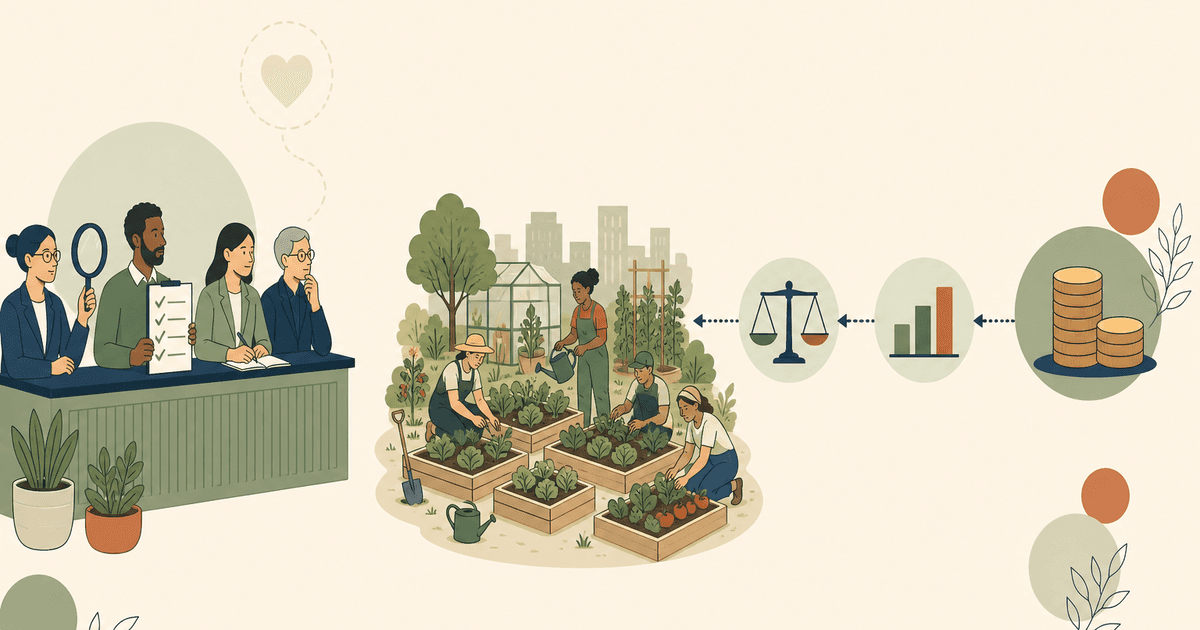
'It's good for the community,' 'it helps welfare' — the era when that sentence alone unlocked a grant is ending. In a 2020 survey of investors by the Global Impact Investing Network, one of the world's largest bodies tracking impact capital, 66 per cent of respondents named concern about 'impact washing' — impact claimed but not delivered — as the single biggest obstacle to the healthy growth of the impact-investing market, far ahead of 'inability to demonstrate impact results' (35 per cent) or 'inability to compare impact results with peers' (34 per cent). Funders no longer take goodwill at its word; what they ask for is evidence of what worked, by how much, and for whom. Amid that shift, how is urban and community farming evaluated, measured and financed? This series tracks that over seven days. Two earlier columns, Urban Farming and Community: The Social Capital that Soil Grows and Care farming and horticultural therapy, covered the benefits a farm itself produces — social capital, physical and mental healing. This series takes up what comes after: how those benefits get proven, priced and paid for.
This article in 3 minutes
- Funder suspicion is now the majority view: GIIN's 2020 investor survey found 66 per cent of respondents named concern about 'impact washing' as the single biggest obstacle to the healthy growth of the impact-investing market.
- The term 'impact investing' itself is a recent invention: coined at meetings the Rockefeller Foundation convened in Bellagio, Italy, in 2007 and 2008. The dedicated international body, GIIN, only launched in September 2009 — this whole field is under two decades old.
- 'No results, no payment' contracts already exist in practice. The world's first Social Impact Bond began in Peterborough, England, in 2010, and seven years later, in 2017, met its target of a 9 per cent cut in reoffending — triggering repayment of investors' capital plus a return of just over 3 per cent a year.
- Japan has a comparable channel: since launching in fiscal 2019, the Dormant Deposit Utilization scheme had disbursed roughly ¥40.1 billion in cumulative grants by the end of April 2026, reaching projects such as a children's-cafeteria network and food-bank operations in Nagano — but every recipient is required to carry out social-impact evaluation.
- Measuring is not free. A 2016 survey of 1,125 US nonprofits by the Innovation Network found only 12 per cent spent 5 per cent or more of their budget on evaluation, and just 8 per cent had any evaluation staff at all — both figures sharply down from the same survey in 2012.
- This article's position is not to doubt urban farming's value — the benefits documented in the earlier columns are taken as given. What this series asks is how that value gets measured, what limits and burdens the measuring itself carries, and what gets left behind in the process.
Opening
The era when the sentence 'it benefits the community' was enough on its own is over
There was a time when a community garden or a food-support group could apply for a grant by simply explaining its purpose — preventing isolation, cutting food waste, giving children a place to belong — and that was enough, because the people reviewing the application did not doubt the goodness of the activity. Today, many funders ask from the first page of the application how the effect will be measured, what method will be used, and whether last year's results can be shown in numbers. The fact that 66 per cent of investors in GIIN's 2020 survey named 'impact washing' as the biggest obstacle is not a quirk of a few conscientious foundations; it shows the suspicion has spread across funders as a whole.
This series assumes two earlier columns: Urban Farming and Community and Care farming and horticultural therapy, which unpacked, through social science and physiology, why a garden connects people and why it heals body and mind. None of that is repeated here. What this series takes up is the part that remains unsolved even once you know the benefit is real: how do you prove it? What does the SROI ratio actually measure, and what does it miss? Who invented the phrase 'impact investing,' and when? What does a 'no results, no payment' contract actually do to an organisation on the ground? How does Japan's dormant-deposit money reach community gardens? Is there any substance to the claim that evaluation itself exhausts the organisations doing it? And is there something wrong with trying to measure what resists measurement in the first place? Seven days, in that order.
Why now
Evidence-based funding, once a term for medicine and aid, has reached welfare and community work
'Evidence-based' began as a phrase from medicine: an insurer cannot keep paying for a treatment nobody has shown works. The same logic spread to public health and international aid, and now reaches welfare, education and community-activity grants. Behind it lies a simple fact — money is finite and the number of applicants keeps rising, so a funder naturally wants to give the same amount to whichever activity does more good. The trouble is that the method for measuring 'more good' is still being worked out. Day two takes up that methodology itself: what SROI and logic models actually do, and why a randomised controlled trial cannot simply be dropped into a welfare programme the way it can into a drug trial.
The other force behind the shift is that funders themselves have diversified. Nonprofit funding used to mean government subsidy and charitable donation, almost exclusively. Now it also includes 'impact investors' who want both a financial return and a social one, and 'outcome-based contracts' that pay according to results achieved. These newer funders operate on the logic of investment rather than charity, and once you are investing, demanding a quantified return — in this case a social one — follows naturally. Day three traces when the idea of 'impact investing' itself was born; day four follows how such contracts actually operate in practice.
Sources & further reading
- GIIN — 2020 Annual Impact Investor Survey
- Rockefeller Foundation — Global Impact Investing Network (GIIN), from the Bellagio archives
- Social Finance UK — Reducing reoffending in Peterborough
- Social Finance — World's first Social Impact Bond shows positive results (2017)
- Government Outcomes Lab, Oxford — INDIGO milestone: 300 impact bonds and counting
- 内閣府 — JANPIA(指定活用団体)ページ
- 内閣府 — 休眠預金等活用制度の概要(説明資料PDF)
- 内閣府 — 社会的インパクト評価の推進に向けて(社会的インパクト評価検討ワーキング・グループ報告書、2016年3月)
- Innovation Network — State of Evaluation 2016: Evaluation Practice and Capacity in the Nonprofit Sector
- Vera Institute of Justice — New study evaluates program financed by the nation's first Social Impact Bond
Everything above is free to read.
The rest is for members
This column has moved into the archive, so the full deep-dive is for Urban Farm Crew members and up. Membership funds the daily collection, research and operation of this independent public database. The latest columns are free for everyone.
Or get new columns free by email first
Every Wednesday: a free email digest of new urban-farming cases, research and events from around the world.
Reader feedback
Was this article useful?
No sign-in required. One vote per article on this device; you can change your choice.
Related columns
The gardens came in 1990, the national law in 2024 — a map of six South American countries
In South America the response to crisis came first, municipalities carried it for two decades, and national law arrived last
17 min readGermany among its neighbours — what is actually different from Britain, France and Poland?
Allotments are no German monopoly. What differs is not the number of plots but the rent cap, the closed list of termination grounds and the legal standing of the association
19 min readA Munich foundation that links 1,000 gardens — anstiftung and the network of self-making
Who keeps the gardens that no law protects?
18 min read1.5 million in the East, a 1983 law in the West — the two gardens that division made
In the East an organisation kept the gardens; in the West a statute did. What unification left standing was the statute, plus a set of exemptions written for the East
18 min read