Who was the farm planted for — the case against the green premium
Greenwash, gated green, displacement — and the design conditions still standing after all three objections
2026-08-18 · 23 min read
Series · Urban Farming and Real Estate7 / 7
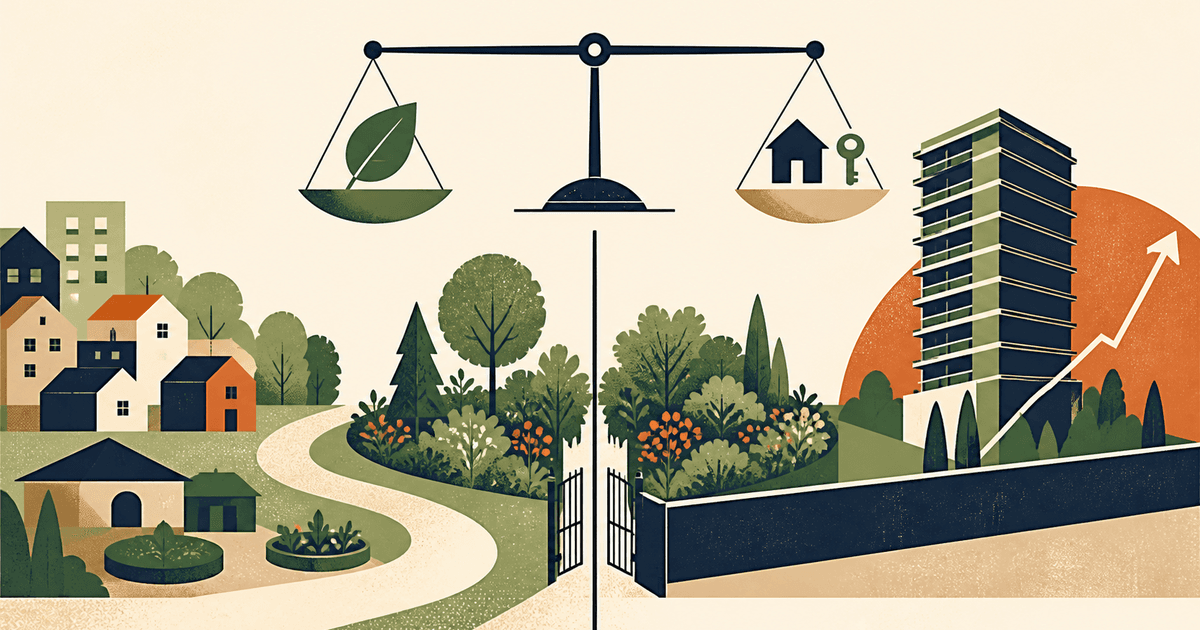
The sixth instalment read the tax machinery that keeps a field a field from the side of money. So when policy works to protect a field, whose field does it remain? This closing instalment takes the opposite chair. The more a farm can be counted as a premium on a property, the closer it comes to being green that exists in order to sell — the objection urban agriculture's advocates find hardest to answer. This article first sets out that objection in three parts: ① the gap between the brochure and the operation (greenwash); ② the inequality of access, in which green enclosed for residents or tenants is not the same object as a public farm anyone can enter; and ③ the structure by which the very people who needed the green can no longer afford to stay once the premium works. It then sets out what still holds after those three objections, in working language: how to fix the rights to the land, who holds the keys and the budget, and where in the first contract the conditions for removal are written. Finally it draws the week's seven instalments into a single line.
This article in 3 minutes
- London's Skip Garden at King's Cross began in June 2009 with six builders' skips, moved three times in ten years across a 67-acre redevelopment site, and left in 2019 when the last plots were built out. It was designed to be movable because the land was never its own.
- In 1961 New York began trading ten square feet of floor area for one square foot of plaza. By 2000 there were 503 privately owned public spaces at 320 Manhattan buildings — and Jerold Kayden's survey rated 41 per cent of them marginal in quality, and separately found spaces apparently out of compliance with their legal requirements at roughly half the buildings.
- New York City's September 2002 settlement preserved 198 community gardens by transferring them to the Parks Department or a nonprofit land trust, left 110 open to development after review, and slated 38 for housing or other projects. The agreement itself expired in September 2010.
- Boston's Dudley Neighbors Incorporated was granted eminent domain in 1988 over privately owned vacant land inside the 62-acre Dudley Triangle. It now holds more than 30 acres carrying 225 permanently affordable homes, a 10,000-square-foot greenhouse and an urban farm — the land stays with the trust and is leased out long term.
- In 2021 Liverpool pledged to place 100 parks and green spaces — over 1,000 hectares — under Fields in Trust's Deed of Dedication in perpetuity. As of reporting in March 2024 exactly one, Falkner Square, had been completed; the council said the legal paperwork had taken far longer than expected.
- Japan has instruments too. The 2017 amendment to the Urban Green Space Act created a certified citizens' green space scheme requiring a management period of at least five years, and the Act on Facilitating the Lending of Urban Farmland — promulgated 27 June 2018 and in force from 1 September that year — opened a route in which the tenant writes the plan and the municipality certifies it. What matters in practice is how few years these run, and who the subject of the certification is.
Orientation
How many keys are there to the farm in the brochure
The photograph of a farm in a sales or letting brochure always looks much the same: tidy rows, a straw hat, a child holding a harvest basket. Inside the frame, the plot looks open to anyone. Outside it, only three things need checking. Who actually does the growing? Who holds the key to the gate? And how many more years does the contract say the plot will be there? A farm that cannot answer those three questions may be selling not green but a picture of green. This article begins by grounding that suspicion in evidence.
To be clear, this is not opposition to farms as such. Over six days this series has followed what happens as urban agriculture starts being described in the language of real estate. Having spent that time on land values, taxes and contested research, the last day is for facing that language's side effects head-on. 'Green carries a premium' has long been an ally of urban farming: it is the single sentence that persuades an authority, courts a landowner and gets a budget through. But once it genuinely starts to work, the farm enters the property calculation. What happens once it is in there is best heard in the words of the critics.
Sorting the objections
Three objections — the veneer, the gated green, and the displacement
The first is greenwash. When a property with a farm attached goes on the market, the advertising speaks of the green in the rendering, while the operation — who grows, who may enter, how many years before it was taken out — is barely recorded anywhere. The second is unequal access. A farm that functions as a premium is enclosed towards the people from whom that premium is recovered: residents, tenants. A farm anyone may enter and a farm supplied in exchange for rent are different institutional animals, however alike the photographs. The third is the displacement structure this series has already brushed against: the better the green premium works, the less able the people who most needed that green are to keep paying the rent. That last point was covered with its figures in our earlier column on green gentrification, so it is not repeated here; instead it is re-examined from the side of property rights.
Of the three, the first two are the ones a practitioner can actually move. The third belongs to a city's housing policy and cannot be solved by the operator of a single farm. Hence the shape of this article: the first half sets out the three objections, each tied to something checkable; the second half extracts the design conditions that can still stand afterwards — how to fix the rights to the land, who holds the keys and the budget, writing the removal conditions at the start — from instruments in New York, Boston, England and Japan. The last section draws the seven days together.
Sources & further reading
- Global Generation — Skip Garden (King's Cross, 2009–2019)
- APOPS / Municipal Art Society of New York — What are POPS? (privately owned public space, 1961 incentive zoning)
- Does urban agriculture lead to gentrification? (Landscape and Urban Planning, 2022)
- Greening practitioners worry about green gentrification but many don't address it in their work (Ecology and Society, 2023)
- New York City Community Garden Coalition — Where We Stand and How We Got Here (1999 auction, 2002 agreement, 2010 expiry)
- Dudley Neighbors, Inc. — History of DNI (eminent domain, 1988; the Dudley Triangle)
- Fields in Trust — Protect your park (Deed of Dedication / Minute of Agreement)
- BBC News — Pace of parks' protection plan criticised (Liverpool, Fields in Trust)
- 国土交通省 公園とみどり:市民緑地認定制度(2017年 都市緑地法改正)
- 衆議院 制定法律 都市農地の貸借の円滑化に関する法律(平成30年6月27日公布・同年9月1日施行)
Everything above is free to read.
The rest is for members
This column has moved into the archive, so the full deep-dive is for Urban Farm Crew members and up. Membership funds the daily collection, research and operation of this independent public database. The latest columns are free for everyone.
Or get new columns free by email first
Every Wednesday: a free email digest of new urban-farming cases, research and events from around the world.
Reader feedback
Was this article useful?
No sign-in required. One vote per article on this device; you can change your choice.
Related columns
The gardens came in 1990, the national law in 2024 — a map of six South American countries
In South America the response to crisis came first, municipalities carried it for two decades, and national law arrived last
17 min readGermany among its neighbours — what is actually different from Britain, France and Poland?
Allotments are no German monopoly. What differs is not the number of plots but the rent cap, the closed list of termination grounds and the legal standing of the association
19 min readA Munich foundation that links 1,000 gardens — anstiftung and the network of self-making
Who keeps the gardens that no law protects?
18 min read1.5 million in the East, a 1983 law in the West — the two gardens that division made
In the East an organisation kept the gardens; in the West a statute did. What unification left standing was the statute, plus a set of exemptions written for the East
18 min read