Compost or methane — the two business models competing for your food scraps
Two industries put different prices on the same bucket of food scraps. One sells the result as electricity; the other can only sell soil. That asymmetry decides which plant gets built
2026-08-24 · 19 min read
Series · Composting Now — Systems, Economics, Limits6 / 7
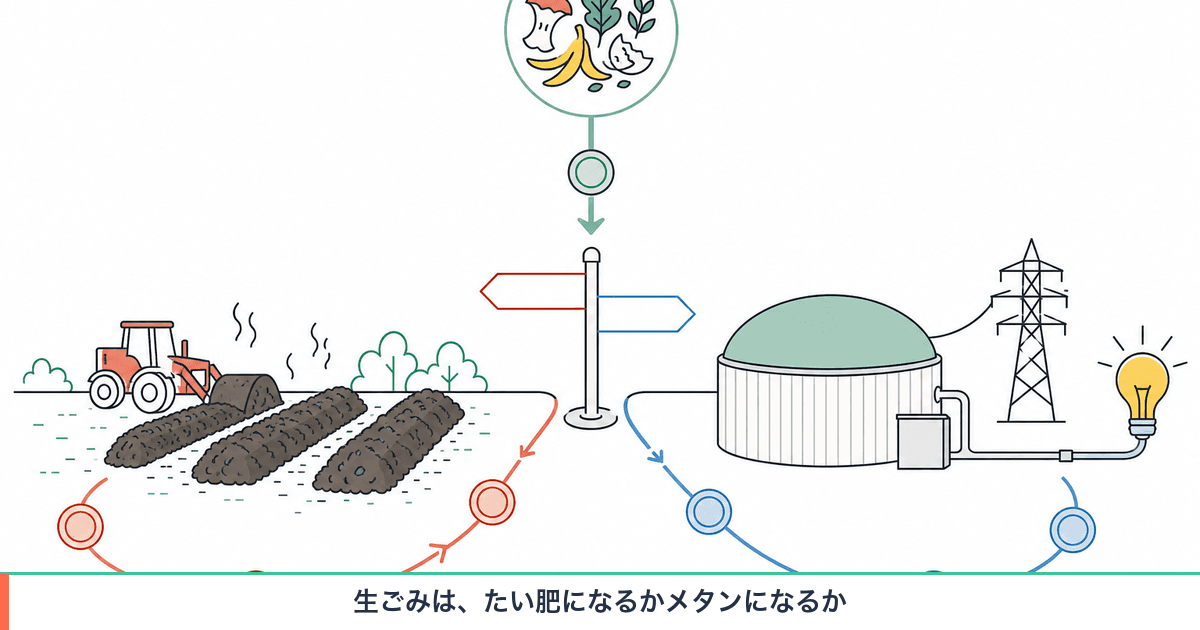
Our previous instalment asked why Japan's household food waste is still barely separated, reading the record of twenty years of the Food Recycling Act. One answer was that no one had an economic reason strong enough to move it. This article takes that economic reason apart, layer by layer. The revenue of a composting facility does not, in the main, come from selling compost. It comes from the gate fee charged to whoever delivers the material — and the ceiling on that fee is set by what it would cost to landfill the same load instead. On EREF figures reported by BioCycle, the average US landfill tip fee in 2023 was 56.80 dollars a ton nationally and 84.44 dollars in the Northeast. Whether a composting business closes at all is decided first against that number. Then the cost side. Plastic mixed into food scraps is not a cosmetic problem but a legal disqualification: California's regulations cap physical contaminants larger than four millimetres at 0.5 percent of dry weight, of which no more than a fifth may be film plastic, and product over the line cannot be sold. Third, extended producer responsibility has begun to put a price on the words 'certified compostable' themselves. And finally the heart of it — send the same scraps to a compost windrow, or to a digester that turns them into methane and electricity? Under Japan's feed-in tariff, power from methane fermentation has been bought at 35 yen per kilowatt-hour since fiscal 2023, for twenty years, the highest rate in the biomass category. Compost has no equivalent institutional buyer. One of the two routes carries a twenty-year price tag and the other does not. This article's position is that what decides where food scraps go is neither the technology nor the environmental performance, but the presence or absence of that tag.
This article in 3 minutes
- A composting business lives on gate fees, not compost sales, and the ceiling on those fees is the local landfill's price. On EREF data reported by BioCycle, the 2023 US landfill tip fee averaged 56.80 dollars a ton nationally — 84.44 in the Northeast, 68.82 at large landfills, 49.70 at medium ones.
- Contamination is not a quality issue but a saleability issue. California's 14 CCR 17868.3.1 caps physical contaminants over four millimetres at 0.5 percent of dry weight, allows no more than a fifth of that to be film plastic, and requires testing every 5,000 cubic yards produced.
- EPR has begun pricing the phrase 'certified compostable'. California's SB 54 programme plan projects costs of 1.26 to 1.87 billion dollars in 2027 and 9.3 to 17.2 billion across 2027–2031, with multi-material laminates charged 13 to 39 cents a pound. Eco-modulation starts in 2028, with penalties running from 10 percent of the base fee to 100 percent.
- Turn the same scraps into methane and an institutional buyer appears. Japan's feed-in tariff paid 39 yen per kilowatt-hour for methane-fermentation power from fiscal 2012 to 2022 and 35 yen from fiscal 2023, in both cases for twenty years — the highest rate in the biomass category.
- In the United States, fuel policy stacks on the digestion side. EPA counts 313 anaerobic digestion facilities handling food waste; of the 65 operational respondents to its 2024 survey, 20 were stand-alone, 15 on-farm and 30 at water resource recovery facilities. Biogas earns credits under the Renewable Fuel Standard; compost has no counterpart.
- This article's position: what routes food scraps is neither the technology nor the environmental case but the design of the revenue. Compost is a product sold into a market; electricity and gas are products the state agrees to buy for twenty years. While that asymmetry holds, urban food waste will keep flowing to energy rather than to soil.
Opening
Two industries are bidding different prices for the same bucket of scraps
Once a city sets up separate collection of household food scraps, two exits are waiting at the far end. One is a composting facility, which keeps oxygen moving through the material and turns it, over some months, into a soil amendment. The other is an anaerobic digester, which shuts oxygen out, captures the methane that results and sends it to a generator or into a gas grid. Textbooks present these as parallel technologies, aerobic and anaerobic. Seen as businesses, though, they are nothing like equals — because one sells its product into a market and the other sells its product to a policy. That difference has quietly, and decisively, governed which kind of plant gets built and where.
This series has so far worked through the greenhouse-gas arithmetic, the history of chemical fertiliser and the landfill, the places where mandates stumbled, and twenty years of Japan's Food Recycling Act. A single wall keeps reappearing in all of them: the thing that ought to work somehow does not. That wall is usually explained by inconvenience, or by a public that has not been persuaded. This article looks at it instead from the side of money — because more often than not, separation fails to take hold not because people lack conviction but because nobody downstream makes a living from it, or because the person who does make a living from it is standing somewhere else entirely.
The earlier column on the science and societies of composting covered what the microbes are doing and what collection systems the world's cities have built. This article does not go back there. It takes up four things only. Where does a composting facility's money actually come from? What does plastic in the feedstock cost, in cash? What price has extended producer responsibility attached to the words 'certified compostable'? And what, in the end, decides whether a given load of scraps becomes soil or becomes gas? Following the figures brings into view a structure of distribution that environmental debate rarely puts on the table.
The frame
A composting business does not, in the main, live by selling compost
Picture the income statement of a composting facility and most people sketch the same thing: make good compost, sell it to farmers. The real structure is rather different. At its centre sits the gate fee — the per-ton charge levied on the municipality, hauler or food business that brings material through the door. Revenue from the compost itself is, at most facilities, far smaller than the gate fee, and at some there is little left of it once haulage is deducted. Composting is designed less as an industry that manufactures fertiliser than as a service industry that accepts organic matter. Take that view and the variables that decide whether the business lives or dies change entirely.
That fee is not set freely. Composting is only one of the options open to whoever holds the material; a landfill or an incinerator is always available instead. The gate fee therefore has a ceiling, and the ceiling is the price of the competing disposal route. Where landfill is cheap, a composter can only attract feedstock at a fee too low to service its plant and payroll. Where landfill is dear, the identical plant turns an ordinary profit. Two cities with the same terrain and the same climate, one with a composting facility and one without — what usually separates them is not technology but the price posted at the landfill down the road.
Sources & further reading
- BioCycle — 2023 Landfill Tip Fees In The U.S. (EREF調査の報告)
- EREF — Analyzing Municipal Solid Waste Landfill Tipping Fees
- Cal. Code Regs. Tit. 14 § 17868.3.1 — Physical Contamination Limits
- US EPA — Emerging Issues in Food Waste Management: Plastic Contamination (August 2021)
- US EPA — Anaerobic Digestion Facilities Processing Food Waste in the U.S. (2022 & 2023)
- US EPA — Renewable Fuel Standard Program
- CalRecycle — SB 54 Plastic Pollution Prevention and Packaging Producer Responsibility Act Regulations
- DLA Piper — California's EPR Program Plan: Costs, compliance, and design considerations for producers
- 経済産業省 — 再生可能エネルギーのFIT制度・FIP制度における2026年度以降の買取価格等と2026年度の賦課金単価を設定します
- 資源エネルギー庁 — 買取価格・期間等(FIT制度・FIP制度)
Everything above is free to read.
The rest is for members
This column has moved into the archive, so the full deep-dive is for Urban Farm Crew members and up. Membership funds the daily collection, research and operation of this independent public database. The latest columns are free for everyone.
Or get new columns free by email first
Every Wednesday: a free email digest of new urban-farming cases, research and events from around the world.
Reader feedback
Was this article useful?
No sign-in required. One vote per article on this device; you can change your choice.
Related columns
Is compost actually good for the environment — the case against composting, and what to do anyway
Compostable plastics that do not break down, PFAS and metals in finished compost, and the climate arithmetic once transport is counted
19 min readWhy Japan still doesn't sort its food waste — twenty years of the Food Recycling Act
Business food-waste recycling reaches 91%, yet four fifths of household scraps still go to the incinerator. What sits between the honour-roll figure and the kitchen the law never covered
19 min readMandating it isn't enough — where the world's composting rollouts have stumbled
France, New York, California and China — four mandates lined up against the same three bottlenecks
19 min readHow cities turned compost into garbage — chemical fertiliser and the century of the landfill
The day nitrogen came out of the air, urban organic matter lost its buyer — and burial became a technology
19 min read