Is compost actually good for the environment — the case against composting, and what to do anyway
Compostable plastics that do not break down, PFAS and metals in finished compost, and the climate arithmetic once transport is counted
2026-08-25 · 19 min read
Series · Composting Now — Systems, Economics, Limits7 / 7
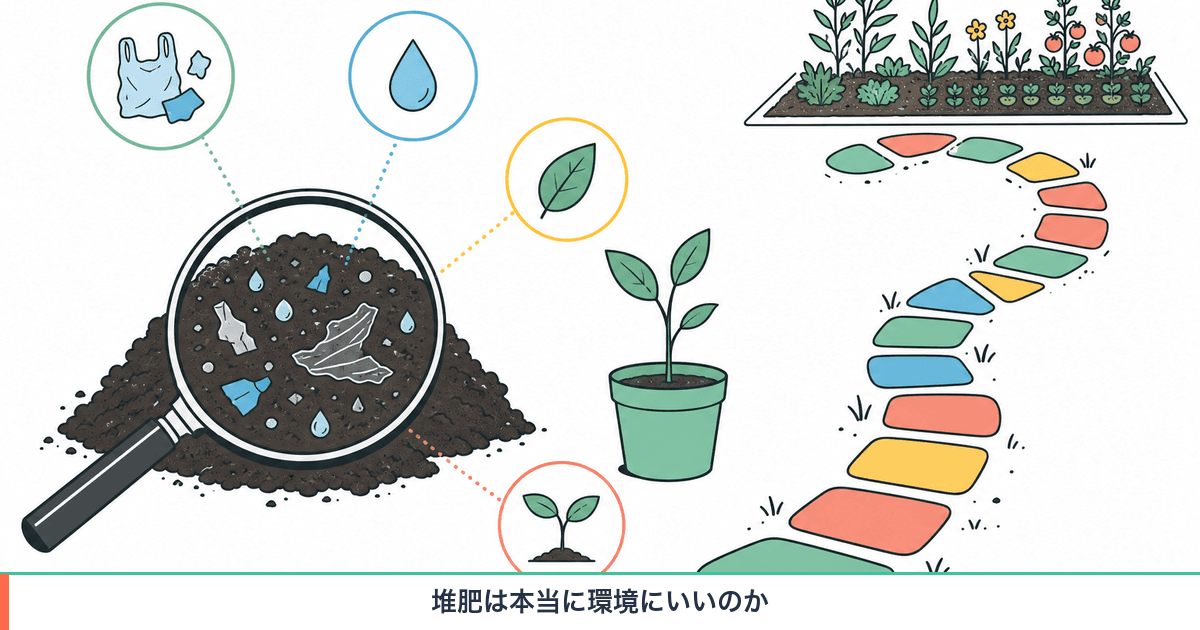
Yesterday's sixth instalment, on whether food scraps become compost or methane, read that fork from the side of two competing business models. If money decides the destination, the next question is what the destination is worth. This closing instalment takes the opposite chair. Composting has long been spoken of as a synonym for doing the right thing. Over the past few years, however, evidence has accumulated that punctures that assumption directly. Much of the plastic certified as compostable does not fully disintegrate in a home heap. PFAS, heavy metals and microplastics turn up in commercial compost. And once the collection round and the energy of the processing site are counted, it is fair to ask how much city-scale composting actually delivers as climate policy. This article sets out those four objections with the best numbers available, then shows where the objections themselves run out. It closes by drawing the seven days together and leaving handles that an individual and a municipality can each take hold of on Monday.
This article in 3 minutes
- UCL's Big Compost Experiment, published in Frontiers in Sustainability in 2022, pooled home composting trials from 1,648 citizens and found that 60 per cent of items certified home compostable did not fully disintegrate. Certification is not a promise but a conditional forecast.
- Yet in April 2024 the Composting Consortium's field test — over 23,000 units across ten facilities over eighteen months — reported average disintegration of 98 per cent by surface area for certified compostable plastics and 83 per cent for fibre. Where an industrial site is run properly, disintegration does happen.
- PFAS is a separate problem. A 2019 study in Environmental Science & Technology Letters analysed ten composts from five US states and found roughly ten times higher PFAS in compost from facilities that accept food packaging. Disintegration does not remove the chemistry.
- The quality of the compost itself is uneven. A 2023 paper in Agriculture reviewed roughly 21,000 German compost analyses from 2015 to 2020 and reported that, against organic-farming limits, 21.6 per cent exceeded on heavy metals and 7.3 per cent on foreign matter.
- The climate arithmetic still lands on composting's side. A 2023 paper in Scientific Reports, counting collection transport and processing, estimated composting emissions to be 38 to 84 per cent below equivalent landfilling, with a net saving of at least 1.4 million tonnes of CO2e for California by 2025.
- This article's position is that the objections are sound but point the other way. What they hit is not the principle of composting but the operating layer — certification, acceptance rules, control at the gate — and that is what needs fixing. For an individual the strongest move is what not to put in; for a municipality, what not to accept.
Orientation
What is the word 'compostable' on the cup actually guaranteeing
You have probably seen 'compostable' printed on a disposable cup or a set of cutlery. For most readers the word means 'this returns to soil'. Read from the standards side, the meaning is much narrower. What an industrial composting standard requires is that, under a specified temperature, moisture and duration, the item disintegrates to a set fraction, biodegrades, and does not inhibit plant growth. Certification therefore guarantees not a property of the material alone but a promise conditional on 'if you give it these conditions'. Taken somewhere the conditions do not hold — a bucket by the back door, a heap that never heats — the certification guarantees nothing at all.
Over six days this series has followed the machinery that treats food scraps as a resource: the methane arithmetic, the history of chemical fertiliser and the landfill, where mandates stumbled, twenty years of Japan's Food Recycling Act, and the economics that decide compost or biogas. What is left for the final day is to doubt the contents that machinery is carrying. The hardest question for composting's advocates is whether composting works at all, and leaving that question to outside critics guarantees it will keep returning as an accusation. Setting out the numbers yourself turns out to be the stronger position.
Sorting the objections
Four objections — it does not break down, it stays, it mixes in, and it may not work
The criticism is not a matter of sentiment; it separates into four checkable claims. The first is physical: items certified compostable do not break down in real compost the way the label implies. The second is chemical: even when they do break down, substances such as PFAS survive and remain in the finished compost. The third concerns quality: heavy metals and microplastics are detected in compost sold on the market. The fourth is accounting: once the mileage of the collection round and the energy of the processing site are counted, is the climate benefit of city-scale composting as large as it is said to be?
This article takes the four in order and attaches the counter-evidence to each. In fairness, it is worth saying at the outset that three of the four are problems practitioners can fix, and that the remaining one — the climate accounting — currently runs in composting's favour on the available data. The failure mode of an article that reports criticism is to let the force of the criticism flip the conclusion along with it. Here each claim is bounded: how far it holds, and where it stops. The closing section then looks back across the seven days and sets out handles that both an individual and a municipality can actually take up.
Sources & further reading
- The Big Compost Experiment: Using citizen science to assess the impact and effectiveness of biodegradable and compostable plastics in UK home composting (Frontiers in Sustainability, 2022)
- UCL Plastic Waste Innovation Hub — The Big Compost Experiment (project page)
- Closed Loop Partners / Composting Consortium — Does Compostable Packaging Actually Break Down? (field test at 10 facilities, 16 April 2024)
- Perfluoroalkyl Acid Characterization in U.S. Municipal Organic Solid Waste Composts (Environmental Science & Technology Letters, 2019)
- Washington State Department of Ecology — Compostable Products Management in Washington State: Report to the Legislature (2024)
- Suitability of Biowaste and Green Waste Composts for Organic Farming in Germany and the Resulting Utilization Potentials (Agriculture, 2023)
- Eco-labeled composts reduce microplastic contamination and mitigate heavy metal bioavailability in agricultural ecosystems (Scientific Reports, 2025)
- Assessing the climate change mitigation potential from food waste composting (Scientific Reports, 2023)
- CalRecycle — Short-Lived Climate Pollutants (SLCP): Organic Waste Methane Emissions Reductions (SB 1383)
- 農林水産省 — 生分解性プラスチック製の生ごみ袋を用いた肥料の生産について(令和6年7月ガイダンス)
Everything above is free to read.
The rest is for members
This column has moved into the archive, so the full deep-dive is for Urban Farm Crew members and up. Membership funds the daily collection, research and operation of this independent public database. The latest columns are free for everyone.
Or get new columns free by email first
Every Wednesday: a free email digest of new urban-farming cases, research and events from around the world.
Reader feedback
Was this article useful?
No sign-in required. One vote per article on this device; you can change your choice.
Related columns
Compost or methane — the two business models competing for your food scraps
Two industries put different prices on the same bucket of food scraps. One sells the result as electricity; the other can only sell soil. That asymmetry decides which plant gets built
19 min readWhy Japan still doesn't sort its food waste — twenty years of the Food Recycling Act
Business food-waste recycling reaches 91%, yet four fifths of household scraps still go to the incinerator. What sits between the honour-roll figure and the kitchen the law never covered
19 min readMandating it isn't enough — where the world's composting rollouts have stumbled
France, New York, California and China — four mandates lined up against the same three bottlenecks
19 min readHow cities turned compost into garbage — chemical fertiliser and the century of the landfill
The day nitrogen came out of the air, urban organic matter lost its buyer — and burial became a technology
19 min read