How cities turned compost into garbage — chemical fertiliser and the century of the landfill
The day nitrogen came out of the air, urban organic matter lost its buyer — and burial became a technology
2026-08-21 · 19 min read
Series · Composting Now — Systems, Economics, Limits3 / 7
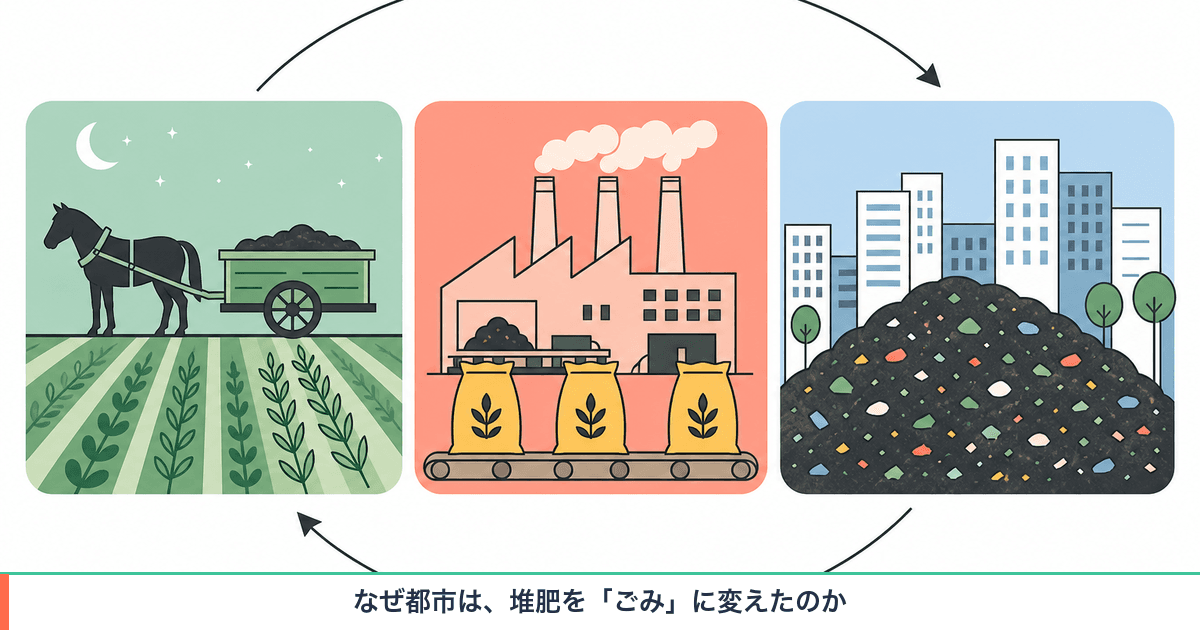
Yesterday's second instalment, on the greenhouse-gas arithmetic of food waste, counted what food scraps emit once they are buried without oxygen. That calculation takes one thing as given: that the scraps go to a landfill at all. This article questions the premise. Urban organic matter has been heading for burial for only about a century. Before that, night soil, kitchen waste and wood ash were commodities that farmers paid to collect. Something removed that price. On 9 September 1913 the world's first ammonia synthesis plant started up at Oppau in Germany, pulling nitrogen out of the air at thirty tonnes a day, and the fertility of a field was decoupled from what a city produced. Organic matter without a buyer became surplus, and in 1937, in Fresno, California, an engineer worked out how to bury it hygienically. Compost did not become garbage because compost changed. It became garbage because its price disappeared and a method of burial was found. What follows traces that disappearance, follows the minority who refused it — Howard and Rodale — and asks what today's mandates are actually trying to buy back.
This article in 3 minutes
- The turning point is 9 September 1913, when BASF's Oppau plant began synthesising ammonia at about thirty tonnes a day; by 1918 Germany was making over 200,000 tonnes a year. Fertility had been unhooked from what cities threw out.
- Yet chemical fertiliser is no simple villain. Erisman and colleagues (Nature Geoscience, 2008) estimated that roughly 48% of the world's population was, at that point, sustained by nitrogen from the Haber-Bosch process.
- Landfill is not a dumping ground but a 1937 design. Jean Vincenz's sanitary landfill at Fresno formalised trenching, compaction and daily earth cover, and was designated a National Historic Landmark on 7 August 2001.
- Japan's loop was cut by economics, not attitude. The environment ministry's white paper states that postwar land reform and cheap fertiliser ended the agricultural use of night soil, leaving its disposal as a problem.
- The line of refusal was thin but unbroken. Albert Howard published An Agricultural Testament in 1940; J. I. Rodale bought a run-down 63-acre farm at Emmaus, Pennsylvania that same year and launched his magazine in 1942.
- The position taken here: composting policy is an attempt to reconstruct, by regulation, a buyer that vanished a century ago. The United States landfilled 146.1 million tons in 2018 while composting 2.6 million tons of food waste.
Opening
On 9 September 1913, fertility divorced itself from what cities throw away
On 9 September 1913, at Oppau near Ludwigshafen, the world's first ammonia synthesis plant went into operation. BASF's own records put its initial capacity at about thirty tonnes a day; within a year it was producing forty, and by 1918 Germany as a whole was making over 200,000 tonnes of synthetic ammonia a year. It was the industrial conclusion of Fritz Haber's patent on the synthesis of ammonia from its elements, filed on 13 October 1908, and of Carl Bosch's translation of that chemistry into high-pressure plant. It is worth restating what the plant did from the city's side of the ledger rather than the farm's. Until then, the nitrogen in a field had to be carried in from somewhere: compost, farmyard manure, night soil, oil cake, fish meal, Chilean saltpetre. The moment nitrogen could be taken out of the air, the top of that list became unnecessary.
Saying it became unnecessary is economically imprecise. What actually happened is that it stopped having a price. Edo's night soil and the manure of European cities were not loops sustained by goodwill; they were commodities that farmers paid to take away. Carting them cost labour, boats and wagons, and it was worth paying because nitrogen was scarce. Synthetic nitrogen abolished the scarcity itself. Once a product existed that was easy to move and store, consistent in composition and an order of magnitude denser in nitrogen per unit weight, the heavy, smelly, variable organic matter of cities quietly left the market. A material with no buyer becomes surplus, and surplus in time becomes something that must be disposed of. What this article follows is the disappearance of that price tag.
The argument
Compost did not fall into garbage; it lost its price and burial was invented to receive it
The argument here comes in two stages. First, the primary cause of urban organic matter's demotion to waste was neither hygiene nor urbanisation but the collapse of its price under a substitute good. Second, a lost price alone does not produce garbage. You also need a technology able to dispose of stranded material cheaply, at volume, and in a way that looks harmless enough. That technology was the sanitary landfill, implemented in 1937 in Fresno, California. The engineer Jean Vincenz's method was to cut a trench, tip the waste in, compact it and cover it with earth every day — a design that made the three standing complaints against open dumping, rats and smell and scatter, disappear at once. By the 1950s it was the most widely used disposal method in the United States. Only with both pieces in place — no price, and a hole engineered to receive it — did urban organic matter settle into the category of garbage.
Read this way, the composting mandates now spreading across the world look different too. Before they are an expression of environmental awareness, they are an attempt to manufacture, by regulation, the buyer that vanished a century ago. Mandating separation, banning organics from landfill, pricing disposal differentially, setting up certification schemes — every one of these is an operation that re-attaches a price, for some other reason, to a material the market stopped pricing. What follows checks first what chemical fertiliser actually replaced, then when Japan's night-soil cycle was cut, then the provenance of burial as a technology, then the line of refusal running through Howard and Rodale. It ends by asking how the loop now being rebuilt differs from the one that was lost.
Sources & further reading
- BASF, 1913 / First Ammonia Synthesis Plant (Oppau)
- Erisman, Sutton, Galloway, Klimont & Winiwarter, How a century of ammonia synthesis changed the world, Nature Geoscience 1, 636–639 (2008)
- FAO, Inorganic fertilizers 2002–2023 (FAOSTAT Analytical Brief)
- National Park Service / City of Fresno, Fresno Sanitary Landfill — National Historic Landmark Nomination (2001)
- US EPA, EPA History: Resource Conservation and Recovery Act (RCRA, 1976)
- US EPA, National Overview: Facts and Figures on Materials, Wastes and Recycling (1960 / 2018 landfilling and composting)
- US EPA, Municipal Solid Waste Landfills (number of MSWLFs, 2009)
- 環境省「平成20年版 環境/循環型社会白書」江戸の循環と戦後のし尿処理問題
- 星野高徳「戦後日本における屎尿処理政策の変容——不衛生処分の残存と下水処理化の進展」社会経済史学 87巻2号 (2021年)
- Rodale Institute, Our Story (1940 Emmaus farm, 1942 magazine, 1947 institute)
- Rodale Institute, Farming Systems Trial (established 1981)
- EUR-Lex, Council Directive 1999/31/EC on the landfill of waste (biodegradable municipal waste diversion targets)
Everything above is free to read.
The rest is for members
This column has moved into the archive, so the full deep-dive is for Urban Farm Crew members and up. Membership funds the daily collection, research and operation of this independent public database. The latest columns are free for everyone.
Or get new columns free by email first
Every Wednesday: a free email digest of new urban-farming cases, research and events from around the world.
Reader feedback
Was this article useful?
No sign-in required. One vote per article on this device; you can change your choice.
Related columns
Is compost actually good for the environment — the case against composting, and what to do anyway
Compostable plastics that do not break down, PFAS and metals in finished compost, and the climate arithmetic once transport is counted
19 min readCompost or methane — the two business models competing for your food scraps
Two industries put different prices on the same bucket of food scraps. One sells the result as electricity; the other can only sell soil. That asymmetry decides which plant gets built
19 min readWhy Japan still doesn't sort its food waste — twenty years of the Food Recycling Act
Business food-waste recycling reaches 91%, yet four fifths of household scraps still go to the incinerator. What sits between the honour-roll figure and the kitchen the law never covered
19 min readMandating it isn't enough — where the world's composting rollouts have stumbled
France, New York, California and China — four mandates lined up against the same three bottlenecks
19 min read