Why Japan still doesn't sort its food waste — twenty years of the Food Recycling Act
Business food-waste recycling reaches 91%, yet four fifths of household scraps still go to the incinerator. What sits between the honour-roll figure and the kitchen the law never covered
2026-08-23 · 19 min read
Series · Composting Now — Systems, Economics, Limits5 / 7
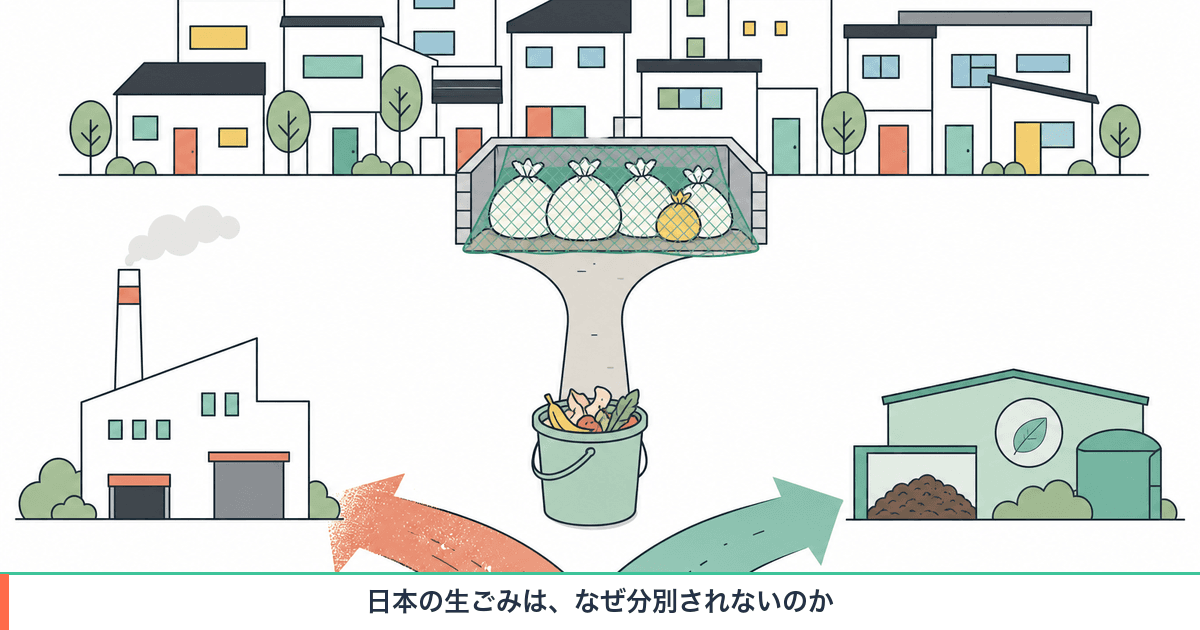
Yesterday's fourth instalment looked at countries where composting mandates were written and the material still failed to move: contamination, household effort, the design of collection. Rules alone do not shift matter. So what about Japan? Japan has had something close to a mandate for a quarter of a century — the Food Recycling Act, passed in 2000 and in force from 2001. And the numbers are remarkably good. On the agriculture ministry's estimates, the food industry as a whole reached a recycling-and-recovery rate of 91% in fiscal 2024; food manufacturing alone reached 98%. Set against the world's stumbles, Japan looks like it is winning. Yet in the same year, environment ministry statistics show that four fifths of Japan's municipal waste goes straight to an incinerator, and that municipal composting plants received less than half of one per cent of all waste processed. Same country, same food scraps. This article follows how those two figures coexist — through the reach of the statute, the contents of the recycling, and the municipal facility ledger. The short version: Japanese food recycling is not succeeding so much as measuring only inside the boundary where success was defined.
This article in 3 minutes
- The agriculture ministry puts the food industry's overall recycling-and-recovery rate at 91% for fiscal 2024. By sector it descends downstream: manufacturing 98%, retail 65%, wholesale 63%, food service 35%.
- The recycling is not composting. In fiscal 2024 the breakdown by use was 8,017 thousand tonnes to animal feed (76%), 1,516 thousand tonnes to fertiliser (14%) and 534 thousand tonnes to methane (5%). Japan's food recycling is, in substance, a feed policy.
- Households sit outside the statute. The Food Recycling Act binds food-related businesses, with periodic reporting required of those generating 100 tonnes a year or more. Kitchen scraps fall under a separate municipal waste regime entirely.
- The infrastructure on that side is thin. In fiscal 2023 municipalities operated 74 composting plants with 1,230 tonnes/day of capacity, against 1,004 incinerators with 174,598 tonnes/day — under one per cent. The direct-incineration rate was 80.3%.
- The gap opens municipality by municipality. The national recycling rate for fiscal 2023 was 19.5%, while Osaki in Kagoshima — first among municipalities under 100,000 people — reached 83.0%. More than a fourfold spread under identical law.
- This article's position: Japan's low rate is a matter of accounting, not attitude. Of 1,004 incinerators, 411 generate electricity, with 2,230 MW of combined capacity. Food scraps are already booked as fuel for a different asset.
Where we are
The honour-roll figure of 91% is measured across a very narrow field
The agriculture ministry's estimate for fiscal 2024 puts the food industry's total generation of food waste at 14,634 thousand tonnes and its recycling-and-recovery rate at 91%. By sector: food manufacturing 98%, food retail 65%, food wholesale 63%, food service 35%. The previous year the overall figure was 90%, and the year before that 89% — a slow, steady climb. A new basic policy published in March 2025 sets targets for fiscal 2029 of 95% for manufacturing, 75% for wholesale, 65% for retail and 50% for food service; manufacturing and retail have already reached their lines. Taken on its own terms this is a genuine achievement, and most countries do not even hold a comparable figure to be placed beside it.
The question is what the statistic counts. Its denominator is food waste arising from food-related businesses; not one gram from a domestic kitchen is in it. Japan's food loss for fiscal 2023 was estimated at about 4.64 million tonnes, split almost evenly between households at 2.33 million and businesses at 2.31 million. On roughly half of the country's food loss, in other words, the 91% says nothing at all. And 'food waste etc.' is a broader category than food loss, taking in the large volumes of inherently inedible matter — vegetable trim, fish frames — that processing produces by design. Most of what sits inside the 91% is material that leaves a factory on a schedule, dry, uniform in character and in bulk. As a physical object it has almost nothing in common with the contents of a kitchen bin.
Reach of the statute
The Food Recycling Act was never looking at the kitchen
The Act on Promotion of Recycling and Related Activities for the Treatment of Cyclical Food Resources — the Food Recycling Act — was enacted in 2000 as Act No. 116 and took effect in May 2001. Its addressees are 'food-related businesses': manufacturers, processors, wholesalers, retailers and operators serving meals, restaurants foremost among them. The machinery sets a priority order — prevent, recycle, recover heat, reduce — then requires periodic reporting from any operator generating 100 tonnes or more of food waste a year, with recommendation, publication and finally an order available where efforts fall conspicuously short. Obligations restricted to businesses; reporting demanded of the larger ones. It is a straightforward design, and it has produced results.
The flip side of that straightforwardness is where household scraps sit. Domestic food waste is municipal solid waste under the Waste Management Act, and responsibility for handling it rests with the municipality. The Food Recycling Act neither obliges municipalities to collect food waste separately nor asks them to compost it. Japan therefore runs two unconnected regimes over the same material. One has reporting duties, numerical targets and an annual published rate. The other has the individual judgement of some seventeen hundred local authorities. The French and Chinese stumbles in yesterday's instalment were failures of mandates that did not move material; for Japanese household scraps there is no mandate to fail. The country has spent a quarter of a century at the stage before stumbling.
Sources & further reading
- 農林水産省「食品廃棄物等の年間発生量及び食品循環資源の再生利用等実施率について」
- 農林水産省「令和6年度食品廃棄物等の年間発生量及び食品循環資源の再生利用等実施率(推計値)」
- 農林水産省「食品廃棄物等の再生利用等の目標について」(令和7年3月14日公表の基本方針)
- e-Gov 法令検索「食品循環資源の再生利用等の促進に関する法律」(平成12年法律第116号)
- 環境省「一般廃棄物の排出及び処理状況等(令和5年度)について」報道発表資料
- 環境省「日本の廃棄物処理 令和5年度版」(資源化等の施設の整備状況・ごみ処理フローシート)
- 環境省「一般廃棄物の排出及び処理状況等(令和6年度)について」(2026年3月27日公表)
- 消費者庁「2023(令和5)年度食品ロス量推計値の公表について」
- 農林水産省「みどりの食料システム戦略」(2021年5月策定)
- 国土交通省「下水汚泥資源の肥料利用」(食料安全保障強化政策大綱の2030年目標)
Everything above is free to read.
The rest is for members
This column has moved into the archive, so the full deep-dive is for Urban Farm Crew members and up. Membership funds the daily collection, research and operation of this independent public database. The latest columns are free for everyone.
Or get new columns free by email first
Every Wednesday: a free email digest of new urban-farming cases, research and events from around the world.
Reader feedback
Was this article useful?
No sign-in required. One vote per article on this device; you can change your choice.
Related columns
Is compost actually good for the environment — the case against composting, and what to do anyway
Compostable plastics that do not break down, PFAS and metals in finished compost, and the climate arithmetic once transport is counted
19 min readCompost or methane — the two business models competing for your food scraps
Two industries put different prices on the same bucket of food scraps. One sells the result as electricity; the other can only sell soil. That asymmetry decides which plant gets built
19 min readMandating it isn't enough — where the world's composting rollouts have stumbled
France, New York, California and China — four mandates lined up against the same three bottlenecks
19 min readHow cities turned compost into garbage — chemical fertiliser and the century of the landfill
The day nitrogen came out of the air, urban organic matter lost its buyer — and burial became a technology
19 min read