Mandating it isn't enough — where the world's composting rollouts have stumbled
France, New York, California and China — four mandates lined up against the same three bottlenecks
2026-08-22 · 19 min read
Series · Composting Now — Systems, Economics, Limits4 / 7
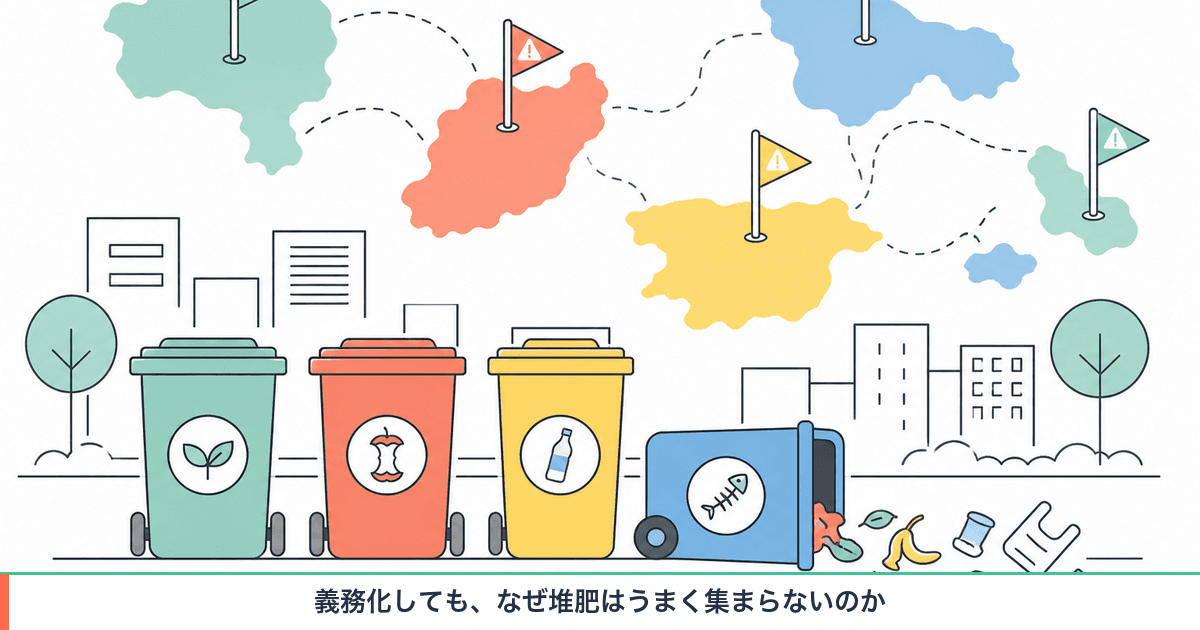
Yesterday's third instalment followed how the twentieth century — chemical fertiliser at one end, the sanitary landfill at the other — moved compost onto the garbage side of the ledger. The 2020s are full of attempts to push it back by law. On 1 January 2024 France made source separation of food waste compulsory with no exemption for size. New York City finished rolling curbside organics collection out across all five boroughs in October 2024 and began fining households the following spring. California legislated in 2016 to cut the organic matter going to its landfills 75 per cent below 2014 levels by 2025. China, starting with Shanghai in 2019, imposed strict sorting on urban residents. None of these is running to schedule. This article lines the four up as cases of stumbling rather than of success, and asks, on a common scale, exactly where each one jammed. The answer, stated in advance: none of the four is a story about public willingness. The place a mandate reaches and the place a system jams turned out not to be the same place.
This article in 3 minutes
- France made source separation of food waste compulsory for every producer, with no minimum threshold, on 1 January 2024. A year on, ADEME counted 32.1 million people — about half the population — with access to a sorting solution, and roughly 900,000 tonnes of biowaste actually separated in a year.
- New York City's curbside organics programme was capturing under 5 per cent of the available material in the autumn of 2024. Enforcement, begun on 1 April 2025, roughly doubled the capture rate to about 10 per cent — and was suspended in under three weeks. Fines resumed only on 1 January 2026.
- California's SB 1383 set a target of cutting landfilled organics 50 per cent below 2014 levels by 2020. The state not only missed it but sent about a million tons more than the baseline year. The Little Hoover Commission, an independent state oversight body, has since issued twelve recommendations including a pause.
- Shanghai's compulsory sorting began in July 2019 and pushed wet waste past 9,000 tonnes a day, against a treatment capacity reported at around 5,050 tonnes a day. The better the sorting, the less fuel for the incinerators: in May 2023 the Laogang plant logged 88 days of stoppage across its twelve lines.
- What the four share is that the mandate lands on the household while the jam sits downstream. What these systems count is access to a sorting option, or the existence of an ordinance — not tonnes of finished compost. A mandate creates a starting line; without receiving capacity and a changed ledger for the incumbent plant, the numbers do not move.
Opening
The obligation began on 1 January 2024; the bin has reached about half the households
France's circular-economy law of 10 February 2020, known as the AGEC law, obliges producers of biowaste to separate it at source. A decree of 21 June 2023 removed the volume threshold, so that from 1 January 2024 every producer, households included, falls inside the obligation. Until then the duty had applied only to large operations generating more than ten tonnes a year, which makes this a substantial jump. Municipalities carry a matching duty: communes above 50,000 inhabitants had to offer a separation route from January 2024, the rest by the end of 2026. The route itself is left open — individual or shared composters, kerbside collection at the foot of a building, drop-off points in public space, industrial composting, anaerobic digestion. The design says only that a household must be given somewhere to put food scraps that is not the residual bin.
The first year's figures came from ADEME, the French environment agency, in April 2025. Some 32.1 million people now have access to a separation route: three times the 2022 number, and roughly one French resident in two. The growth is real, but read the other way it means that a year after the obligation took effect, the other half still had nothing to use. The tonnage is heavier news. About 900,000 tonnes of biowaste a year is actually being separated and handled. In the household survey, 56 per cent say they sort food waste and 37 per cent say they compost it, while only 12 per cent use a municipal separate collection. The duty covers everyone; the quantity that travels through the system and comes out as compost or biogas remains a small fraction of what is generated. That gap is the first shape a stumble takes.
The frame
Where a mandate lands is not where the system jams
What follows dissects four systems against the same three bottlenecks. The first is the household's own hand: willingness is not enough when the obstacles are where to keep the scraps, the smell, the extra work, and whether a container exists at all. The second is the receiving end — whether the vehicles, sites and plants that must accept the separated material and turn it into compost or biogas exist in the quantities the mandate implies. The third is the incumbent's ledger: incinerators and landfills were built against an assumed input and are serviced by debt and by gate fees. Pull the food waste out and that economy shifts. However firmly a statute is worded, if any one of the three is blocked, the compost does not appear.
Sorted that way, the four cases separate with unusual clarity. France is jammed mainly at the first and second points; New York at the first; California at the second; China at the second and third. What matters more is that none of the four measures the distinction for itself. The 32.1 million France announces is a count of access. What California requires of its jurisdictions is ordinances and collection services. What Chinese cities publish is separation rates. Not one of these systems has adopted, as its headline indicator, the quantity that became compost and went back onto soil. What is not measured does not improve — that sentence is the spine of this article.
Sources & further reading
- Ministère de la Transition écologique — Tri à la source des biodéchets : une obligation, de nombreuses solutions
- ADEME Infos — Un an après sa mise en place, quel bilan peut-on tirer du tri à la source des biodéchets ? (2025)
- Banque des Territoires — Le tri à la source des biodéchets désormais proposé à près d'un Français sur deux, selon l'Ademe
- Waste Dive — New York City pauses curbside organics enforcement (2025)
- West Side Rag — City Resumes Enforcement of Composting; What the UWS Numbers Show About Participation (2026)
- Institute for Local Self-Reliance — Three NYC Composting Failures That Reflect Troubling National Trends
- Little Hoover Commission — Reducing California's Landfill Methane Emissions: SB 1383 Implementation
- Waste Dive — California commission recommends a pause on SB 1383 organics law, industry disagrees
- Library of Congress, Global Legal Monitor — China: New Waste-Sorting Rules to Take Effect in Shanghai (2019)
- Eco-Business / Dialogue Earth — Four years of waste sorting leaves China's incinerators short of fuel (2023)
- CGTN — A year into Beijing's compulsory household waste-sorting policy (2021)
Everything above is free to read.
The rest is for members
This column has moved into the archive, so the full deep-dive is for Urban Farm Crew members and up. Membership funds the daily collection, research and operation of this independent public database. The latest columns are free for everyone.
Or get new columns free by email first
Every Wednesday: a free email digest of new urban-farming cases, research and events from around the world.
Reader feedback
Was this article useful?
No sign-in required. One vote per article on this device; you can change your choice.
Related columns
Is compost actually good for the environment — the case against composting, and what to do anyway
Compostable plastics that do not break down, PFAS and metals in finished compost, and the climate arithmetic once transport is counted
19 min readCompost or methane — the two business models competing for your food scraps
Two industries put different prices on the same bucket of food scraps. One sells the result as electricity; the other can only sell soil. That asymmetry decides which plant gets built
19 min readWhy Japan still doesn't sort its food waste — twenty years of the Food Recycling Act
Business food-waste recycling reaches 91%, yet four fifths of household scraps still go to the incinerator. What sits between the honour-roll figure and the kitchen the law never covered
19 min readHow cities turned compost into garbage — chemical fertiliser and the century of the landfill
The day nitrogen came out of the air, urban organic matter lost its buyer — and burial became a technology
19 min read