Chilean urban planning has no land use called agriculture — that is the gap the bill is trying to fill
A 500-square-metre ceiling, a register and the temporary use of abandoned land: the bill tabled on 24 March 2025 has yet to be voted on in the Chamber
2026-09-15 · 19 min read
Series · Crisis first, law later — urban farming in six South American countries7 / 7
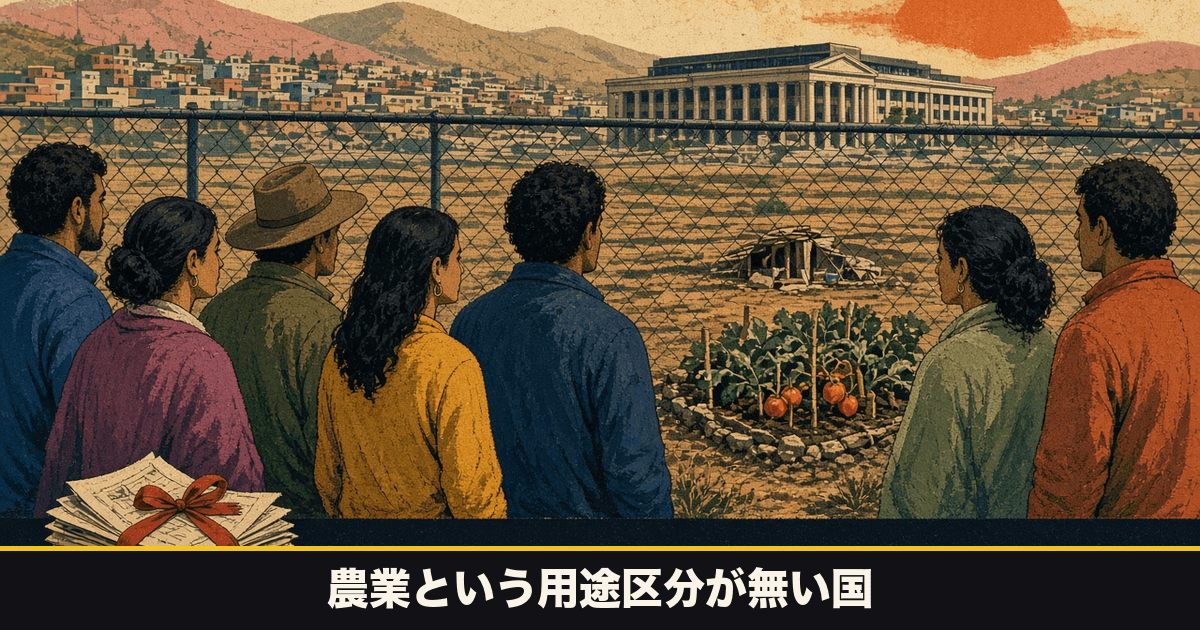
Chilean urban planning has no land-use category for agriculture. Decree 75 of the housing and urban development ministry, dated 25 June 2001, amended the General Ordinance on Urbanism and Construction and standardised land uses into six classes — residential, facilities, productive activities, infrastructure, public space and green space. That is article 2.1.24, and agriculture fits into none of the six. This does not mean Chile has no law about gardens. Law 6,815 of 5 February 1941 directed 30 per cent of the national housing fund's money to gardens for workers and their families, and that law has never been repealed. What disappeared, in 1953, was the fund the text names. On 24 March 2025 six deputies tabled a new bill on urban gardens: boletín 17.433-06, which defines an urban garden as up to 500 square metres and sets up a register. The 1941 law required a garden of no less than 5,000.
This article in 3 minutes
- Chilean urban planning has no land-use category for agriculture: Decree 75 of 25 June 2001 standardised land uses into six classes, and agriculture fits none of them.
- Before 2001 municipalities had a way round it. Two direct methods — zoning for exclusive agricultural use and a minimum plot size — carried the protected area across five cases past 3,000 hectares in the 1990s.
- A national garden law does exist. Law 6,815 of 5 February 1941 has never been repealed and even makes a ban on transfer, mortgage and subdivision registrable against the title — but the housing fund that ran it went in 1953.
- The plot has shrunk tenfold. The 1941 law set a garden at no less than 5,000 square metres; the 2025 bill caps an urban garden at 500. The line has flipped from a floor to a ceiling.
- The bill has not moved since 24 March 2025. The Chamber's open data records no vote on it at all: a private member's bill by six deputies, admitted and left there.
- This article's position is that what the bill would create is a register rather than gardens. Of the six countries covered over seven days, not one has written down a rent ceiling or a term of tenure.
Opening
Calling Chile the country that has no law yet is not accurate
Law 6,815 was sanctioned on 5 February 1941 and printed in the Diario Oficial, issue 18903, on 4 March. It came from the labour ministry, and its title reads: allocating funds for the formation of workers' gardens and for the development and promotion of home industries. Article 1 instructs the higher council of the Caja de la Habitación Popular, the national housing fund, to devote 30 per cent of the money at its disposal each year to forming workers' and family huertos and workers' and family jardines, and 5 per cent to promoting home industries, agricultural and livestock ones above all. Look the law up in Ley Chile, the database of the National Congress Library, and the latest version is dated 8 January 1960 and its status is recorded as not repealed. A text written eighty-five years ago is still on the books.
What is not alive is the machinery. The Caja de la Habitación Popular was created by Law 5,950, sanctioned on 8 October 1936. In 1953 responsibility for housing policy passed to CORVI, the housing corporation, and the fund ceased to exist. Article 9 of Law 6,815 names that corporation, so the text was plainly rewritten after the change — and the corporation is gone in its turn. The body article 1 orders to allocate the money no longer exists. A text surviving while the machinery that works it disappears is something this series has already seen: in Lima, on day five, framework ordinance 1629 was never once repealed while the municipal garden programme was dismantled and restarted as mayors changed. What stops is the budget and the office, not the clause. Chile is the extreme case, with the clause alone left standing for eighty-five years.
The order for today, set out in advance. First we check what the 1941 law actually says, clause by clause, and then look at what became of the land bought under it, in La Pintana in the south of Santiago. Next we follow what Decree 75 took away from municipalities in 2001, through the changing surface of protected land across five cases. Then we open the 2025 bill and set its three substantive parts — a 500-square-metre ceiling, a register, and the temporary use of abandoned land — beside the instruments seen from day two to day six. Finally we pin down in figures what is actually being cultivated now, and count what the bill leaves untouched. The recap goes not to today's article but to a summing-up of all seven days.
Where the gap is
With no land-use category a plot can occupy, municipalities have disguised their plots as something else
Decree 75 of the housing and urban development ministry, dated 25 June 2001, amended the General Ordinance on Urbanism and Construction. It laid down new rules for drawing up planning instruments, and at the centre of it stood the standardisation of land uses. Article 2.1.24 sorts the use of land into six classes: residential, facilities, productive activities, infrastructure, public space and green space. Agriculture belongs to none of them. The same amendment limited the minimum plot subdivision a municipal plan may set in urban areas to 2,500 square metres, and its exceptions cannot be made to include agriculture either. This account comes from the paper Ana Zazo-Moratalla, Alejandro Orellana-McBride and Claudia Cerda-Inostroza published in 2023 in EURE, volume 49, issue 147.
What the three examined was five cases across four conurbations: Gran La Serena; the comunas of Peñalolén and La Pintana in Gran Santiago, treated as separate cases because they do not adjoin; Gran Chillán; and Gran Concepción. They found twenty-one planning instruments that took agriculture into account, three of which cancelled the protection instead. Their conclusion runs like this: Chilean law has never conceived farmland as something to be regulated, municipalities could make up for that with ad hoc devices until 2001, and the framework now imposes the premise that agriculture is not among the uses available inside the urban limit. What is left is camouflage — hiding the plot inside an environmental protection zone or the grounds of an educational facility and protecting it indirectly. Bogotá handing out eight growing methods, Lima enumerating the places a plot may sit: each was a remedy shaped to that country's particular gap. Chile's gap is in the category list itself.
Sources & further reading
- Biblioteca del Congreso Nacional de Chile / Ley Chile — Ley 6.815, DESTINA FONDOS PARA LA FORMACION DE HUERTOS OBREROS Y AL DESARROLLO Y FOMENTO DE LAS INDUSTRIAS CASERAS(1941年2月5日裁可、3月4日官報第18903号。第2条・第8条・第16条・第17条)
- Biblioteca del Congreso Nacional de Chile / Ley Chile — Ley 5.950, CREA LA CAJA DE LA HABITACION POPULAR(1936年10月8日裁可、10月10日公布)
- Cámara de Diputadas y Diputados de Chile — Datos abiertos, Proyecto de ley Boletín 17.433-06「Fija normas para el fomento, desarrollo y registro de huertos urbanos」(受理2025年3月24日、モシオン、提出者6名、採決記録なし)
- Actualidad Jurídica, Diario Oficial de Chile — Proyecto de ley fija normas para el fomento, desarrollo y registro de huertos urbanos(2025年3月28日。上限500平方メートル、登録制、放置地の一時利用、pernoctar ni residir の禁止)
- Zazo-Moratalla A., Orellana-McBride A. & Cerda-Inostroza C. (2023) — Agricultura urbana en barbecho. Concepciones en la planificación urbana chilena, EURE 49(147)(2001年の省令75号、UAE/SPM/USC/SPE、5事例の面積の推移)
- Gurovich Weisman, A. (2003) — Conjugando los tiempos del verbo idealizar: los huertos obreros y familiares de La Pintana, Santiago de Chile, Cuadernos del CENDES 53(1942年の農場取得、半ヘクタール500区画、1946/1950/1957年の各期、1979〜85年の327.73%)
- Biskupovic C., Maurines B., Carmona R. & Canteros E. (2022) — Food democracy and sustainability in France and Chile: Community gardens promote ecological citizenship, Frontiers in Sustainable Food Systems(ラ・ピンタナの労働者菜園、NGOクルティボス・ウルバノス、ロンキマイの高地菜園)
- Herrera-Oesterheld M. S. ほか (2025) — Social-ecological filters influence plant and invertebrate diversity in educational gardens in a South American metropolis, Scientific Reports(サンティアゴ首都圏の学校菜園33か所、植物362種、無脊椎動物127形態種)
- Ladera Sur — 10 sorprendentes beneficios de los huertos comunitarios urbanos(2007年ラ・ピンタナの市営コミュニティ菜園700平方メートル・11区画、2012年ごろサンティアゴに約40か所)
- Municipalidad de Providencia — Festival de la Cosecha 2026(2026年6月20日、Espacio Verde Urbano、Padre Mariano 140)
Institution ① 1941
The law of 1941 built the plot as housing finance, not as agricultural policy
Article 2 of Law 6,815 defines two terms. A huerto obrero or huerto familiar is popular housing with an annexed piece of land suited to working one or more small industries or crops, whose economic yield suffices for the family's subsistence and for servicing the loan. A jardín obrero or jardín familiar is popular housing built mainly within the urban perimeter or just outside it, with an annexed plot of not less than 500 and not more than 5,000 square metres. Article 8 adds further conditions: these must be established in groups of no fewer than twenty, the surface of a huerto may not fall below 5,000 square metres, and on irrigated ground the holding must carry a water allocation matching the technical requirements of the farming to be done. The state, in other words, held the size of the plot up from below.
There are clauses on money and on staff as well. Article 9 requires each group to reserve space for streets, roads, squares, schools, sports fields, cooperative premises and the works it needs, and places the general costs of that urbanisation — streets, squares, buildings for shared services, sewerage, drinking water, electricity, agricultural development, and everything directed at the social purpose, from welfare and education to sport — on the state, at no cost whatever to the purchasers. Article 10 puts each group for its first five years under the direction of an agricultural engineer together with whatever specialists and practical farmers are needed, after which only the engineer and the minimum supervision remain until the debt is extinguished. Under article 6, loans go to Chileans alone, with first priority to legally constituted cooperatives of workers or employees, especially those formed before the law.
And then the clauses on land. Article 16 provides that someone who has received a plot may claim definitive title only once twenty per cent of the price has been amortised, and that the provisional title is non-transferable. Article 17 goes further: without the fund's authorisation these huertos and jardines, and the water rights attached to them, may not be transferred in whole or in part, mortgaged or subdivided, until the price has been paid in full — and the text specifies that the prohibition must be entered in the register of real property. Here is the clause that day six, in Quito, said was missing everywhere: the one that makes an existing garden hard to move. It admits more than one reading, though. The prohibition protects the lender's security as much as the garden, and it binds the person doing the digging. Article 16 also lets the council, by a two-thirds majority, remove administratively and without any judicial procedure a beneficiary whose conduct has become a nuisance to the neighbours.
On the ground ①: from 1942
The land bought under that law is still undivided eighty years on
In 1942 the housing fund acquired title to the La Pintana estate, some eighteen kilometres south of central Santiago, land that had once belonged to President Aníbal Pinto Garmendia, who held office from 1876 to 1881. The purchase was made in order to try out an exemplary settlement under the new law. What the fund built there was a población modelo for the José Maza cooperative society, formed in 1937: porticoed three-bedroom houses on five hundred lots. Each lot was half a hectare, that is 5,000 square metres — exactly the floor article 8 had fixed. The first stage was completed in 1946, the second in 1950 and the third in 1957. It is a case of a statutory design appearing directly on the ground, with the dimensions of the parcels taken from the text.
The land around it went the other way. From the 1950s the large agricultural estates nearby were sold and parcelled out, producing similar operations at Mapuhue and Las Rosas. From about 1960 the state's serviced-site programmes, the operaciones sitio, coincided with land occupations, and the population rose sharply. Between the censuses of 1970 and 1982 La Pintana's annual cumulative growth rate ran at 6.23 per cent, 2.27 times that of Greater Santiago. It climbed to 8.71 per cent between 1982 and 1992 and fell to 1.39 per cent between 1992 and 2002. In the six years from 1979 to 1985, when the comuna became a destination for forced relocations under military rule, the number of resident families increased by 327.73 per cent, 12.94 times the Greater Santiago average. Seen from the plots, those were six years in which everything around them became housing.
The model settlement survived even so, and what preserved it was not the planning system. It was an agreement the cooperative made at its founding and maintains to this day, forbidding the subdivision of the plots and forbidding any productive activity that would alter the neighbourhood beyond agriculture, housing and inoffensive small industry. A 2003 study wrote that the settlement, though hemmed in by other developments, had held good and had become a paradigm, thanks above all to the persistence of a community organised around its cooperative. The comparative study by Consuelo Biskupovic and colleagues, published in Frontiers in Sustainable Food Systems in 2022, likewise took La Pintana's workers' gardens as one of its three Chilean cases and records them as having lasted more than fifty years. The one place in Chile where a plot became immovable was held there by a covenant between neighbours, not by a statute.
Institution ② 2001
What closed in 2001 were the two direct methods of protection municipalities had been using
The EURE paper sorts the methods municipalities used into four. Exclusive agricultural use, UAE, is a direct method: zoning that permits agriculture and nothing else. Minimum plot size, SPM, is also direct, regulating the size of parcels so they cannot be broken up. Compatible land use, USC, is indirect, folding the plot inside some other permitted use. And no specific protection, SPE, describes a plan that mentions agriculture without providing any means of protecting it. The paper's analysis makes the two direct methods decisive: UAE kept incompatible uses out, SPM kept the ground from fragmenting, and combined they held back property pressure. The 2001 legislation removed both. Having passed 3,000 hectares across the five cases in the 1990s, the protected surface has fallen ever since.
The case figures show it. In Gran La Serena an indicative intercommunal plan of 1948 treated 1,398 hectares as agriculture, and the regulation lapsed in 1952. La Serena's plan of 1964 protected 482 hectares as a zone of orchards and market gardens, Coquimbo's of 1968 protected 94 hectares as agricultural parcels, and a sectional plan of 1991 took the minimum plot size up to 20,000 square metres and added 339 hectares more. La Serena's plan of 1992 protected 2,125 hectares. Then, after the 2001 framework, the plan of 2004 did no more than treat agriculture as a compatible use inside a residential zone, and the most recent plans of both comunas drop any mention of agriculture at all. Follow only the movement of the figures and the year the instruments disappeared is still legible.
The same thing happened in Santiago. Peñalolén's municipal plan of 1989 protected 258 hectares in two polygons, and modifications in 2002 and 2018 stripped the protection from one of them. In La Pintana the metropolitan plans of 1989 and 1994 protected 559 hectares, and the 2002 modification divided that zone into east and west. The metropolitan plan of 2018 kept protection over 261 hectares in the west, while the eastern sector, La Platina, was left without specific protection, opening it to housing, service buildings and landscaped green areas. In Gran Chillán the 146 hectares that had been protected under an educational use lost that protection in the municipal plan of 2016, clearing the way for conversion to housing. Gran Concepción's horticultural production zone shrank to 47 hectares. It is worth holding on to the fact that the protection in both La Pintana and Chillán ran through an educational use: the plots survived because a university was farming them.
The bill, 2025
The bill's 500 square metres is a ceiling, not a floor
Pull the bill's record from the Chamber of Deputies' open data and it reads as follows. Boletín 17.433-06, entitled Fixing rules for the promotion, development and registration of urban gardens; entered on 24 March 2025; type, a private member's bill, a moción; chamber of origin, the Chamber of Deputies. The authors are six: Jaime Mulet Martínez, Daniel Melo Contreras, Félix González Gatica, Consuelo Veloso Ávila, Rubén Darío Oyarzo Figueroa and Jorge Saffirio Espinoza. It is recorded as admissible. And the field for votes is empty. A year and a half after it was tabled, the Chamber holds no record of a single vote on it. Press accounts and this site's own record say it was referred to the Chamber's committee on housing, urban development and national assets; the Chamber's own site could not be reached, so what this article verifies at first hand is the entry and the absence of any vote.
The contents were summarised by the official gazette's legal bulletin on 28 March 2025. An urban garden is a growing space of up to 500 square metres inside urban territory, intended for producing vegetables, fruit, greens, medicinal herbs and flowers for the growers' own consumption. The state is to set up a register of them. Whoever runs a garden must adopt measures to guarantee safety and to promote social and territorial integration. They may hire people for the work, and in doing so may give priority to those in vulnerable situations and to older people. And sites that are out of use, or evidently abandoned in a way that puts public safety at risk, may be given over temporarily to urban gardens — though nobody may spend the night or live on them: pernoctar ni residir, in the words of the text.
Set those three beside the countries of days two to six and the bill's position becomes clear. The 500-square-metre ceiling is the same order of magnitude as the roughly 300 square metres Rosario lends each grower for nothing — but the character differs. Rosario's 300 square metres is what the city hands over; Chile's 500 is what the law would permit. The register works on much the same idea as the directory of growers and crops that Bogotá's Acuerdo 605 told its botanical garden to build, and the enumeration of eligible sites has the shape of Lima's framework ordinance 1629. Chile's bill, in other words, would do at national level, in one instrument, what its neighbours have done through municipal ones. The difficulty lies in the third element. The clause on temporary use of abandoned and hazardous land writes into statute the very premise the EURE paper attacks — that agriculture is a fallow interval, a barbecho, before the ground turns into something else.
On the ground ②: 2007 to 2026
What is actually cultivated now are small municipal parcels and school gardens
The first municipal community garden in the Santiago metropolitan area opened in 2007, in the comuna of La Pintana. It covered 700 square metres, divided into eleven parcels. By around 2012 the number of community gardens in Santiago is reported to have reached about forty. So the same comuna holds both the model settlement of the 1940s and the garden of 2007. Compare the dimensions. A single lot under the 1941 law was 5,000 square metres; the whole site of the 2007 garden is 700; divided eleven ways, one parcel comes to some sixty. Between the era when the state distributed plots as housing finance and the era when a municipality opens a garden on a piece of spare ground, the area reaching one person differs by two orders of magnitude.
For school gardens there are measurements. A paper by María Sofía Herrera-Oesterheld and colleagues, published in Scientific Reports in 2025, surveyed 33 vegetable gardens at municipal schools in the Metropolitan Area of Santiago, counting vascular plants and invertebrate morphospecies. It recorded 362 plant species and 127 invertebrate morphospecies. The strongest influences on plant richness were the area of the garden, the percentage of cultivated ground cover, and irrigation through the summer. For invertebrates the strongest were plant species richness and bare ground cover, the latter negatively, with tree cover in the surrounding buffer and summer irrigation counting for less. The authors conclude that the biodiversity of these gardens is tied far more closely to conditions and management inside the garden than to what lies around it. Housing may close in on all sides; keep watering and the plot still carries life.
The record also names who is doing the growing. The 2022 study by Biskupovic and colleagues covered three Chilean sites: the workers' gardens of La Pintana, the work of the NGO Cultivos Urbanos, and the Pehuenche high-mountain gardens at Lonquimay. Cultivos Urbanos works in Peñalolén, San Joaquín and Recoleta, with its principal project in the historic Barrio Yungay since 2011. Twenty-seven families are involved in the gardens at Lonquimay. The calendar keeps filling too: on Saturday 20 June 2026, from ten in the morning until six in the evening, the municipality of Providencia held the second edition of its harvest festival at the urban green space on Padre Mariano 140, with a market of seasonal vegetables and seeds and a home-gardening workshop for beginners. Not one of these is waiting for the bill to pass. And not one of them is protected if the ground changes hands.
The limits
The bill says nothing about rent or term — and neither does any of the six countries
List the absences. There is no ceiling on rent. There is no minimum term of use. There is nothing restricting termination by the owner. And there is nothing that would add agriculture to the land-use categories available inside the urban limit. A register records who is growing; it does not record for how many years they may. The benchmark was set on day one: section 5 of Germany's Federal Allotment Gardens Act binds the rent to no more than four times the local going rate for commercial fruit and vegetable growing, cutting the plot loose from urban land values. Law 6,815 of 1941 at least forbade transfer, mortgage and subdivision in its article 17 and made that prohibition registrable. The 2025 bill carries no clause of the kind.
Run the six countries and the same absence lines up. Rosario in Argentina hands each grower about 300 square metres under a free loan for use — and one plot went fourteen years from 2008 without ever receiving the paperwork. Brazil's PNAU has neither a rent ceiling nor a minimum term, and what Belo Horizonte grants is a permission the administration can withdraw. Colombia hands over a register and materials while the applicant supplies the ground. Peru's framework ordinance 1629 leaves the use of vacant land to an agreement with its owner, and the gardens beneath the power lines have stood for twenty years on a transmission company's consent. Ecuador is still on permission to use after twenty-four years, and the obligation in its 2025 ordinance binds only new residential developments. Chile adds a sixth variant: a country that once had a clause binding the title, tabling a bill that does not go near one.
The counter-argument belongs here. It could be said that the bill is wise to stay away from land: a private member's bill that touched property rights would never pass, whereas a definition and a register might, and if they did they would form a base for the next amendment. That reading has real force. But the EURE paper's finding answers it directly. So long as agriculture belongs to none of the six land uses, a registered garden is still a garden standing on land classified as something else. A register makes a plot visible. It does not make it hard to move. That what held La Pintana's model settlement for eighty years was a registered prohibition on subdivision is the worked example of the point.
Recap
What none of the six countries has obtained is a clause that makes a garden hard to move
Lay today's route out again. It starts with Law 6,815 of 5 February 1941, which put 30 per cent of the housing fund's money into workers' and family gardens, set a garden at no less than 5,000 square metres and a group at no fewer than twenty households, and, in article 17, forbade transfer, mortgage and subdivision until the price was paid, making the prohibition registrable. In 1942 the fund acquired the La Pintana estate and laid out five hundred half-hectare lots for the José Maza cooperative, formed in 1937; the first stage came in 1946, the next in 1950 and 1957. Around them, between 1979 and 1985, the number of resident families rose by 327.73 per cent. Decree 75 of 25 June 2001 then standardised land uses into six classes and removed the two direct methods of protection, exclusive agricultural zoning and minimum plot size. And on 24 March 2025 a bill capping an urban garden at 500 square metres was tabled, and has still not been voted on.
Three points from today, restated. First, Chile's gap is not the absence of a law but the absence of a category: agriculture is not among the six uses article 2.1.24 of Decree 75 sets out — residential, facilities, productive activities, infrastructure, public space and green space. Second, the loss of the direct methods of protection shows up in hectares. Across the five cases the protected surface passed 3,000 hectares in the 1990s and then contracted; in La Pintana the 559 hectares of 1989 and 1994 had become 261 hectares in the west alone by 2018, while the eastern sector, La Platina, was opened to housing and service buildings. Third, what is cultivated now is small. Against the 5,000 square metres of a single 1941 lot, the municipal garden opened in La Pintana in 2007 occupies a 700-square-metre site in eleven parcels. Even so, 33 school gardens in the Santiago metropolitan area held 362 plant species and 127 invertebrate morphospecies.
The gaps and reservations belong on the record. First, the committee referral could not be verified at first hand. The Chamber's own site could not be reached, and what could be confirmed is the entry of 24 March 2025 in the open data and the absence of any recorded vote. The statement that it went to the committee on housing, urban development and national assets rests on press accounts and this site's record. Second, the present effect of Law 6,815 could not be verified. Being registered as not repealed means the text has not been struck out; it does not mean loans are still being made under it, and the housing fund named in article 1 vanished in 1953. Third, there is an obvious objection. Reading the 1941 law as a law that protected gardens is hindsight: its purpose at the time was housing supply and the cultivation of cooperatives, and article 16 allowed a beneficiary who became a nuisance to the neighbours to be removed without any judicial procedure. The clause that protects and the clause that binds are one and the same.
Finally, a summing-up of all seven days. The sequence set out on day one — crisis first, then the municipality, then national law — held across all six countries. Thirty-four years separate ProHuerta on 3 August 1990 from Brazil's PNAU on 29 July 2024, and city halls carried the interval. But the seven days showed more than a sequence. Rosario had gardens from 1987, and what the collapse produced was the paperwork that hands over land and a market. In Brazil the device that works hardest is not a statute but school meal procurement, whose floor Law 15,226 of 2025 raised to 45 per cent. Colombia's gardens began with a hip hop collective, and what Bogotá's Acuerdo 605 created was a register. In Peru national law arrived for the communal pot rather than for the plot, and Quito housed the work in a private-law non-profit corporation and outlasted five city governments. In Chile the text alone survived eighty-five years while the body that worked it went first. One thread runs through all of it: nowhere among the six is there a ceiling on ground rent or a minimum term of tenure. What is handed over is seed, training, materials, a place on a register and a place to sell — not land. Which makes the action to take on finishing plain enough. For the plot you are involved with, check whether you can write three things down. Who owns the ground. How many years you may use it, and whether that rests on a document. Who buys what you grow. Whichever line you cannot write is what your garden will lose first.
Key takeaways
- Chilean urban planning has no category for agriculture. Decree 75 of 25 June 2001 standardised land uses into six classes — residential, facilities, productive activities, infrastructure, public space and green space — and agriculture fits none of them.
- What went in 2001 was the municipal way round it. With exclusive agricultural zoning and minimum plot size no longer available, the area protected across five cases has contracted ever since it passed 3,000 hectares in the 1990s.
- The national garden law has never been repealed. Law 6,815 of 5 February 1941 directs 30 per cent of the housing fund's money to workers' gardens — but the fund itself disappeared in 1953.
- The dimension flipped from floor to ceiling. The 1941 law set a garden at no less than 5,000 square metres; the 2025 bill defines an urban garden as at most 500.
- What kept La Pintana's plots for eighty years was not planning law. It was the prohibition on subdivision the José Maza cooperative, formed in 1937, agreed at its founding and had registered.
- The bill has not moved since 24 March 2025. The Chamber's open data holds no record of a vote on it: a private member's bill from six deputies, admitted and left there.
- Not one of the six countries sets a rent ceiling or a term of tenure. A register records who is growing; it does not record for how many years they may.
Don't miss the rest of the series
Columns publish one each morning, seven to a series. The free weekly email wraps up the series that just ended and introduces the one that's starting — every Wednesday.
Reader feedback
Was this article useful?
No sign-in required. One vote per article on this device; you can change your choice.
Related columns
Five city administrations came and went, and the gardens stayed — AGRUPAR in Quito, Ecuador
It sits not in a city department but in a private-law non-profit corporation that holds training, seedlings and the marketplace in one hand
19 min readThe national law came for the pot, not the plot — Peru, Lima's gardens and communal kitchens
In a city with under 15 millimetres of rain a year, what keeps the gardens going is a municipal ordinance and women's neighbourhood organisations
17 min readThe rap collectives made the gardens first — Colombia, Medellín and Bogotá
In Medellín the gardens began from the memory of the disappeared, and in Bogotá residents mapped them before the city did
18 min readThirty-one years in city hall, nine in congress — how urban farming became law in Brazil
What the national statute took over was a circuit with a buyer at the end, already built by municipalities and the school meal programme
18 min read