Five city administrations came and went, and the gardens stayed — AGRUPAR in Quito, Ecuador
It sits not in a city department but in a private-law non-profit corporation that holds training, seedlings and the marketplace in one hand
2026-09-14 · 19 min read
Series · Crisis first, law later — urban farming in six South American countries6 / 7
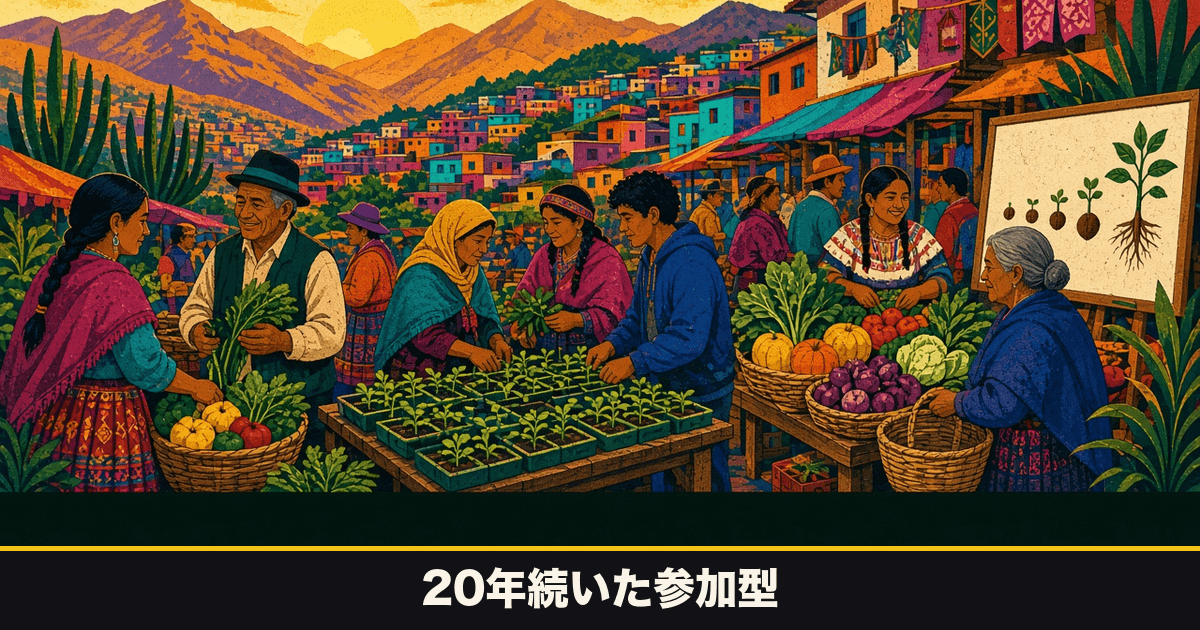
AGRUPAR, Quito's urban agriculture programme, began in 2002 and enters its twenty-fourth year in 2026. A paper published in 2022 records that five municipal administrations of differing political outlook came and went from 2000 onward while the programme held on to its core values and principles. Part of the reason is the shelf it sits on. AGRUPAR is not housed in a city department but in CONQUITO, the economic promotion agency constituted by resolution C 0193 of the Metropolitan Council on 28 March 2003. Article 1 of its statute defines it as a private-law non-profit corporation with assets of its own and no fixed term. From there the programme hands out training, seedlings and technical support, and runs the bioferias where the produce is sold. The rules caught up much later: food security entered the city's land use and development plan on 13 September 2021, and the ordinance on urban gardens passed on 29 April 2025.
This article in 3 minutes
- Part of why AGRUPAR outlasted changes of city government is where it sits. The programme is not in a municipal department but inside CONQUITO, a private-law non-profit corporation constituted by resolution C 0193 of 28 March 2003.
- A 2022 paper records that five municipal administrations of differing political outlook have passed since 2000. AGRUPAR nonetheless enters its twenty-fourth year with its core values and principles intact.
- What it hands out is not land but an unbroken chain: training and technical assistance, 2,051 pieces of productive infrastructure, 48 community banks, and the bioferias where the produce is sold — all held by one organisation.
- About 84 per cent of participants are women heads of household. Roughly 4,500 people grow each year, and the additional income is put at around USD 175 a month per garden.
- The rules arrived after the practice. Quito's land use and development plan (PUGS) was approved at an extraordinary council session on 13 September 2021, and the ordinance on urban gardens passed on 29 April 2025.
- This article's position is that the shelf it sits on and the unbroken chain of delivery are what kept it running. Even so, after twenty-four years the plots still have neither a secured lease term nor a rent ceiling.
Opening
AGRUPAR outlived changes of city government because it sits outside city hall
Quito's municipality first touched city gardens in 2000, starting them with support from the Urban Management Programme for Latin America and the Caribbean (PGU-ALC), and in 2002 the work became a formal programme under the name AGRUPAR. For its first three years it was run by the city's Directorate for Sustainable Human Development. In 2005 it moved to CONQUITO, the economic promotion agency, and it has stayed there for more than twenty years since. A 2022 paper in Frontiers in Sustainable Food Systems, written by people inside the programme, records that five municipal administrations with different political perspectives and priorities passed from 2000 onward while the programme held to its core values and principles. That sentence is more concrete than the bare fact of twenty-odd years. What changed was the city government; the programme did not.
It is worth pinning down what CONQUITO is before going further. Its full name is the Corporación de Promoción Económica CONQUITO. Resolution C 0193 of the Metropolitan Council of Quito, dated 28 March 2003, approved its constitution, and its statute was authorised by ministerial agreement 03 528 of 27 October 2003, later amended by ministerial agreement 15 208 of 28 October 2015. Article 1 of that statute sets out its character: a private-law non-profit legal person, holding assets of its own, of indefinite duration, with no ceiling on the number of members. It is not a department of the city but a separate legal person in which the city takes part as a principal member. That distinction tells whenever a budget year turns over.
Set against the South American cities of the past five days, this is where Quito is unusual. In Rosario, in Belo Horizonte and in Bogotá the work belonged to a department inside city hall. Quito put the same work inside a corporation and gave that corporation the training, the seedlings and the marketplace as well. The opening instalment of this series gave that arrangement a single paragraph. Today opens the paragraph up and checks it against the text of the statute and against figures. For a sense of scale: in the World Future Council's record, 60 per cent of the cumulative 3,679 plots are family gardens and 26 per cent are run by organised groups, and against 73,936 direct beneficiaries stand 113,774 indirect ones. The order runs like this: first what the programme hands out, then who does the growing, and only then how the rules caught up twenty years late.
What it hands over
What AGRUPAR hands over is not land but an unbroken chain from training to the marketplace
The record compiled by the World Future Council sets out the programme's content item by item. Technical training sessions: 16,172, attended by 21,746 people, 84 per cent of them women. Instances of technical assistance: 81,886. Pieces of productive infrastructure installed: 2,051. Community banks — bancos comunales — created: 48. Businesses started: 177, of which 104 were formally registered. Jobs created since 2016: 337. The number of people growing is put at 12,000. Saying that a programme has been kept going is an abstraction; what is actually being kept going is repetition of this kind. Courses each year, infrastructure each year, markets each year, accumulating into these figures. Put the other way round, drop any one of them and the figures stop rising. Hand out equipment and stop the courses and the equipment sits idle; run the courses without a marketplace and the harvest stops inside the house.
At the far end sit the bioferias, the organic markets where growers sell directly. The same record counts 17 of them established, 6,663 market days held since 2007, 105 kinds of food on offer, and roughly 25 per cent of production sold there for something like USD 350,000 a year. The 2022 paper counts differently: 15 markets, 19 weekly occurrences, about 850 market days a year. The count varies with the method, but the shape does not. The organisation that runs the courses also provides the place where what those courses taught people to grow can be sold. This is not a design that distributes training and then turns the growers loose on the market. The growing itself takes up little ground. A 2020 census put the city's production area at roughly 60 hectares in total, spread across sites of no more than 7,500 square metres each. Supporting thousands of small parcels is precisely what makes a secretariat of this size necessary.
Sources & further reading
- CONQUITO (Agencia de Promoción Económica) — Agricultura urbana participativa(参加者数・女性世帯主84%・対象施設)
- Corporación de Promoción Económica CONQUITO — Estatuto(第1条の法人格、第28条の理事会構成、第35条の議長)
- CONQUITO — Informe Narrativo de Rendición de Cuentas 2023(決議C 0193号による設立、2023年の研修目標と月次実績)
- Quito Informa (Municipio del Distrito Metropolitano de Quito) — En Quito se aprobó una ordenanza que fomenta la creación de huertos urbanos(2025年4月29日)
- Quito Informa — Quito mira su futuro aprobando el PUGS(2021年9月13日の臨時市議会第173回で承認)
- Rodríguez A. ほか (2022) Agro-ecological Urban Agriculture and Food Resilience: The Case of Quito, Ecuador, Frontiers in Sustainable Food Systems
- World Future Council / futurepolicy.org — Quito's Participatory Urban Agriculture Programme (AGRUPAR)(研修・技術支援・ビオフェリアの実績)
- Veolia Institute / Field Actions Science Reports — Rodríguez Dueñas, How the municipality of Quito supports vulnerable city dwellers through urban agriculture(行政交代・予算削減・土地利用法制という課題)
- Huertomanías 公式サイト(重度の精神疾患のある人が組合員として働く都市菜園)
- Municipalidad de Guayaquil — Programa de huertos comunitarios del Municipio ha beneficiado a miles de personas(57か所・67,020人)
Institution ① 2003
What holds AGRUPAR is not a city department but a non-profit corporation with assets of its own
Read the text of the statute. Article 1 constitutes the corporation with its seat in the Metropolitan District of Quito as a private-law, non-profit legal person, holding assets of its own, of indefinite duration and with no ceiling on the number of members. Its legal basis is Title XXX of Book One of the Civil Code and the Regulation on Non-Profit Legal Persons. The corporation therefore stands under Ecuador's general law on non-profit bodies, not under the city's own rules of organisation. A new mayor can reorganise departments; dissolving a separate legal person is a different procedure. That the assets belong to the corporation works the same way: the equipment and vehicles AGRUPAR uses are the corporation's property, not municipal stock. Article 2 sets the corporation's purpose as promoting socio-economic development by bringing public bodies, private business, universities and civil society together to encourage enterprise, local production, productivity and competitiveness. A garden programme fits under that purpose because it is framed as work that generates income and employment.
The statute also fixes the shape of governance. Under article 28 the board has seven members, two of them permanent seats held by founding members. One is the Mayor of the Metropolitan District or a delegate, and the statute specifies that the delegate must be the city's Secretary for Economic Development. The other is the President of the Chamber of Small Industry of Pichincha, or a delegate. The remaining five are non-permanent: one drawn from the other founding members, three from active members and one from honorary members, all designated by the General Assembly. Non-permanent board members serve two years and may be re-elected. Public and private representatives hold permanent seats on the same board while the rest turn over on a two-year cycle — a clock running on a different beat from the electoral one. The supreme organ is the General Assembly of all members, which designates the board, amends the statute and decides on dissolution; the executive director acts as its secretary.
One point calls for care here. Article 35 gives the presidency of both the board and the General Assembly to the Mayor of the Metropolitan District or a permanent delegate. So it cannot be said that the programme survived because it sits in a body independent of politics. The mayor is in the chair. Under article 30 it is the board that appoints the executive director, but from a shortlist of three names put forward by that same chair. The gateway to the post that runs day-to-day delivery is on the chair's side of the table. What the design supplies is not independence from politics but continuity: the legal person, its assets and its membership all outlast a change of administration. And AGRUPAR did in fact live inside a city department, the Directorate for Sustainable Human Development, from 2002 to 2004. There is no direct way to measure whether the 2005 decision to move it into the corporation was the right one. What accumulated in the twenty years after the move is set out in the figures above.
The design
It did not stop at training: seedlings, infrastructure, credit and the marketplace are all held by the same body
Line up what gets handed out and the design becomes visible. Seed and seedlings first. Then technical assistance, which means someone coming to the plot to look at the soil, the water and the pests. Then productive infrastructure — greenhouses, water tanks, hydroponic benches, composting equipment, the sort of thing an individual struggles to buy. The figure of 2,051 is the accumulation of that investment. Growing is encouraged on low-cost lines using reclaimed materials, and the practice of planting into crates and salvaged containers is partly a choice about cost. Instead of handing out land, the programme assembles the conditions for starting on the ground people already have. The number under support keeps rising: more than 1,800 plots were receiving training and technical follow-up in 2019, more than 2,200 by the time of the 2022 paper, with a stated aim of adding 200 a year.
Then credit. The 48 community banks are arrangements in which members pool small sums and lend to each other, putting working capital within reach of people no bank will underwrite. Few urban agriculture programmes in Latin America go as far as finance. A 2019 account written by AGRUPAR's own lead lists six components side by side: technical support, capacity building, infrastructure, enterprise management, access to microcredit, and applied research on agroecology. Handling the garden and the loan at the same counter is something the programme can do because its home is an economic promotion corporation. Housed in a welfare department, the goal of generating income would not have stood so far forward. Its place inside the organisation is equally concrete: CONQUITO's 2023 accountability report carries the work as a project named Participatory Urban Agriculture in the Metropolitan District of Quito, with an Urban Agriculture Unit named as responsible. A named project with a named unit behind it has now persisted for more than twenty years.
And then the outlet. The 2022 paper reports that 53 per cent of production goes to the growers and their families and 47 per cent is sold. Annual output exceeds 1,200 tonnes, and about 11 tonnes a week is said to head for the city's most vulnerable neighbourhoods. Processing accounts for 15 per cent of the enterprise options growers take up, and 82 of the product types sold at the markets are processed goods. The additional income per garden runs at about USD 175 a month, whether the garden belongs to a family, an individual or a group. Elsewhere the same paper puts it as 1.35 million kilograms a year, of which 769,000 kilograms are eaten by the growers and their families and 581,000 kilograms are sold — a split of 57 to 43. Among the processed goods, meat accounts for 26.47 per cent, preserves for 21.76 per cent, snacks for 20.00 per cent, baked goods for 17.06 per cent and dairy for 14.71 per cent. The ratio between eating and selling moves with the point of measurement, but the fact that nearly half is sold shows that these are not hobby plots.
Who takes part
The growers are mostly women heads of household, and the settings run from nurseries to rehabilitation centres
CONQUITO's own page puts participation at more than 4,500 growers a year, 84 per cent of them women heads of household. It also lists where the gardens go: nurseries, schools, associations of older people, centres for people with disabilities, addiction recovery centres, social rehabilitation centres, children's shelters, women's centres, services for migrants, and health facilities. This is not a scheme built around back gardens alone. It places plots on the grounds of schools and institutions — land the city can reach. The same sequence shows here as elsewhere: start with the ground you can already use, without changing who owns it. On the selling side there are permanent outlets too: the same page lists fixed points for healthy food carrying around 105 organic products. Beyond the weekly market, in other words, there are places in the city where the produce can be bought at any time.
On what happened to the people who took part, the 2022 paper cites figures from a 2016 study by Kate Oviatt. Among women taking part in the urban gardens, 88 per cent said they had control over their own money, 99 per cent said the gardens had improved their family's nutrition, 91 per cent said they were eating more fruit and vegetables than before, and 83 per cent said their health overall had improved. All of these are self-reported, and none is a measurement against a comparison group. Even so, that control over one's own money comes first on the list fits the fact that the programme has aimed above all at women who head households. What the plot hands over is not only vegetables. On these figures it also hands over the standing to decide how the cash from a sale gets spent.
The scale of the training is worth pinning down too. CONQUITO's published accountability report for 2023 states the participatory urban agriculture project's target as training 20,000 people in production techniques and food security by 2023, and lists the monthly attendance. The lowest month, August, records 941 people; the highest, November, records 5,080. Adding the twelve months given there comes to 20,808. Twenty thousand people a year is not a volume a single city department runs on the side. Choosing to house the programme in a corporation was also a choice to maintain a secretariat capable of assembling that many courses, year after year. The report divides the courses into conventional, accelerated and complementary strands, with the complementary strand carrying most of the numbers, and records 23 events held in the same year to promote sustainable diets.
Institution ② 2017–2025
Twenty years of practice were written, afterwards, into the city plan and into an ordinance
Institutionalisation moved first through food policy. In 2017 the Agri-Food Pact of Quito (Pacto Agroalimentario de Quito, PAQ) was created, binding its signatories to build a sustainable and resilient agri-food system that would deliver healthy food to the most vulnerable. In April 2019 the Quito Agri-Food Strategy was published. Urban agriculture is written into the Climate Action Plan 2015–2025 and its update to 2050, into the Resilience Strategy, and into that agri-food strategy. The strategy contains a Food Action Plan, built through an approach that traces trajectories of change. So far this is the world of planning documents; nothing had yet appeared that bore directly on budgets or on land. It is worth noting that the push to create the agri-food pact came from AGRUPAR itself. That one of the main actors in the city's food policy was the programme rather than the other way round is another mark of practice having come first.
The document on the land side came in 2021. At extraordinary council session 173 on 13 September the Land Use and Management Plan (PUGS) was approved, with a validity of twelve years, and it took effect in March 2022. The 2022 paper describes this plan as an instrument that guides the municipality's actions and enables budget allocation, one that placed food security as the foundation of an inclusive and ecological development of the city and incorporated strategic guidelines for scaling AGRUPAR's operation. The phrase about enabling budget allocation matters. Only once it is written into the plan does urban agriculture hold a place in the annual budget. The same paper advances the hypothesis that cities which set up an urban agriculture programme first are better placed to implement food policies serving resilience and sustainable urban development — which is another way of saying that the plan could be written because the practice came first.
Then, on 29 April 2025, Quito's Metropolitan Council passed an ordinance promoting urban gardens. Councillor Wilson Merino consolidated four separate initiatives into a single text and carried it as a joint proposal with councillor Analía Ledesma. The ordinance rests on three pillars: opening gardens on municipal land that is going unused, requiring new residential developments to provide space for urban gardens, and promoting agroecological and organic growing methods. ConQuito supplies residents with seed and training, and the harvest is sold at bioferias run by the Zonal Administrations and ConQuito. The text is explicit that existing markets must not be undercut. The city puts the current count at about 2,000 urban gardens, with the target of doubling that by 2030.
Outside the programme
There are gardens outside the municipal programme — Huertomanías, and cities other than Quito
Huertomanías grew out of an assembly held in 2014 at a community mental health service in the north of Quito, attended by service users, families and professionals. It began operating the following year, 2015, and by the end of that year had secured a plot at Nayón on the edge of the city. People with severe mental health conditions such as schizophrenia work there as members, growing agroecologically and processing and selling organic food. Its own site describes it as an enterprise and a place where people with severe mental health problems can thrive, and it also runs workshops on community mental health, organic agriculture and life skills. The background is that employment for people with mental health conditions has been largely disregarded in Ecuadorian policy planning. Its site names Ember Mental Health and the Universidad San Francisco de Quito (USFQ) among its partners. CONQUITO's list of settings does include addiction recovery and social rehabilitation centres, but the practice that takes work for people with severe mental illness as its direct subject came from outside the municipal programme.
The initiative has been evaluated from outside. The study by Zamora-Moncayo and colleagues appeared in Qualitative Health Research, volume 34, issue 14, in December 2024. It used a participatory approach, with twelve people taking part through cognitive mapping, a photovoice project and interviews. The impacts it organised fall into four domains — financial and personal autonomy, interpersonal and environmental relations, mental health, and family dynamics — with family support and public policy and health services identified as external factors shaping recovery. It is, however, a qualitative study of twelve people. It measures no quantitative outcome such as symptom change or job retention. It is not proof that a garden aids recovery but a description of what the people involved say is working.
Urban agriculture in Ecuador is not confined to Quito. In Guayaquil, the country's largest city, the municipality's Community Liaison Directorate has established 57 community gardens, 50 of them at schools and 7 in neighbourhoods and homes. Alongside these it reports 30 hands-on activations, 17 municipal fairs, 2 workshops at community centres, 4 summer garden programmes for children and 10 community events, reaching 67,020 people so far. The city hands over seed, nutrients and compost free of charge and residents do the planting. There is no corporation here: a city department runs the work directly. Guayaquil has nothing like twenty-four years behind it, but its choice to build mainly on school grounds closely resembles where Quito puts its plots.
What is missing
After twenty-four years the plots still have no secured lease term and no rent ceiling
The person who has led AGRUPAR has put the difficulties on record. A 2019 account states that the programme faces significant challenges in changes of administration, budget cuts, and restrictive land-use legislation. Housing it in a corporation does not change where the money comes from: the money comes from the city. Legal personality protects the survival of the organisation, not the size of its annual budget. It is worth registering that these three difficulties were being listed by the programme's own lead at much the same time as it took the silver Future Policy Award, given by the World Future Council with FAO and IFOAM, in 2018. An international prize can provide cover; it cannot defend a budget line. Nor should it be missed that changes of administration appear on that list at all. Surviving five city governments and being shaken at each handover are not contradictory statements.
Of the three, land is the heaviest. According to this site's record, AGRUPAR's plots sit on family, community, school and institutional ground, which participants use within the framework of the municipal programme. That is permission to use, not a leasehold. Neither a minimum term nor a ceiling on rent appears in any text. In Germany, the subject of last week's series, section 5 of the Federal Allotment Gardens Act binds the rent to no more than four times the local commercial horticultural rate and, together with the protection against termination, decouples the plot from urban land values. Quito's twenty-four years have accumulated without a single clause of that kind. If the programme stops, the basis for the gardens stops with it. That has not changed.
The 2025 ordinance addresses that gap for the first time. It opens unused municipal land to gardens and requires new residential developments to provide space for them. Rules that reserve growing ground in advance, as a city is built, are rare anywhere. But the obligation falls on new residential developments. It does not firm up the ground under the roughly 2,000 plots already being worked. The target of 4,000 by 2030 is a target for increase, not for protection. Nor is the number an easy one. Adding 2,000 plots in the five years from 2025 to 2030 means about 400 new ones a year, where the aim cited in the 2022 paper was 200 a year: the ordinance asks for twice the pace. In a city where the order ran backwards, what is missing now is not machinery for making new gardens but a clause that makes an existing garden hard to move.
Recap
What today traced is how the shelf it sits on, and an unbroken chain of delivery, carried twenty-four years
Lay the route out again. It starts in 2000, when the municipality of Quito began making gardens with support from the Urban Management Programme for Latin America and the Caribbean, becoming the formal programme AGRUPAR in 2002. From 2002 to 2004 it was run by the city's Directorate for Sustainable Human Development, and from 2005 by CONQUITO, the economic promotion agency. We then read the statute and checked the corporation's character, the composition of its board and the rule on who chairs it. From there we looked at what is handed out, in the order of training, technical assistance, productive infrastructure, community banks and bioferias, and at who does the growing, through the figure of 84 per cent women heads of household and the list of settings. Finally we followed how policy caught up — the agri-food pact of 2017, the PUGS of 13 September 2021, the ordinance of 29 April 2025 — and set out what is still missing, which is a question about land.
Three points restated. First, the shelf. AGRUPAR sits inside CONQUITO, constituted by resolution C 0193 of 28 March 2003, which article 1 of its statute defines as a private-law non-profit legal person holding assets of its own and of indefinite duration. Second, the unbroken chain: 16,172 technical training sessions, 21,746 people trained, 81,886 instances of technical assistance, 2,051 pieces of productive infrastructure, 48 community banks, and 17 bioferias holding 6,663 market days since 2007. One organisation holds everything from the course to the stall. Third, the order. Practice in 2002; the entry into the city plan on 13 September 2021; the ordinance on 29 April 2025. The rules arrived nineteen to twenty-three years late.
The reservations and counter-arguments belong on the record. First, the number of gardens does not agree between sources. The World Future Council's record gives a cumulative 3,679; the 2022 paper puts the plots currently supported at more than 2,200; the city's 2025 statement says about 2,000; this site's own record says more than 5,200. Cumulative and current are different measures, and this article has not forced them into one. Second, the name of the neighbourhood category created by the 2025 ordinance wavers: the city's official news release writes Vecindarios Alimentarios Saludables where this site's record has Barrios de Alimentación Saludable. This article follows the city's wording. Third, the largest counter-argument is this: the claim that it survived because it sits in a corporation is hard to falsify. Under article 35 the mayor chairs both board and assembly, and the shortlist for executive director comes from that chair. Whether the programme lasted because of where it was housed or because the same people stayed, this article cannot separate. Nor has it been able to confirm how the 2021 plan's food-security provisions were treated in later revisions.
This instalment's job within the series is to check, in a single city, what accumulates on the ground when a municipal programme runs for more than twenty years. Day two, on Rosario, showed a crisis producing an institution; day three, on Brazil, showed a national government catching up with thirty-one municipal years. Quito shows the case in between: a city that turned the handle for twenty-four years on its own, with no national statute behind it. Tomorrow, day seven, goes to Chile, where a bill on urban gardens has still not become law. If Quito is the example of how far a city can get without a statute, Chile is where we see what goes unsettled while there is none. Set side by side, the two should make visible what a legal text is finally for. It is not for making gardens. It is for making an existing garden hard to move.
Key takeaways
- AGRUPAR is held not by a city department but by a corporation. CONQUITO was constituted by resolution C 0193 of 28 March 2003 as a private-law non-profit legal person with assets of its own and no fixed term.
- That does not make it independent of politics. Under article 35 of the statute the mayor, or a permanent delegate, chairs both the board and the assembly, and two of the seven board seats are permanent.
- What has been kept going is annual repetition: 16,172 technical training sessions, 21,746 people trained, 81,886 instances of technical assistance, 2,051 pieces of productive infrastructure and 48 community banks.
- One organisation holds both the course and the stall. Seventeen bioferias have been established, holding 6,663 market days since 2007, where about 25 per cent of production is sold for roughly USD 350,000 a year.
- The growers are mostly women who head households. CONQUITO puts 84 per cent of its more than 4,500 growers a year in that category, with additional income of about USD 175 a month per garden.
- The rules came nineteen to twenty-three years late. Food security entered the land use and management plan on 13 September 2021, and the ordinance on urban gardens passed on 29 April 2025.
- After twenty-four years there is still no security of land. The plots sit on permission to use; no minimum lease term and no rent ceiling appear in any text, and the 2025 ordinance's obligation binds only new residential developments.
Don't miss the rest of the series
Columns publish one each morning, seven to a series. The free weekly email wraps up the series that just ended and introduces the one that's starting — every Wednesday.
Reader feedback
Was this article useful?
No sign-in required. One vote per article on this device; you can change your choice.
Related columns
The national law came for the pot, not the plot — Peru, Lima's gardens and communal kitchens
In a city with under 15 millimetres of rain a year, what keeps the gardens going is a municipal ordinance and women's neighbourhood organisations
17 min readThe rap collectives made the gardens first — Colombia, Medellín and Bogotá
In Medellín the gardens began from the memory of the disappeared, and in Bogotá residents mapped them before the city did
18 min readThirty-one years in city hall, nine in congress — how urban farming became law in Brazil
What the national statute took over was a circuit with a buyer at the end, already built by municipalities and the school meal programme
18 min readThe gardens existed from 1987 — what the 2001 collapse made Rosario build was the machinery for handing over land
A 300-square-metre plot, no rent, and a market three or four times a week: Argentine urban farming in units of land and money
19 min read