The day food scraps become infrastructure — a map for seven days on composting
What changed when a corner of the kitchen was wired into climate targets, statute books and the remaining capacity of landfills
2026-08-19 · 19 min read
Series · Composting Now — Systems, Economics, Limits1 / 7
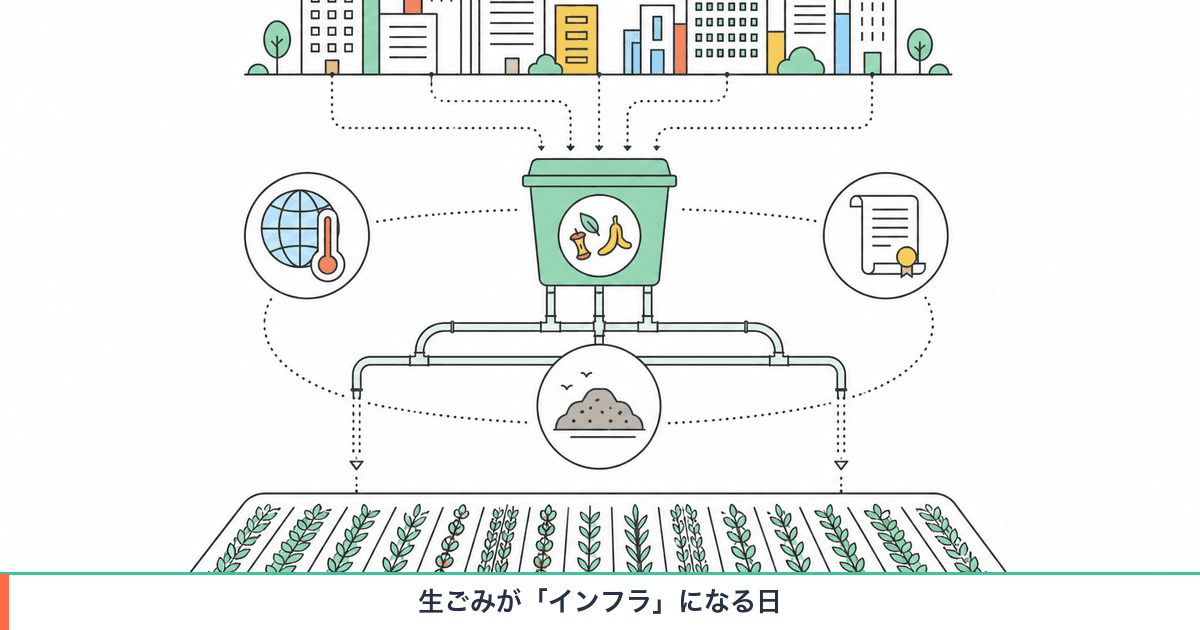
For a long time composting was a hobby: a bin at the end of the garden, the timing of the turn, arguments about the carbon-to-nitrogen ratio. Then, in the 2020s, the practice began to be discussed in the vocabulary of policy. The EU made separate collection of biowaste an obligation across the union with a deadline of 31 December 2023; France extended source separation to every producer of waste, household or business, from 1 January 2024. California wrote into law a 75 per cent cut in landfilled organic waste against a 2014 baseline by 2025, and Japan brought a food-loss reduction act into force in 2019. What happened? This article's answer is that three currents met in one place: climate targets — methane above all — the codification of food-waste reduction, and the physical limits of the container we call a landfill. Where those three converge, food scraps stop being something individuals ought to reduce and become something a city collects and processes: infrastructure. An earlier column, Composting: the science and the societies, covered why decomposition happens and what systems the world has built. This series takes up what comes after. Where have mandates stumbled, who is paying, and is compost actually good for the environment? Today is the map.
This article in 3 minutes
- Food waste is not the sum of individual carelessness but a statistical mass. UNEP's Food Waste Index 2024 put 2022 global food waste at about 1.05 billion tonnes, or 132 kg per person, of which households accounted for roughly 631 million tonnes.
- Compost entered climate policy through methane, not carbon. In the United States, municipal solid waste landfills are the third-largest human-related source of methane, about 14.4 per cent in 2022, and the 2021 Global Methane Pledge commits participants to cutting methane at least 30 per cent below 2020 levels by 2030.
- The mandates are already on the statute books. Article 22 of the EU Waste Framework Directive required biowaste to be collected separately or recycled at source by 31 December 2023, and France's AGEC law extended source separation to every waste producer from 1 January 2024, with municipalities above 50,000 inhabitants obliged to offer collection from that date.
- Japan is a country with targets rather than a country that separates household food waste. The Food Loss Reduction Act took effect on 1 October 2019 with a goal of halving waste against a fiscal-2000 baseline, and the fiscal-2023 figure fell to 4.64 million tonnes — 2.31 million from business, 2.33 million from homes — yet separate household collection remains the exception rather than the rule.
- The limit of landfill capacity is rarely the simple countdown it is made out to be. At the end of fiscal 2023 Japan had 1,554 municipal landfill sites with 95.75 million cubic metres of remaining capacity and a national average of 24.8 years left — a figure that neither refutes the scarcity argument nor licenses complacency, since it averages sharply unequal regions in which new sites are almost impossible to open.
- This article's position is that composting must now be judged from its institutions, economics and limits rather than from first principles. Once food scraps become infrastructure, the useful question is not whether compost is good but who collects it at what cost, where the system breaks, what it contaminates, and what is given up in exchange.
Opening
The same bucket became, in a decade, an object of law rather than a hobby
Most writing about composting begins with first principles. Aerobic microbes break organic matter down, the pile heats, humus remains; you balance carbon against nitrogen and keep the moisture in range. That account is accurate and self-contained, which is why what it leaves behind is an impulse to try it rather than a question about how to design a system. In the 2020s, though, the centre of gravity of the argument moved. Composting as it now appears in government documents is not a story about microbes but about collection frequency, capture rates, contamination rates, gate fees and emission factors. The same bucket has moved, within a decade, from being a hobbyist's tool to being an object of law.
The series assumes an earlier column, Composting: the science and the societies, which covered the science of decomposition and the collection-and-composting systems built in Japan, South Korea, Taiwan, Europe, the United States and India. None of that is repeated here. What this series takes up is the part that understanding the principles does not solve. Why, in countries that made separation compulsory, do the scraps still fail to arrive as expected? Who pays to build a processing plant and what revenue keeps it running? What actually decides whether a given tonne of food waste becomes compost or becomes methane for a generator? And how much substance is there in the charge that finished compost is itself a source of contamination? Seven days, in that order.
The map
Climate, statute, container — three currents that met in one place
Why the 2020s? Looking for a single cause will mislead. At least three independent currents happened to converge on food waste at roughly the same moment. The first is climate targets: policy attention shifted from carbon dioxide alone toward methane — short-lived but powerful — and landfills were named as a major source of it. The second is the codification of food loss: countries translated an international goal into domestic statute, and a moral intuition about not being wasteful turned into numerical targets and reporting duties. The third is the physical container itself. Landfills are extraordinarily difficult to open, existing capacity is finite, and organic matter consumes volume while generating leachate and odour.
The three move independently. From the climate side, the objective is to keep organic matter out of landfill; whether it becomes compost or is digested for energy is a choice of means. From the legislative side, what matters is reducing the total generated, while the treatment of what is nonetheless generated falls under a different statute. From the landfill's side, the value is simply volume avoided. That the three objective functions do not coincide is a fact that will resurface repeatedly across this week. Where mandates stumble, and why compost and methane compete for the same tonne, both trace back to it. Today we set the three layers out separately and ask what each of them is actually demanding of a bag of food scraps.
Sources & further reading
- UNEP — Food Waste Index Report 2024
- EUR-Lex — Directive 2008/98/EC on waste (consolidated, Article 22 bio-waste)
- Zero Waste Europe — Bio-waste separate collection takes off
- Ministère de la Transition écologique — Tri à la source des biodéchets
- California Senate Bill 1383 (2016) — Short-lived climate pollutants: organic waste
- US EPA LMOP — Basic Information about Landfill Gas
- Global Methane Pledge — official site
- 環境省 — 令和5年度 一般廃棄物処理事業実態調査の結果(報道発表資料)
- 環境省 — 我が国の食品ロスの発生量の推計値(令和5年度)の公表について
- 消費者庁 — 食品ロスの削減の推進に関する法律等
Everything above is free to read.
The rest is for members
This column has moved into the archive, so the full deep-dive is for Urban Farm Crew members and up. Membership funds the daily collection, research and operation of this independent public database. The latest columns are free for everyone.
Or get new columns free by email first
Every Wednesday: a free email digest of new urban-farming cases, research and events from around the world.
Reader feedback
Was this article useful?
No sign-in required. One vote per article on this device; you can change your choice.
Related columns
Is compost actually good for the environment — the case against composting, and what to do anyway
Compostable plastics that do not break down, PFAS and metals in finished compost, and the climate arithmetic once transport is counted
19 min readCompost or methane — the two business models competing for your food scraps
Two industries put different prices on the same bucket of food scraps. One sells the result as electricity; the other can only sell soil. That asymmetry decides which plant gets built
19 min readWhy Japan still doesn't sort its food waste — twenty years of the Food Recycling Act
Business food-waste recycling reaches 91%, yet four fifths of household scraps still go to the incinerator. What sits between the honour-roll figure and the kitchen the law never covered
19 min readMandating it isn't enough — where the world's composting rollouts have stumbled
France, New York, California and China — four mandates lined up against the same three bottlenecks
19 min read