How much methane if you don't compost it? The greenhouse-gas arithmetic of food waste
0.86 tonnes per tonne, the 61% that never gets captured, and what 'certified compostable' does not certify
2026-08-20 · 19 min read
Series · Composting Now — Systems, Economics, Limits2 / 7
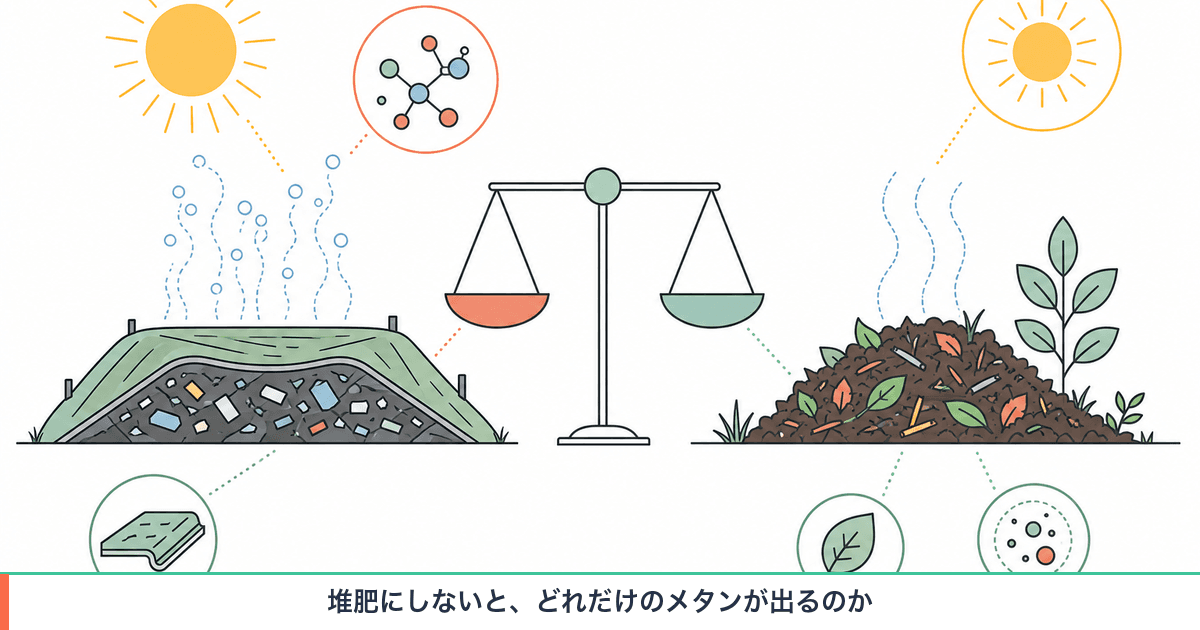
Yesterday's opening instalment, The day food scraps become infrastructure, mapped the three currents — climate targets, food-waste reduction and landfill capacity running out — that pushed compost towards being treated as public infrastructure. Today we open the first of those ledgers. 'Landfilled food waste releases methane' now appears in the preamble of ordinances and in corporate decks alike. But how much? Counted by whom, and how? And does composting really bring it to zero? The US Environmental Protection Agency's first published estimate, in 2023, puts roughly 0.86 tonnes of carbon dioxide equivalent into the atmosphere for every tonne of food waste landfilled. That figure, though, is the output of a decay model rather than a measurement — and when aircraft flew over the same landfills, the plumes were larger than the models predicted. Composting, meanwhile, is not zero either. This article works back to where each number comes from. The decomposition science covered in our earlier column is taken as given; what is examined here is how that science gets written into a climate ledger.
This article in 3 minutes
- The US EPA's October 2023 estimate puts about 0.86 tonnes of CO2 equivalent into the air for every tonne of food waste landfilled — roughly 55 million tonnes CO2e in the United States in 2020 alone, and the first peer-reviewed national reference point for the question.
- Food waste is 24% of landfilled material by weight but the source of 58% of landfill methane. It decays fast, and most of the gas escapes before collection infrastructure is in place: EPA estimates 61% of the methane generated is never captured.
- Composting is not zero-emission. Vergara and Silver's continuous measurements (Environmental Research Letters 14:12, 2019) recorded 1.7 ± 0.32 g of methane per kilogram of wet feedstock, 75% of it in the first three weeks — yet the life-cycle total still came out at −690 g CO2e per kilogram.
- Digestion leaks too. Scheutz and Fredenslund measured 23 Danish biogas plants (Waste Management 97, 38–46, 2019) and found methane losses of 0.4% to 14.9% of production, averaging 4.6%. Facilities built to sell methane are releasing some of it.
- 'Certified compostable' is a promise about a facility, not about a garden. Field trials at ten industrial sites recorded 98% disintegration by surface area, while a UK citizen-science study of 1,648 home compost bins found 60% of items certified home-compostable did not fully break down.
- This article's position: the climate benefit of composting is real, but its magnitude is governed by uncertainty in the counterfactual — how much was leaking from the landfill. If you quote a number, quote it with its model, its measurement basis and its assumed capture rate attached.
Starting point
0.86 tonnes per tonne — a number that did not exist until 2023
That landfilled food waste generates methane has been understood for nearly half a century. But the question of how much methane, nationally, per year, from food waste specifically, did not get an official numerical answer in the United States until October 2023. The EPA report Quantifying Methane Emissions from Landfilled Food Waste covers 1990 to 2020 and estimates that roughly 0.86 tonnes of carbon dioxide equivalent reach the atmosphere for every tonne of food waste buried — about 55 million tonnes CO2e in 2020 alone. Its central observation was uncomfortable: total emissions from municipal solid waste landfills are trending down, while the share attributable to food waste is going up.
What usually falls away when that sentence is quoted in policy documents is how it was counted. Landfill methane does not emerge from a stack at a single point; it seeps across a surface, slowly, for decades. Direct measurement is therefore hard, and in practice the number comes from a model. The 0.86 figure is the output of a calculation about how food waste rots underground, when that rot becomes methane, and what fraction of that methane a gas collection system intercepts. Change one assumption and the number changes. The first thing this article wants to locate is where those assumptions sit.
Framing the question
The same carbon becomes a different greenhouse gas depending on the exit
As our earlier column set out, decomposition splits along a single line: with oxygen it yields mostly carbon dioxide, without it, methane. As physics, that is the whole of it. Entered into a climate ledger, however, the fork becomes heavy. On the IPCC's Sixth Assessment values, non-fossil methane has a hundred-year global warming potential of 27, fossil methane 29.8, and on a twenty-year horizon both sit near 80. The same carbon atom, depending on nothing more than whether oxygen was present, becomes a gas some eighty times weightier over two decades. Everything said about composting as climate policy reduces, in the end, to managing that fork.
Managing the fork, though, does not mean composting is zero. Anaerobic pockets form inside aerobic piles and vent methane. Digesters make methane deliberately and then leak some of it. Landfills collect gas, but never all of it. All three destinations, in other words, belong on a scale of how much rather than a binary of whether. What follows works through the structure of the landfill calculation, the gap between models and aerial measurement, the measured emissions of composting and of digestion, and finally how far plastics labelled 'compostable' actually break down.
Sources & further reading
- U.S. EPA (2023) Quantifying Methane Emissions from Landfilled Food Waste
- U.S. EPA — From Field to Bin: The Environmental Impacts of U.S. Food Waste Management Pathways(Wasted Food Scale の根拠報告)
- IPCC 2019 Refinement to the 2006 Guidelines, Volume 5 Chapter 3: Solid Waste Disposal(一次減衰法・半減期・DOCf)
- IPCC AR6 WGIII Annex II: Definitions, Units and Conventions(メタンのGWP100 = 27/29.8、GWP20)
- Vergara, S.E. & Silver, W.L. (2019) Greenhouse gas emissions from windrow composting of organic wastes: patterns and emissions factors. Environmental Research Letters 14(12)
- Pérez, T., Vergara, S.E. & Silver, W.L. (2023) Assessing the climate change mitigation potential from food waste composting. Scientific Reports 13
- Scheutz, C. & Fredenslund, A.M. (2019) Total methane emission rates and losses from 23 biogas plants. Waste Management 97: 38–46
- Duren, R.M. et al. (2019) California's methane super-emitters. Nature 575: 180–184
- Purkiss, D. et al. (2022) The Big Compost Experiment: using citizen science to assess the impact and effectiveness of biodegradable and compostable plastics in UK home composting. Frontiers in Sustainability 3: 942724
- Closed Loop Partners / Composting Consortium (2024) Breaking It Down: The Realities of Compostable Packaging Disintegration in Composting Systems
Everything above is free to read.
The rest is for members
This column has moved into the archive, so the full deep-dive is for Urban Farm Crew members and up. Membership funds the daily collection, research and operation of this independent public database. The latest columns are free for everyone.
Or get new columns free by email first
Every Wednesday: a free email digest of new urban-farming cases, research and events from around the world.
Reader feedback
Was this article useful?
No sign-in required. One vote per article on this device; you can change your choice.
Related columns
Is compost actually good for the environment — the case against composting, and what to do anyway
Compostable plastics that do not break down, PFAS and metals in finished compost, and the climate arithmetic once transport is counted
19 min readCompost or methane — the two business models competing for your food scraps
Two industries put different prices on the same bucket of food scraps. One sells the result as electricity; the other can only sell soil. That asymmetry decides which plant gets built
19 min readWhy Japan still doesn't sort its food waste — twenty years of the Food Recycling Act
Business food-waste recycling reaches 91%, yet four fifths of household scraps still go to the incinerator. What sits between the honour-roll figure and the kitchen the law never covered
19 min readMandating it isn't enough — where the world's composting rollouts have stumbled
France, New York, California and China — four mandates lined up against the same three bottlenecks
19 min read